

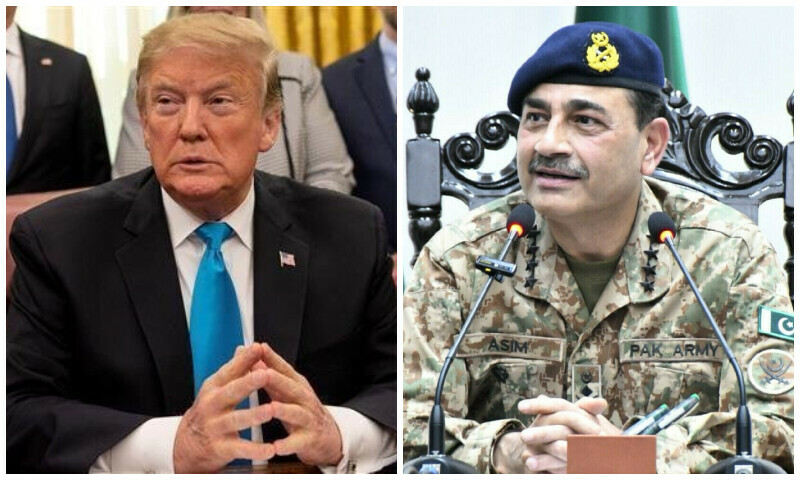
In a move that has surprised diplomatic observers, U.S. President Donald Trump is set to host Pakistan’s Chief of Army Staff, Field Marshal Syed Asim Munir, for a private lunch at the White House on Wednesday. The meeting, listed on the president’s official schedule and to be held in the Cabinet Room, will be closed to the press. This unexpected engagement is being hailed in Islamabad as a major diplomatic victory, particularly in light of the perceived snub Pakistan faced earlier this month when an Indian delegation secured a meeting with U.S. Vice President JD Vance, while Pakistan’s outreach appeared to go unanswered.
Gen. Munir’s invitation to the White House is now being framed by Pakistani officials as a strategic diplomatic counterbalance, especially following the tense India-Pakistan conflict in May that brought the region to the brink of nuclear confrontation. Munir, who is on a five-day official U.S. visit, is the first Pakistani military leader to be elevated to the rarely bestowed five-star rank of Field Marshal since Ayub Khan in 1959. His trip has garnered significant attention, particularly his remarks urging India to act as a “civilized nation” rather than pursuing regional dominance.
Addressing members of the Pakistani-American community on Monday night at Washington’s Four Seasons Hotel, Munir forcefully rejected India’s allegations that Pakistan was behind the Pahalgam terror attack, calling such claims a fabricated pretext for cross-border aggression. He warned against India’s attempts to create a “new normal” of violating international borders and stated that Pakistan “would rather embrace martyrdom than accept this dishonour.” His address was met with adulation, rose petals, and slogans from supporters inside the venue, while protestors aligned with Pakistan’s opposition PTI party demonstrated outside for democratic reforms and the release of political prisoners.
Munir also touched upon regional developments, expressing Pakistan’s “clear and strong” support for Iran in its conflict with Israel while simultaneously supporting U.S.-led efforts to de-escalate the war. He called for an immediate end to hostilities in the region. However, a standout moment of his visit was the deepening counterterrorism collaboration between Pakistan and the United States, particularly in operations targeting the Islamic State Khorasan (IS-K) group.
U.S. Central Command chief Gen. Michael Kurilla, speaking before the House Armed Services Committee, called Pakistan a “phenomenal partner” in counterterrorism and praised its effective operations along the Pakistan-Afghanistan border. Kurilla revealed that Pakistan had conducted numerous raids, supported by U.S. intelligence, resulting in the elimination of key IS-K operatives, including the arrest and extradition of Mohammad Sharifullah — one of the masterminds of the deadly 2021 Kabul Abbey Gate bombing that killed 13 U.S. troops. Kurilla recounted that Munir personally called him to confirm the arrest and request that the U.S. notify its Secretary of Defense and the President.
Further briefing the Senate Armed Services Committee, Kurilla emphasized Pakistan’s crucial role in dismantling IS-K safe havens that continue to pose threats not only to the region but also to U.S. national security. Despite suffering over 1,000 terrorist attacks in 2024, resulting in the deaths of 700 security personnel and 2,500 civilians, Kurilla noted that Pakistan has proven to be a steadfast counterterrorism ally.
Munir, addressing the diaspora community, lauded overseas Pakistanis for their vital contributions to the national economy, framing emigration not as a “brain drain” but as a “brain gain.” He refrained from engaging in partisan political discussions, urging unity and democratic values when questioned about domestic politics or opposition figures. In a moment that underscored this stance, he gently shut down a joke about “software fixing” political opponents, affirming that the right to dissent must be protected in any democracy.
The evening ended with a message of mutual commitment between Pakistan’s military leadership and the diaspora, with both pledging to work toward a stronger and more united Pakistan.