

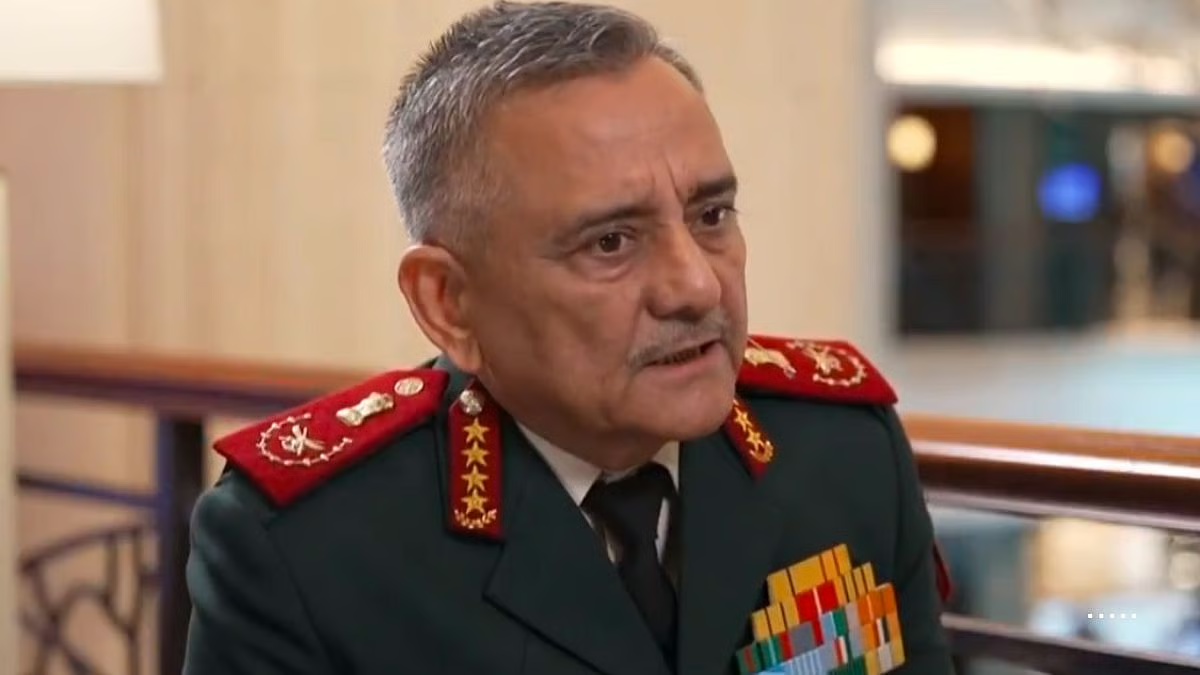
In a significant admission during the Shangri-La Dialogue in Singapore, India’s Chief of Defence Staff (CDS), General Anil Chauhan, confirmed that Indian Air Force (IAF) jets were shot down by Pakistan during the intense four-day conflict known as Operation Sindoor, which unfolded earlier this month. The conflict, now recognized as the most serious military flare-up between the two nuclear-armed neighbors in years, has drawn global attention and sparked a wide range of international responses.
The operation was launched by India in retaliation for a deadly terror attack in Pahalgam, Jammu and Kashmir, which resulted in the deaths of 26 civilians. In response, Indian forces executed precision missile strikes on multiple alleged terrorist camps across Pakistan and Pakistan-administered Kashmir, including locations in Bahawalpur, Muzaffarabad, Kotli, Muridke, Sialkot, and Shakargarh.
Aircraft Losses Acknowledged
In a candid interview with Bloomberg, General Chauhan confirmed that Indian jets had been downed during the operation. His remarks came in the wake of widespread media reports and visual evidence published by The Washington Post, confirming that at least two French-made Indian fighter jets — a Rafale and a Mirage 2000 — were shot down by the Pakistan Air Force (PAF). Additional reports from Dawn, CNN, and Reuters also corroborated these findings, with U.S. and French intelligence sources confirming the loss of Indian aircraft.
According to Pakistani sources, six Indian jets were brought down during the conflict: three Rafales, one Su-30MKI, one Mirage 2000, and one MiG-29, all reportedly within a 40-minute window on the night of May 6–7. Notably, Pakistani jets did not cross the border or engage in close combat, instead using Chinese-supplied air superiority platforms and missile systems to intercept.
When asked about the loss of aircraft, General Chauhan said,
“I think what is important is not the jets being downed, but why the jets were shot down. The good part is that we were able to understand the tactical mistakes we made, remedied them, and re-engaged effectively two days later with deep-strike precision.”
He stressed that despite the setbacks, all IAF pilots returned safely, and India’s capability to conduct long-range precision strikes remained intact.
Ceasefire and International Mediation
Following tit-for-tat airstrikes and drone interceptions, a ceasefire was brokered by the United States on May 10. While Pakistan acknowledged the American diplomatic intervention, Indian officials maintained the ceasefire was negotiated bilaterally.
The U.S. State Department, in a statement issued later, emphasized the need for de-escalation and encouraged both countries to pursue counterterrorism cooperation within the framework of regional peace.
French officials expressed concern over the loss of Rafale jets and are reportedly reviewing the operational use and survivability of their platforms in contested South Asian airspace. French President Emmanuel Macron has called for restraint and a “comprehensive investigation” into the conflict’s origin and escalation.
Indian military leadership, while acknowledging the aircraft losses, has emphasized the need to extract strategic lessons from the episode. According to Air Marshal A.K. Bharti, Director General of Air Operations,
“Losses are part of combat, but the IAF’s response demonstrated adaptability, speed, and continued dominance in long-range strike capability.”
General Chauhan reaffirmed that nuclear escalation was never on the table, and that India’s actions were calibrated to remain below that threshold while dealing a strategic blow to terror infrastructure.
Regional and Global Reaction
- India has called for broader reforms in tactical doctrine and interoperability of air assets in future combat operations.
- Pakistan has hailed its air defense response as a deterrent success, while urging international organizations to initiate neutral investigations into India’s initial strikes.
- The United States, France, and other global powers have reiterated the need for crisis management mechanisms between India and Pakistan to avoid unintentional escalation in the future.
- China, while silent on the specific engagement, reaffirmed its strategic ties with Pakistan, particularly in defense cooperation.