

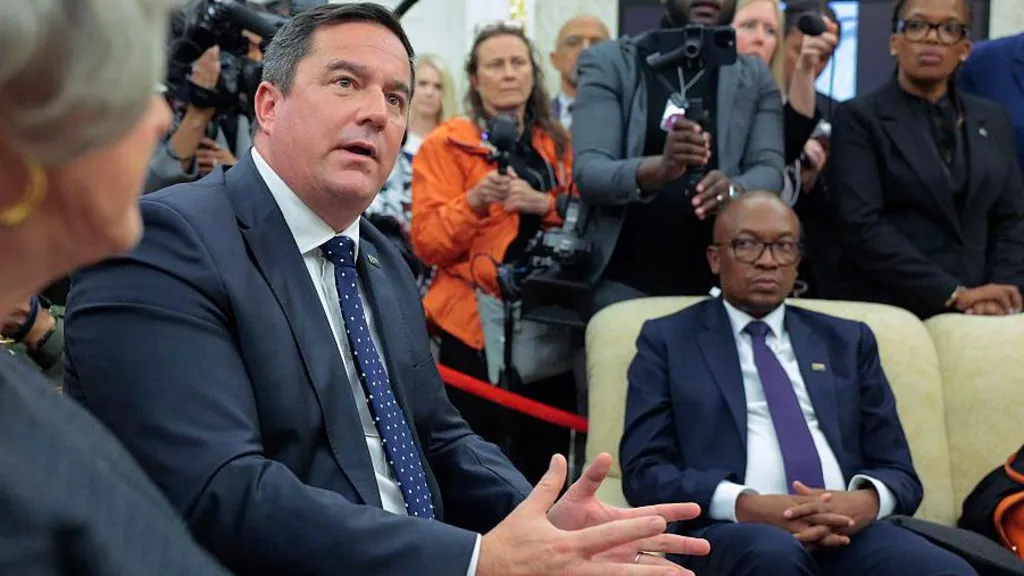
What was billed as a diplomatic meeting to reset U.S.-South Africa relations quickly derailed into controversy on Wednesday, as President Donald Trump blindsided South African President Cyril Ramaphosa with a dramatic and highly contentious presentation on alleged attacks against white farmers.
During a live press briefing in the Oval Office, Trump aired a provocative video suggesting a “white genocide” was occurring in South Africa—a narrative widely discredited by global watchdogs and the South African government itself.
The meeting came just one week after the U.S. granted refugee status to 59 white South Africans, mostly Afrikaners, prompting South African officials to accuse the Trump administration of exploiting racial divisions.
Ramaphosa, who had hoped to focus on trade—including easing looming tariffs on South African exports—attempted to defuse the situation with diplomatic composure. But Trump had other plans.
With cameras rolling, Trump dimmed the room lights and played a video showing South African opposition figure Julius Malema singing an incendiary chant—“Shoot the Boer”—and images of white crosses, presented as symbolic graves of murdered white farmers. Trump then handed Ramaphosa printed stories alleging attacks on white South Africans.
“These are not just stories,” Trump said. “These are real people being killed, and I want an explanation.”
Ramaphosa pushed back firmly. “Those voices in the video do not reflect government policy,” he said, reminding Trump and the press that South Africa is a multiparty democracy. “We are committed to racial reconciliation, and our constitution protects freedom of speech—even speech we disagree with.”
The White House claims the video and asylum offer are responses to rising violence in rural South Africa, though official statistics show farm murders remain rare and are not racially motivated. South Africa does not release crime data by race, but recent figures from late 2024 report only a dozen killings related to farm attacks, involving victims of different races.
When Trump accused the South African government of allowing land to be seized and white farmers to be killed “with no consequences,” Ramaphosa dismissed the claim as a gross misrepresentation.
“Yes, we passed land reform legislation,” he explained, referencing a controversial new law that permits land expropriation without compensation in limited cases deemed to be in the public interest. “But no land has been taken under that law yet.”
Ramaphosa attempted to change the tone by gesturing toward members of his delegation—including white South African golf legends Ernie Els and Retief Goosen, and billionaire Johann Rupert.
“If there were a genocide, these men wouldn’t be standing here beside me,” he said.
Trump persisted, saying, “But the farmers are not black… just saying.”
Observers say the confrontation echoed previous encounters Trump has had with world leaders, including his fraught meeting with Ukrainian President Volodymyr Zelensky in February.
Back in South Africa, opposition leader Julius Malema, the subject of Trump’s video, mocked the incident on social media. “A group of older men in Washington gossiping about me,” he wrote on X.
Helena Humphrey, former U.S. Ambassador to South Africa under President Obama, called the meeting “truly embarrassing,” adding: “This was a setup. The intent was to shame President Ramaphosa and, by extension, South Africa.”
Despite the chaos, Ramaphosa managed to preserve composure. Whether bilateral relations can recover from the high-profile clash remains to be seen.