

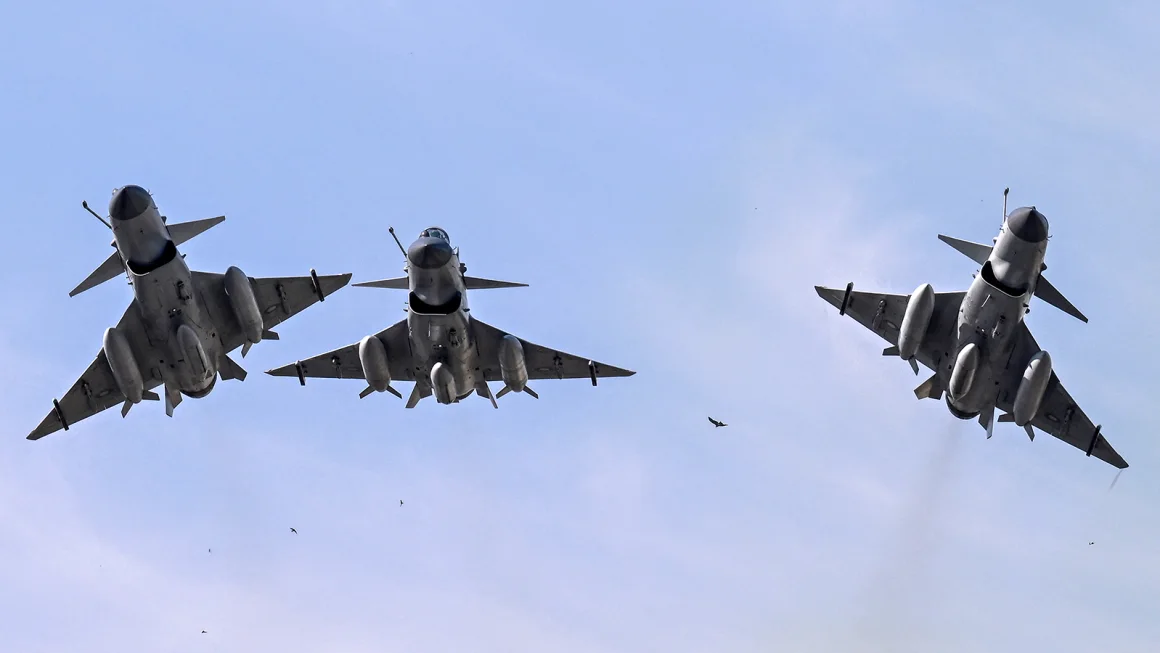
HONG KONG — As military tensions between India and Pakistan continue to rise, the conflict is emerging as an unexpected proving ground for Chinese defense technology—and Beijing is watching closely.
Chinese military hardware, long untested in real-world warfare, may now be facing its first major battlefield challenge. The Pakistan Air Force claimed it deployed China-made J-10C fighter jets to shoot down five Indian warplanes during a massive aerial battle earlier this week. Among the alleged losses were India’s prized Rafale jets, purchased from France as part of a sweeping modernization of its air force. While India has not confirmed any losses, the battle has already caused shockwaves in both financial markets and defense circles.
Shares of AVIC Chengdu Aircraft, the Chinese firm that manufactures the J-10C, soared over 40% this week amid news of its involvement. In China, state media and military enthusiasts have hailed the confrontation as a symbolic triumph of Chinese technology over Western-made platforms.
The geopolitical stakes are significant. China has not fought a major war in over 40 years, yet under President Xi Jinping, it has poured billions into military modernization. Pakistan—China’s closest military partner—has been a key recipient of that technology. According to the Stockholm International Peace Research Institute (SIPRI), China now supplies more than 80% of Pakistan’s weapons, ranging from fighter aircraft and missiles to radar systems and drones.
Defense experts say the current hostilities in South Asia have become more than a bilateral crisis; they are now a litmus test for China’s growing arms industry. “This isn’t just a regional clash anymore. It’s a glimpse into how Chinese defense exports are reshaping the military balance,” said Craig Singleton, senior fellow at the U.S.-based Foundation for Defense of Democracies.
If confirmed, Pakistan’s successful deployment of the J-10C against India’s Rafale and Su-30 jets would mark a significant milestone for Beijing’s defense industry. Military observers believe the J-10C, equipped with China’s PL-15 beyond-visual-range missiles and advanced avionics, could be giving Western fighters a real challenge—especially in export-friendly configurations like the J-10CE.
Analysts stress, however, that India’s potential losses could stem from more than just superior weaponry. Tactical missteps, underestimating enemy capabilities, or limited rules of engagement may have contributed. “Modern warfare is not just about hardware—it’s about integration, intelligence, coordination, and timing,” Singleton noted.
India’s airstrikes earlier this week did succeed in hitting multiple targets in Pakistan, including alleged militant infrastructure. The strikes reportedly bypassed air defense systems armed with Chinese HQ-9B surface-to-air missiles, raising questions about the reliability of Chinese-made radar and missile systems under actual combat conditions.
Still, the symbolism is powerful. For China, the conflict acts as an unsolicited global commercial—the first high-profile showcase for the J-10C and the broader family of Chinese-made systems. “From China’s perspective, this is a powerful advertisement,” said Macau-based defense analyst Antony Wong Dong. “Potential buyers will now seriously consider how to face this new reality.”
The broader context is one of a shifting global alignment. India, historically non-aligned, has deepened defense ties with the U.S., France, and Israel, while reducing its reliance on Russia. Pakistan, by contrast, has increasingly embraced China, both as a military supplier and as a political ally under Beijing’s Belt and Road Initiative.
As the world watches this high-stakes regional conflict unfold, Beijing’s arms are being tested not just in the air, but in the court of global perception—where a victory or failure could recalibrate military buying patterns far beyond South Asia.