

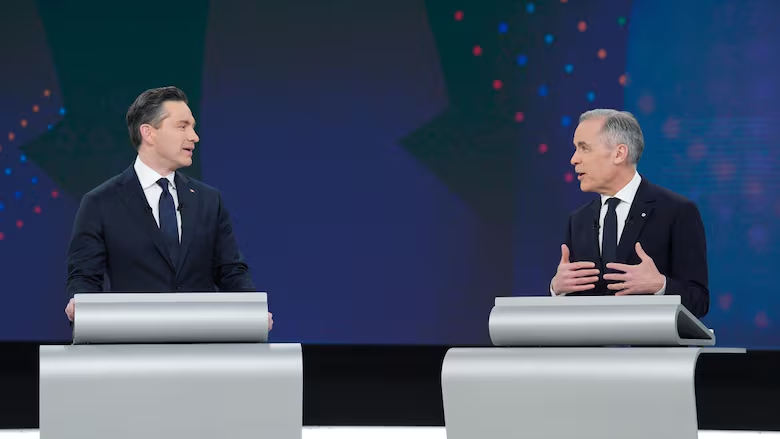
As Canada’s federal election enters its final days, the country’s top two parties are revealing sharply different visions—not just in policy, but in how they communicate those policies. The newly released campaign platforms of the Liberal Party and the Conservative Party offer a striking contrast in both tone and strategy, reflecting their diverging approaches to leadership and voter engagement.
The Conservatives, led by Pierre Poilievre, opted for a streamlined, 30-page document heavy on imagery and light on detail. The platform is packed with photos of Poilievre—on the cover with his wife Anaida, and throughout the pages smiling, shaking hands, and rallying support—underscoring the party’s leader-centric campaign style. In contrast, the Liberals, under Mark Carney, released a 67-page policy-dense platform, largely devoid of visuals, aiming to showcase thoughtful governance and substantive plans.
According to Akaash Maharaj, senior fellow at the Munk School of Global Affairs and Public Policy, the parties are “telling radically different stories.” He suggests the Liberals are framing themselves as a stable, competent governing force, while the Conservatives are presenting themselves as a movement for dramatic change—one that isn’t concerned with policy nuance but focused on a shift in priorities.
While leader-centric branding isn’t new, Maharaj finds the Conservatives’ choice to spotlight Poilievre so prominently somewhat surprising. Poilievre remains a polarizing figure: adored by the party’s base, but less popular among the undecided voters the party needs to sway. Maharaj notes that the Liberals, during Justin Trudeau’s tenure, operated similarly by making the campaign an extension of the leader’s persona. However, this time, he believes Carney’s lower-profile approach might benefit the Liberals, as many voters appear to be leaning toward “quiet competence” over personality-driven politics.
The timing and tone of the platforms also reveal key strategic decisions. The Conservatives released their document late—after the advance polls had closed—perhaps a signal that the goal isn’t persuasion, but turnout. Liberal strategists, meanwhile, embraced a traditional, detail-rich model to reinforce Carney’s image as a capable technocrat.
Political science professor Andrea Lawlor sees the Conservative platform as a smart tactical move. Shorter, more visual, and less policy-heavy, it avoids overcommitting while keeping the message simple and broadly palatable—especially for a party that hasn’t had access to the federal books in nearly a decade. Meanwhile, the Liberals’ detailed proposals aim to position Carney as a thoughtful, policy-first leader.
Still, Lawlor notes, both documents touch on major issues like cost of living, trade, infrastructure, and defense. It’s not what’s said, but how it’s said that sets them apart. Carney’s platform seeks to signal depth and seriousness, while Poilievre’s visual-heavy rollout reflects a populist effort to appear accessible and relatable.
Vincent Raynauld, a communications expert at Emerson College, agrees. He believes the Conservative strategy speaks to modern voters’ reading habits—especially those consuming content via smartphones. By simplifying their platform and focusing on digestible visuals, the Conservatives may be betting on emotional resonance over intellectual appeal.
Despite the buzz, most analysts agree these platforms are unlikely to shift the political landscape. With a record-breaking 7.3 million Canadians already casting ballots during advance polls, Maharaj argues that the time to persuade has largely passed. Instead, both parties are now focused on motivating their base to show up.
In this election, platforms seem less like roadmaps for governance and more like rallying calls for the already convinced.