

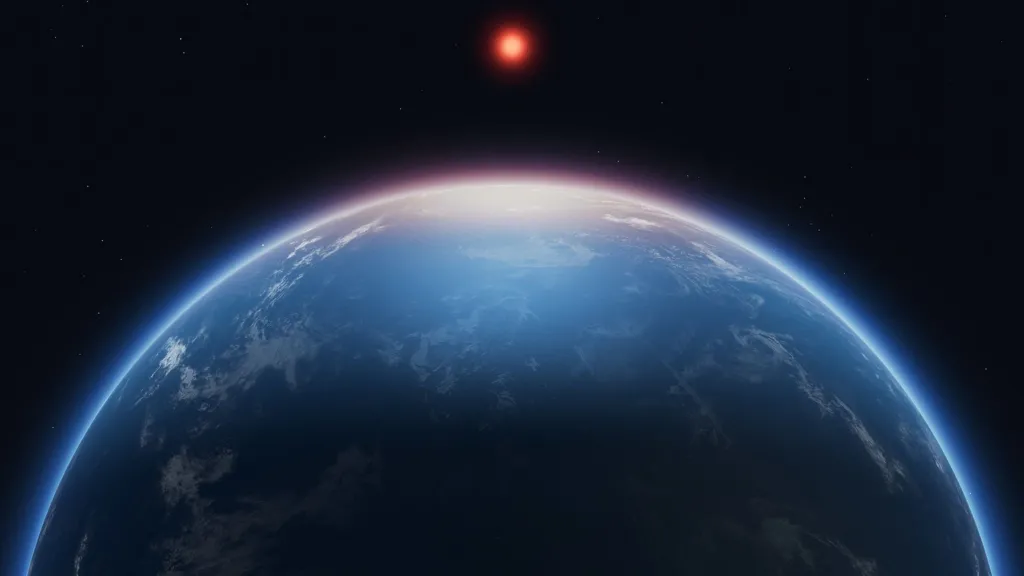
Scientists from the University of Cambridge have announced what they call the strongest evidence yet that life may exist on a planet orbiting a distant star. The findings, published in The Astrophysical Journal Letters, stem from new observations of the exoplanet K2-18b, made using NASA’s James Webb Space Telescope (JWST).
Researchers studying the atmosphere of K2-18b detected molecular signatures of dimethyl sulphide (DMS) and dimethyl disulphide (DMDS)—gases that, on Earth, are produced almost exclusively by living organisms, particularly marine phytoplankton and bacteria.
“This is the strongest evidence yet there is possibly life out there,” said Professor Nikku Madhusudhan, lead author and astrophysicist at Cambridge’s Institute of Astronomy. “If the association with life is real, then this planet will be teeming with life.”
K2-18b lies 124 light-years from Earth in the constellation Leo, orbiting a small red dwarf star. It is about 2.5 times the size of Earth and is located in its star’s habitable zone, where temperatures could allow liquid water to exist—a key requirement for life as we know it.
What stunned Madhusudhan’s team was the high concentration of DMS-like gases, thousands of times greater than what is found in Earth’s atmosphere, detected during just one observation window. “If confirmed, it would mean that life is not only possible there—it may be thriving,” he said.
Still, the Cambridge scientists are urging caution. Their findings currently stand at a three sigma level, or about 99.7% certainty, far short of the five sigma (99.99999%) confidence required to claim a formal scientific discovery.
“We are not making any definitive claims yet. There is a 0.3% chance this is a statistical fluke,” Madhusudhan explained, adding that they hope to reach confirmation-level certainty within one to two years.
The discovery has reignited intense debate in the astrophysics community. Some scientists caution that the presence of DMS and DMDS doesn’t automatically imply life. Prof. Catherine Heymans, Astronomer Royal for Scotland, noted that such molecules could, in theory, be produced by unknown geological or chemical processes on other planets.
“There’s still the question of the gas’s origin,” she said. “Just because we know how it’s produced on Earth doesn’t mean the same holds elsewhere.”
The structure of K2-18b itself is also under scrutiny. Some researchers suggest the planet might host a deep ocean, absorbing gases like ammonia, and creating the right conditions for life. Others propose it could be a mini gas giant with no surface at all—hardly a hospitable environment.
In response, Prof. Madhusudhan’s team is collaborating with other groups to test whether these biomarker gases could be created in non-biological conditions in laboratory settings.
Even with all the uncertainties, many scientists agree that the James Webb Space Telescope has opened a new frontier in the search for extraterrestrial life.
“This could be the tipping point,” Madhusudhan said. “We may look back on this as the moment when the living universe came within reach.”