

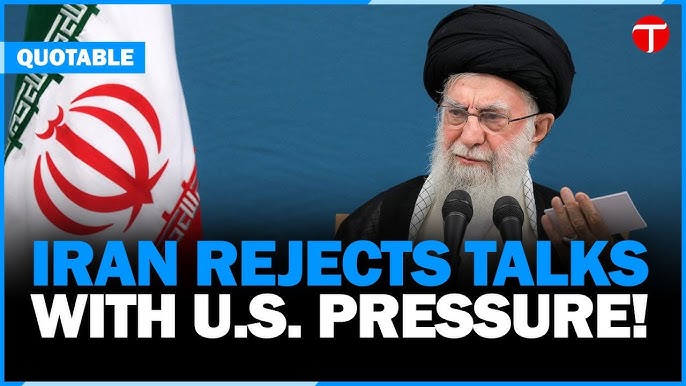
Iran’s Supreme Leader, Ayatollah Ali Khamenei, delivered a resolute rebuke to U.S. overtures for nuclear negotiations on Saturday, declaring that Tehran will not屈服 (yield) to what he branded as Washington’s “bullying” tactics. The statement, issued during a meeting with senior Iranian officials in Tehran, came just one day after U.S. President Donald Trump revealed he had sent a letter to Iran’s top authority urging a new nuclear deal to curb Tehran’s advancing nuclear program.
“Iran will not be bullied into negotiations,” Khamenei asserted, as reported by Iranian state media. “The insistence of some bully governments on negotiations is not to resolve issues, but to dominate and impose their own expectations on us. Talks for them are a path to have new expectations—it is not only about Iran’s nuclear issue. Iran will definitely not accept their expectations.”
Trump, speaking in an interview on Friday, March 7, outlined a stark choice for Iran: “There are two ways Iran can be handled: militarily, or you make a deal.” He emphasized his preference for diplomacy over conflict, aiming to prevent Tehran from acquiring nuclear weapons—a prospect he has repeatedly called unacceptable. The letter, a rare direct outreach to Khamenei, marks Trump’s first significant engagement with Iran since reclaiming the presidency in January 2025. However, it remains unconfirmed whether the 85-year-old Supreme Leader received or acknowledged the correspondence.
The U.S. President’s overture arrives amid his reinstatement of a “maximum pressure” campaign, a hallmark of his 2017-2021 term. This strategy seeks to choke Iran’s economy and zero out its oil exports through crippling sanctions—a policy rebooted last month to force Tehran back to the negotiating table. Trump’s first term saw him unilaterally withdraw the U.S. from the 2015 Joint Comprehensive Plan of Action (JCPOA), a landmark accord with Iran and world powers that traded sanctions relief for strict limits on Tehran’s nuclear activities. Following the 2018 pullout, Iran ramped up its uranium enrichment, far exceeding JCPOA caps and edging closer to weapons-grade levels.
Khamenei’s Saturday remarks underscore a deep-seated mistrust of U.S. intentions, rooted in the JCPOA’s collapse. “Washington’s offer for negotiations is aimed at imposing their own expectations,” he told officials, framing talks as a tool of domination rather than resolution. He pointed to broader U.S. demands—beyond the nuclear file—such as curbs on Iran’s ballistic missile program and regional influence, which Tehran views as non-negotiable pillars of its defense and sovereignty.
Iran insists its nuclear work remains peaceful, a stance bolstered by a religious decree from Khamenei banning nuclear weapons. Yet, the International Atomic Energy Agency (IAEA) has sounded alarms, with Director General Rafael Grossi warning that time is dwindling for diplomatic solutions. Iran’s stockpile of near-weapons-grade uranium—enriched to 60% purity—could fuel multiple bombs if pushed to 90%, experts estimate, heightening global stakes.
Khamenei’s rejection contrasts with earlier signals of openness. In August 2024, he suggested there was “no harm” in engaging the U.S., a nod that fueled hopes of revived talks under Iran’s reformist President Masoud Pezeshkian. But Saturday’s tone aligns with his historical wariness, recalling Trump’s 2018 betrayal of the JCPOA. “The very person who is in office today tore up the agreement,” he said last month, a sentiment echoed in his latest defiance.
The White House, via National Security Council spokesman Brian Hughes, doubled down Saturday, reiterating Trump’s binary framing: negotiate or face military consequences. “We hope the Iran regime puts its people and best interests ahead of terror,” Hughes stated, reflecting U.S. insistence on a deal.
Meanwhile, Iran’s Foreign Minister Abbas Araghchi had preemptively dismissed Trump’s letter on Friday, telling AFP that Tehran won’t negotiate under “maximum pressure.” The rial, Iran’s currency, hit a record low of 872,000 to $1 in aftermarket trading post-Khamenei’s speech, signaling economic strain under sanctions.
The standoff escalates tensions as Trump navigates a crowded foreign policy slate—trade wars with Canada and Mexico, and a Ukrainian crisis—while Europe watches warily. EU leaders, meeting in Brussels on March 6, pledged increased defense spending and support for Ukraine, wary of U.S. reliability under Trump’s “America First” pivot. Next week, Trump’s envoy Steve Witkoff is slated to probe ceasefire options with Ukrainian negotiators in Saudi Arabia, a sideshow to this nuclear brinkmanship.
For Iran, the path forward remains defiant. Khamenei’s words cement a hardline stance, challenging Trump’s dual-track gambit of diplomacy and coercion. As the IAEA’s clock ticks, the world braces for whether this deadlock yields talks—or something far graver.