

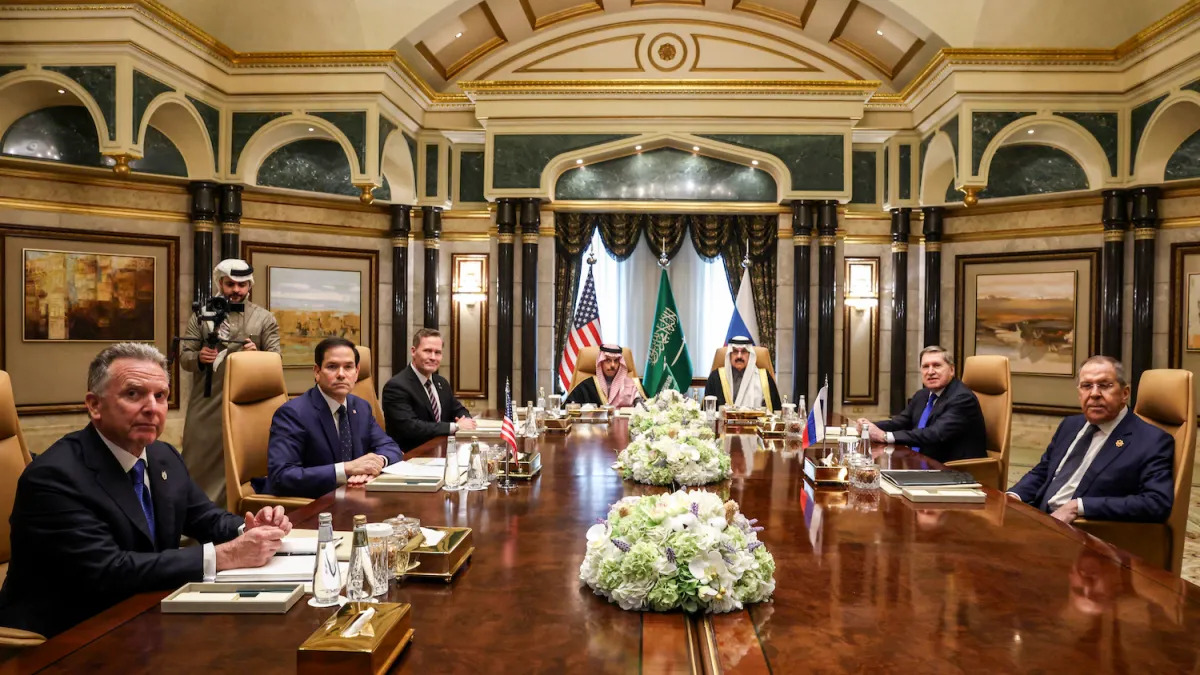
The United States and Russia have held their first high-level diplomatic talks since the Ukraine war began, sparking global concerns over Moscow’s reintegration into diplomacy while excluding Ukraine from key negotiations.
Top officials from both countries met in Riyadh, Saudi Arabia, to explore a potential settlement for the Ukraine conflict and reset US-Russia relations.
The US delegation included Secretary of State Marco Rubio, National Security Adviser Mike Waltz, and special envoy Steve Witkoff. Russia was represented by Foreign Minister Sergey Lavrov and senior Kremlin officials.
Following the meeting, Rubio announced that both sides had agreed to establish high-level teams to negotiate an end to the war. He also suggested that resolving the conflict could open doors for broader US-Russia cooperation on global security and economic issues.
However, Ukrainian President Volodymyr Zelenskyy strongly opposed the move, warning that any settlement must not be imposed on Ukraine, which has already lost nearly 20% of its territory to Russian forces.
The talks come just days after former US President Donald Trump spoke directly with Russian President Vladimir Putin, signaling a dramatic shift in US foreign policy.
Trump, who has long criticized US aid to Ukraine, expressed confidence in brokering a peace deal, stating:
“Russia wants to do something. This should have ended long ago.”
Zelenskyy, however, criticized Washington’s engagement with Moscow, arguing that it helps Russia escape international isolation.
“This isn’t positive for Ukraine. It’s bringing Putin back into global discussions,” Zelenskyy said.
The Riyadh talks also included discussions about:
- Restoring diplomatic relations by appointing new ambassadors
- Easing sanctions that have crippled Russian industries
- Allowing some US businesses to re-enter the Russian market
Since 2022, the US and its allies have imposed over 21,000 sanctions on Russia, leading to an estimated $324 billion in losses for American companies that exited the Russian market. Russian officials now anticipate some US businesses could return in 2025.
One of the most controversial aspects of the US-Russia meeting was the absence of Ukraine and NATO allies.
Zelenskyy expressed frustration, stating:
“The Russian-American meeting in Saudi Arabia came as a surprise to us, just as it did to many others.”
European leaders also reacted cautiously, concerned that Trump’s foreign policy shift could leave Ukraine vulnerable and weaken NATO’s influence in the region.
Meanwhile, Trump has been pushing NATO members to increase their defense spending to 5% of GDP, far beyond the 2% commitment made in 2014.
For Moscow, the diplomatic thaw presents an opportunity to push for the removal of economic sanctions, especially the price cap on Russian oil exports.
Trump has also expressed support for Russia’s return to the G7, a move that would mark a significant shift in global power dynamics.
Lavrov welcomed Trump’s approach, saying:
“He is the first and only Western leader who has openly acknowledged NATO’s role in fueling the Ukraine crisis.”
While no official date has been set, Kremlin spokesperson Dmitry Peskov hinted that Trump and Putin could meet as early as this month.
Trump himself suggested during a press conference at Mar-a-Lago that a face-to-face meeting with Putin could take place in the coming weeks.
With Ukraine growing increasingly isolated from peace talks and Europe on edge, the evolving US-Russia rapprochement is set to reshape global geopolitics in the months ahead.