

A fragile ceasefire between the United States and Iran has been thrown into doubt after U.S. forces carried out fresh military strikes inside Iran and President Donald Trump declared that the interim agreement was effectively over, raising fears of renewed conflict across the Middle East and triggering a sharp rise in global oil prices.
The latest escalation began after the United States revoked a licence that had allowed Iran to sell oil under the temporary agreement reached earlier this year. Washington said the decision was a response to Iranian attacks on commercial shipping in the strategically vital Strait of Hormuz, a waterway through which roughly one-fifth of the world’s traded oil and natural gas normally passes.
The U.S. military’s Central Command said American forces launched precision strikes against Iranian military infrastructure, including air defence systems, radar installations and more than 60 fast attack boats operated by Iran’s Revolutionary Guard. According to U.S. officials, the operation was intended to impose significant costs on Iran for threatening international shipping while remaining limited in scope.
Iran responded by launching missile and drone attacks targeting U.S. military facilities in Bahrain and Kuwait. Both Gulf nations activated missile warning systems, while Iran’s Revolutionary Guard confirmed responsibility for the strikes. Iranian state media also reported explosions in several parts of the country, including Bandar Mahshahr and Bushehr, where one of Iran’s major nuclear facilities is located.
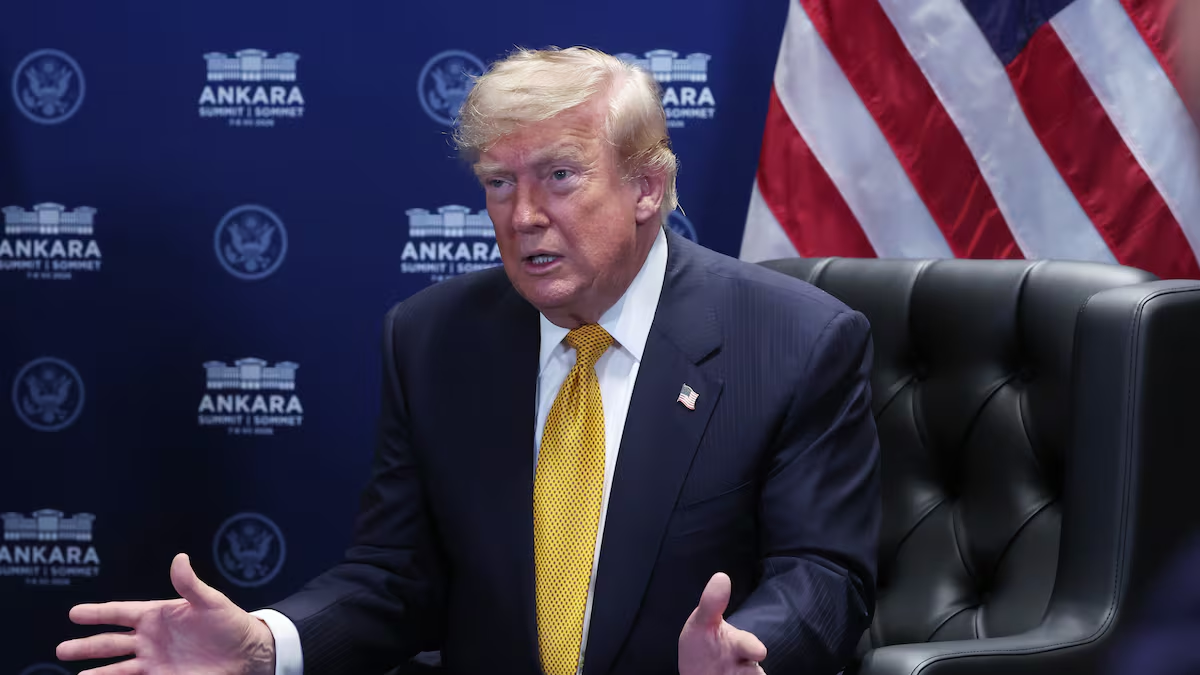
Speaking at the NATO summit in Türkiye, President Trump said he considered the ceasefire finished, although he indicated that diplomatic talks could technically continue. He expressed little optimism about negotiations, stating that further discussions were unlikely to produce meaningful results. His remarks immediately heightened concerns that the conflict could intensify once again.
The renewed hostilities come during funeral ceremonies for Iran’s late Supreme Leader, Ayatollah Ali Khamenei, who was killed earlier in the conflict. Negotiations aimed at achieving a permanent agreement—including reopening the Strait of Hormuz and addressing Iran’s nuclear program—had been expected to resume following the conclusion of the funeral. The latest military exchanges have now cast serious doubt over those diplomatic efforts.
Iranian officials insisted the country would not yield to military pressure. Parliament Speaker Mohammad Bagher Qalibaf declared that the era of coercion was over and said Iran would not be intimidated. Meanwhile, senior officials in the United Arab Emirates condemned Iran’s attacks on Bahrain and Kuwait, describing them as evidence that Tehran remains unwilling to pursue genuine de-escalation.
The latest crisis was also fuelled by attacks on commercial shipping in the Strait of Hormuz. One tanker carrying Qatari natural gas caught fire after being struck near the coast of Oman, while two other vessels sustained damage but were able to continue their voyages. Qatar strongly condemned the attack, calling it a serious threat to international navigation and global energy security, and held Iran legally responsible.
The escalating confrontation has had immediate economic consequences. Global oil prices climbed by more than five per cent as investors reacted to concerns that further disruption in the Strait of Hormuz could threaten international energy supplies and destabilize global markets.
Despite the sharp escalation, neither Washington nor Tehran has formally withdrawn from diplomatic negotiations. However, with military operations resuming, sanctions tightened and both sides exchanging direct attacks, prospects for restoring the ceasefire have become increasingly uncertain.