

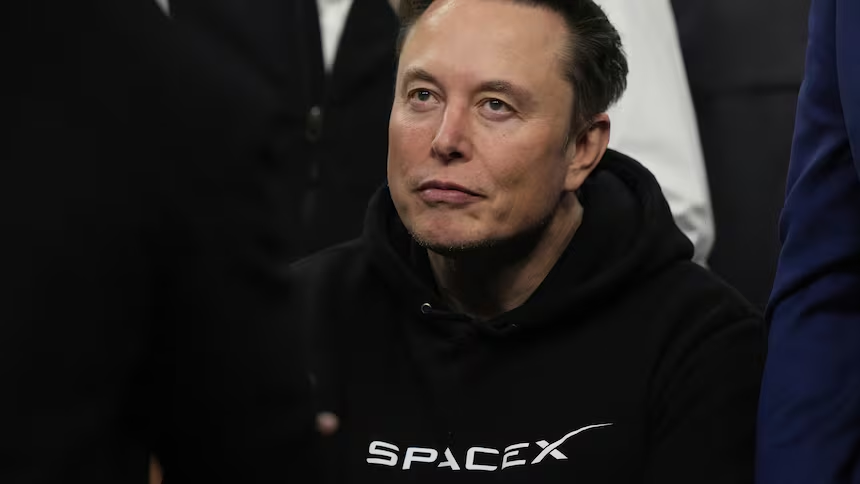
A new wave of blockbuster stock market listings is sweeping across Wall Street, led by the highly anticipated public debut of Elon Musk’s space exploration giant, SpaceX. The company’s initial public offering (IPO), expected to be the largest in financial history, has triggered intense excitement among investors while also raising questions about valuations, risks, and whether the current enthusiasm surrounding technology stocks can be sustained.
The public listing of SpaceX marks a major milestone not only for the company but also for global financial markets. With shares priced at approximately US$135 and a valuation approaching US$1.8 trillion, SpaceX is set to become one of the world’s most valuable publicly traded companies almost overnight.
The excitement surrounding SpaceX is being matched by growing anticipation for upcoming stock market debuts from artificial intelligence leaders OpenAI and Anthropic. Both companies are reportedly preparing public offerings that could value them near the trillion-dollar mark, reflecting investor confidence in technologies that many believe will transform the global economy over the coming decades.
An Initial Public Offering, commonly known as an IPO, occurs when a private company sells shares to the public for the first time. The process allows businesses to raise substantial amounts of capital for expansion, research, acquisitions, and future growth while providing ordinary investors the opportunity to purchase ownership stakes in companies previously accessible only to private investors.
Much of the enthusiasm surrounding the current IPO wave stems from investor belief that industries such as artificial intelligence, space technology, satellite communications, and advanced computing will define the next era of economic growth. SpaceX, in particular, has attracted global attention through its ambitious missions, satellite network, reusable rockets, and plans for deep-space exploration.
However, not everyone is convinced the valuations are justified. Some analysts argue that investor optimism may have pushed prices well beyond what current financial performance supports. Research firm Morningstar has reportedly estimated a significantly lower value for SpaceX than its IPO pricing, suggesting that expectations may already be ahead of reality.
The company itself has acknowledged risks in its public filings, noting that it has historically recorded net losses and may not achieve sustained profitability in the future.
One unique aspect of the SpaceX offering is the continued dominance of founder Elon Musk. Despite becoming a public company, Musk is expected to retain control of more than 80 percent of the company’s voting power, giving him significant influence over strategic decisions, operations, and future direction.
Financial experts note that this governance structure differs from many traditional public companies, where shareholders typically exercise greater influence over management decisions. Investors purchasing SpaceX stock will, in many ways, be placing their trust directly in Musk’s leadership and long-term vision.
The IPO will also generate enormous wealth for existing stakeholders. Musk’s ownership stake alone could push his net worth into unprecedented territory, potentially making him the world’s first trillionaire. Early venture capital investors, private equity firms, employees holding stock options, and investment banks involved in the offering are also expected to benefit significantly.
Retail investors, however, face a different reality. While companies are increasingly allocating shares directly to ordinary investors before public trading begins, demand often far exceeds supply. Many investors who request IPO shares receive only a small portion of what they seek, forcing them to purchase shares later on public markets at potentially higher prices.
History shows that investing in IPOs can be highly rewarding but also highly risky. Some of the world’s most successful companies generated extraordinary returns after going public. For example, investors who purchased shares of Tesla during its 2010 IPO enjoyed gains worth millions of dollars over the following decade.
At the same time, many once-hyped companies failed to meet expectations. Daily-deals company Groupon experienced an impressive debut after its 2011 IPO, only to lose the majority of its value within a short period.
Financial analysts caution that newly listed stocks often experience significant volatility during their early months of trading. Prices can surge dramatically on opening day before falling sharply as early investors sell their holdings and markets reassess long-term prospects.
For SpaceX, those risks may be even greater because investors are evaluating a company operating in a complex, capital-intensive, and still-evolving industry. Success depends not only on technological innovation but also on regulatory approvals, commercial contracts, launch reliability, satellite operations, and future profitability.
Despite the uncertainty, investor appetite remains strong. Many view SpaceX, OpenAI, and Anthropic as rare opportunities to invest directly in companies shaping the future of humanity’s relationship with space exploration and artificial intelligence.
Whether this new generation of technology giants ultimately delivers returns comparable to companies like Tesla—or follows the path of less successful IPOs—remains to be seen. What is clear, however, is that the world is witnessing one of the most significant periods of public market excitement since the technology boom of previous decades.
For investors, the lesson remains unchanged: extraordinary opportunities often come with extraordinary risks. As Wall Street prepares for a new era of mega-IPOs, the excitement is undeniable—but so is the need for caution.