

Conservatives Demand Answers While Liberals Argue Economic Picture Is More Complex Than GDP Figures Alone
OTTAWA – A growing political battle erupted on Parliament Hill Monday after new economic data showed Canada’s economy contracted for a second consecutive quarter, meeting the widely accepted technical definition of a recession.
The latest figures from Statistics Canada have sparked a heated debate between the federal government and the Opposition Conservatives, with both sides offering sharply different interpretations of the country’s economic condition.
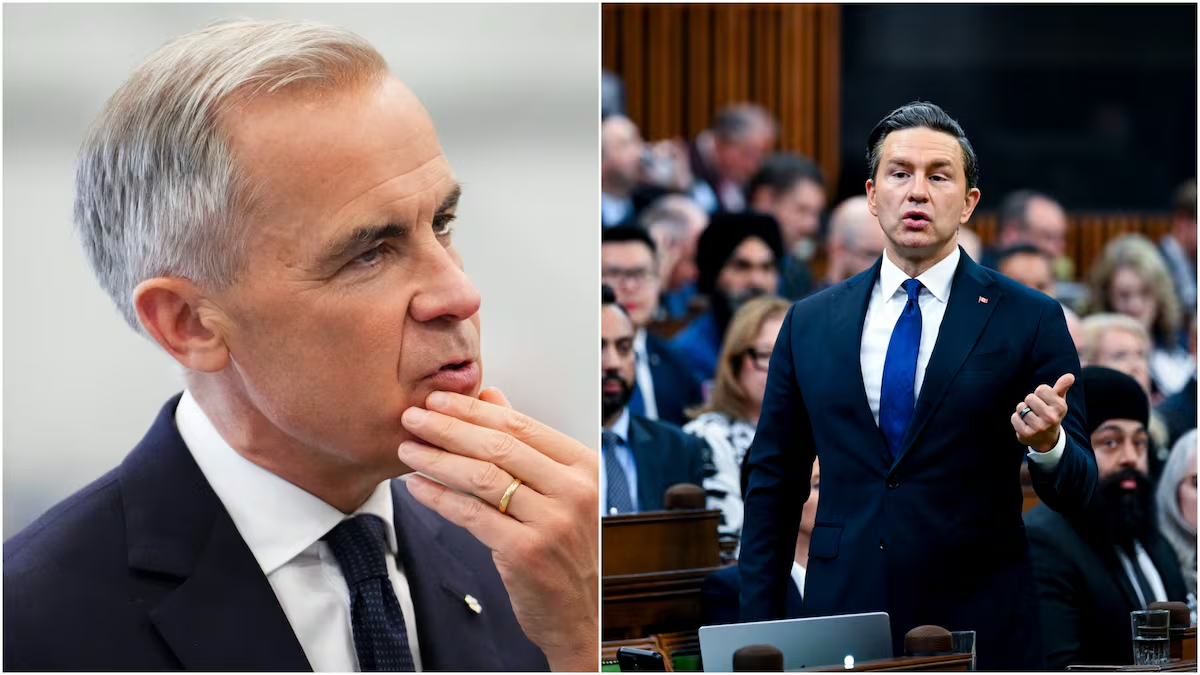
Conservative Leader Pierre Poilievre intensified pressure on Prime Minister Mark Carney by requesting an emergency debate in the House of Commons on the state of Canada’s economy, arguing that millions of Canadians are struggling with rising costs, shrinking household budgets and economic uncertainty.
“The prime minister couldn’t be bothered to say a single thing about this emergency since he learned of it on Friday morning,” Poilievre told Parliament.
Calling the situation an economic emergency, Poilievre said many Canadians are facing empty refrigerators, depleted savings and growing financial anxiety while expecting leadership and answers from Ottawa.
However, House Speaker Francis Scarpaleggia rejected the request for an emergency debate, ruling that it did not meet the parliamentary requirements necessary to proceed.
The decision further fueled criticism from the Opposition, which has accused the government of avoiding accountability following the release of the latest economic data.
Statistics Canada’s report, released Friday, showed Canada’s Gross Domestic Product (GDP) declined for a second straight quarter. Traditionally, two consecutive quarters of economic contraction constitute what economists refer to as a “technical recession.”
Despite the data, Liberal MPs and government officials have challenged the characterization that Canada is officially in recession.
During Question Period last week, Liberal Member of Parliament Carlos Leitão stated more than once that Canada is not in a recession, emphasizing instead that economic challenges are being driven largely by external factors such as international trade disruptions and tariffs.
His comments prompted Conservative MP Gérard Deltell to raise a question of privilege in the House on Monday, accusing the Liberal government of misleading Canadians about the true state of the economy.
Government officials responded by arguing that economic conditions cannot be assessed solely through GDP figures.
Finance Minister François-Philippe Champagne’s office pointed to comments from senior economic experts and Bank of Canada officials who caution against relying on a single indicator when evaluating the overall health of the economy.
Appearing before a parliamentary committee, Bank of Canada Senior Deputy Governor Carolyn Rogers acknowledged that while the GDP data may satisfy one commonly used definition of recession, broader economic indicators tell a more nuanced story.
“I think we need to be careful not to put too much weight on any one indicator,” Rogers said.
Government representatives argue that employment levels, business investment, consumer spending, inflation trends and international economic pressures must all be considered before drawing conclusions about Canada’s economic condition.
The debate comes at a challenging time for Canadians already grappling with affordability concerns, high housing costs and uncertainty caused by ongoing global economic instability.
Economic pressures have been further intensified by international trade tensions, tariffs and the continuing geopolitical conflict in the Middle East, all of which have affected supply chains, investment confidence and energy markets.
While economists continue to debate whether the current downturn will be brief or develop into a more prolonged slowdown, the political implications are already becoming clear.
The economy is rapidly emerging as one of the most significant issues facing the Carney government, with opposition parties attempting to hold the government accountable for campaign promises related to affordability, economic growth and fiscal management.
For many Canadians, however, the debate over technical definitions may matter less than the day-to-day realities they face at grocery stores, gas stations and mortgage renewal offices.
As Parliament continues to wrestle with competing interpretations of the latest economic data, households across the country will be watching closely to see whether economic conditions improve in the months ahead or whether concerns about a broader recession become increasingly difficult to dismiss.
The coming quarters are expected to provide a clearer picture of Canada’s economic direction and whether current challenges represent a temporary slowdown or the beginning of a more significant economic downturn.