

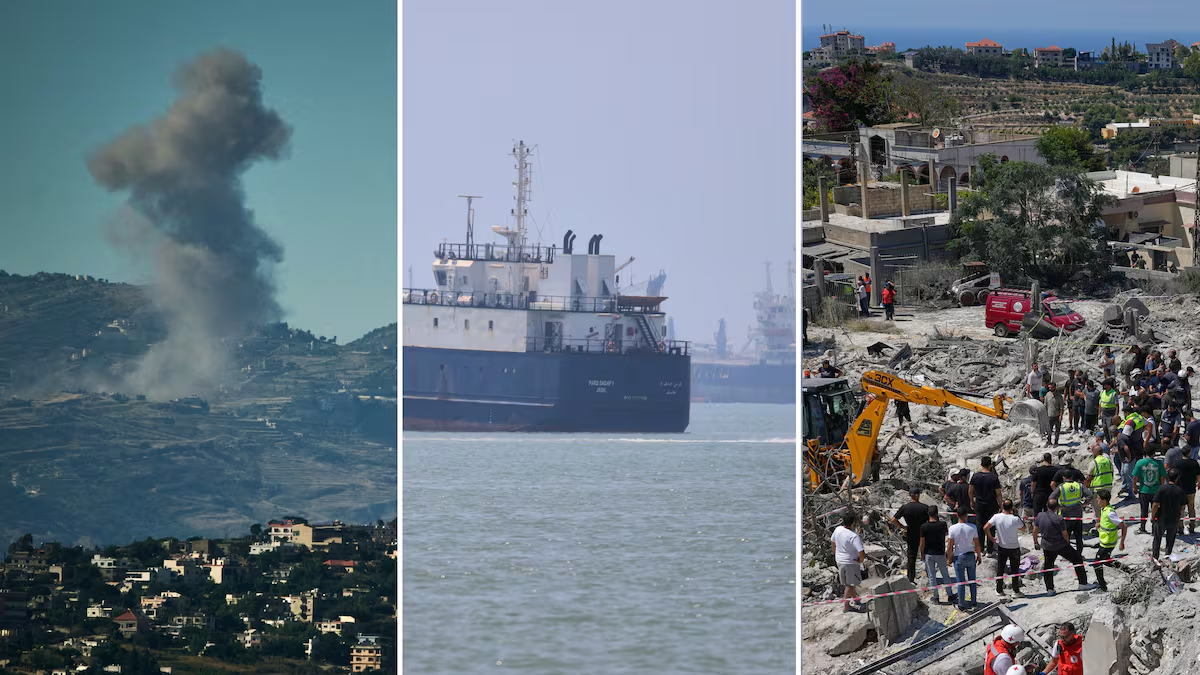
Senior U.S. and Iranian negotiators are scheduled to meet in Switzerland on Sunday in an effort to advance their interim agreement aimed at ending the conflict and paving the way for a broader nuclear deal. The talks come amid rising tensions after Tehran announced that it had once again closed the Strait of Hormuz in response to continuing Israeli military operations in Lebanon, warning that progress toward a final agreement could be jeopardized if the fighting does not cease.
President Donald Trump responded by warning that the United States could impose tolls on vessels using the strategic waterway if a comprehensive agreement with Iran is not reached within the 60-day period established under the interim accord. Trump said the fees would compensate the United States for acting as the “guardian” of stability in the Middle East. Under the temporary agreement, shipping through the strait remains toll-free during the current negotiation period.
The upcoming technical-level discussions are being facilitated by Pakistan and Qatar. Vice President JD Vance departed for Switzerland and expressed optimism about both the nuclear negotiations and efforts to secure a ceasefire in southern Lebanon. Top American negotiators Jared Kushner and Steve Witkoff have already arrived in Switzerland, while Iran’s delegation includes parliamentary speaker Mohammad Bagher Qalibaf, Foreign Minister Abbas Araghchi and senior officials responsible for oil and financial matters. The interim agreement also provides for the release of billions of dollars in frozen Iranian assets.
Pakistan’s Prime Minister Shehbaz Sharif and Army Chief Field Marshal Asim Munir are also traveling to Switzerland to support diplomatic efforts. The talks had originally been scheduled to begin on Friday but were delayed due to the worsening conflict in Lebanon. Behind-the-scenes diplomacy involving the United States, Qatar and Iran reportedly helped secure understandings aimed at reducing hostilities between Israel and Hezbollah.
Iranian officials emphasized that negotiations toward a permanent agreement depend on all parties honoring their commitments, warning that the entire memorandum of understanding could collapse if those obligations are not fulfilled.
The Strait of Hormuz has once again become a major flashpoint. Iran’s military command declared that the waterway had been closed because of what it described as a U.S. failure to uphold commitments by allowing the conflict in Lebanon to continue. The United States rejected the claim, insisting that maritime traffic remained uninterrupted and that American forces were monitoring the area. Military officials reported that dozens of commercial ships carrying more than 17 million barrels of oil had successfully transited the strait on Saturday.
The global economy remains on edge as uncertainty surrounding energy supplies and regional stability intensifies. The interim agreement signed earlier this week by President Trump and Iranian President Masoud Pezeshkian temporarily lifted restrictions on Iran’s ports and allowed Tehran to resume oil exports, although critics in Washington have questioned the concessions made in exchange for the ceasefire framework.
Meanwhile, violence continued across southern Lebanon. Iranian officials reportedly informed Hezbollah that the Strait of Hormuz would remain closed until Israel publicly committed to a comprehensive ceasefire and halted military operations. Hezbollah signaled that it would observe a ceasefire if Israel did the same. Israeli military officials later confirmed receiving new instructions to cease offensive operations while maintaining the right to respond to attacks.
Despite those developments, Israeli strikes across southern Lebanon killed at least 16 people, including children, and several others remained trapped beneath collapsed buildings. The Israeli military said Hezbollah had launched more than 50 projectiles toward Israeli positions overnight and stated that it had carried out attacks on dozens of Hezbollah targets. Five Israeli soldiers were also reported killed during the previous 48 hours.
Neither Israel nor Hezbollah is formally a party to the U.S.-Iran agreement, complicating efforts to secure a broader peace. Lebanon’s health authorities announced that the death toll from the latest conflict with Israel has now surpassed 4,000.
The current war erupted shortly after joint U.S. and Israeli strikes on Iran in late February, prompting Hezbollah to launch rockets and drones into northern Israel and triggering Israeli operations deep inside southern Lebanon. New U.S.-backed negotiations involving Israel and the Lebanese government are expected to take place in Washington next week.
Israeli Prime Minister Benjamin Netanyahu has pledged to maintain military operations in southern Lebanon until all threats against Israel are eliminated, while Hezbollah insists that attacks will continue until Israeli forces withdraw. Fighting and airstrikes continued along the border on Saturday, with casualties reported in several Lebanese villages and Israeli aircraft flying low over the coastal city of Tyre.
Residents on both sides of the border expressed exhaustion after months of violence. Many in Lebanon said a ceasefire would transform their daily lives, while some residents in northern Israel remained skeptical that any agreement would bring lasting peace to the region.