

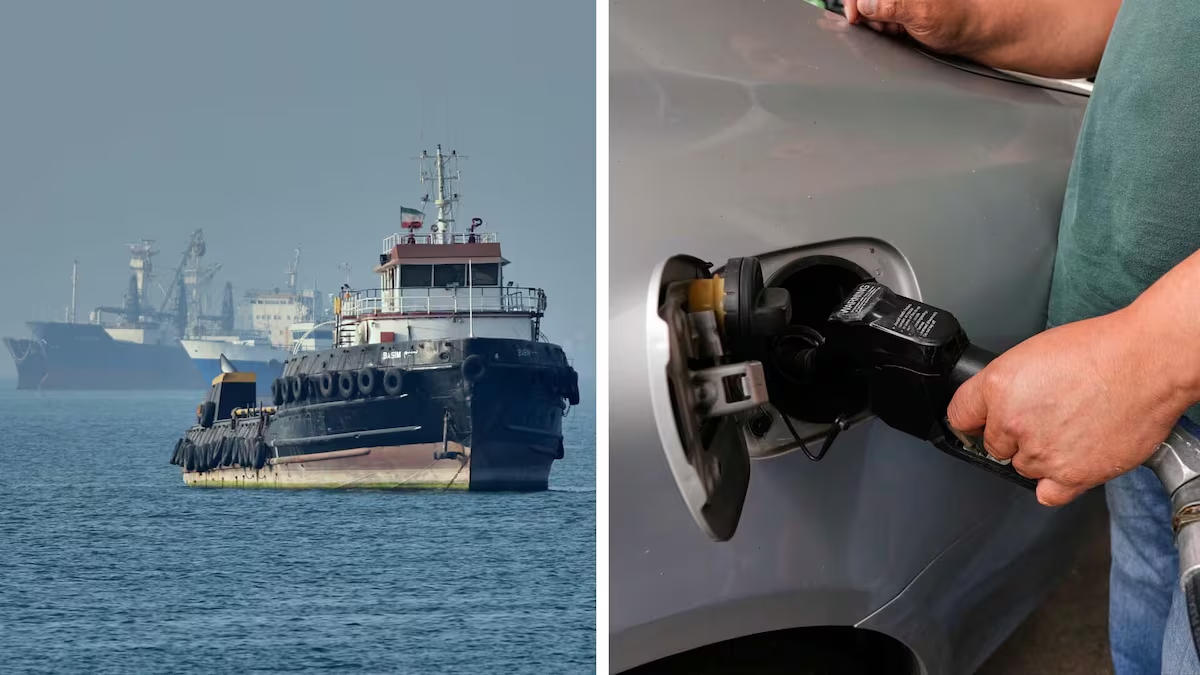
The recently announced peace agreement between the United States and Iran has eased fears of a wider conflict in the Middle East and brought some relief to global energy markets. However, experts say Canadians should not expect a significant drop in gasoline prices anytime soon, as the impact of the conflict will continue to affect oil supplies and energy costs for months, and possibly years.
Financial markets reacted positively after news emerged that the United States and Iran had reached a peace framework aimed at ending weeks of military tensions and restoring stability to the region. One of the first signs of optimism came from oil markets, where Brent crude, the international benchmark for oil prices, fell nearly five per cent to approximately US$83 per barrel.
Despite the decline, oil prices remain considerably higher than they were before the conflict began. Industry analysts point out that current prices are still more than US$10 per barrel above pre-war levels, suggesting that the market continues to price in risks associated with ongoing uncertainty in the region.
For Canadian consumers, this means that while some temporary relief may be seen at gas stations, fuel prices are likely to remain elevated. According to data from the Canadian Automobile Association, the national average gasoline price was approximately $1.66 per litre this week, compared with around $1.35 per litre at the same time last year.
Energy experts believe the global oil market has entered a new phase where higher prices may become the norm rather than the exception. The conflict disrupted production, damaged critical energy infrastructure, and created uncertainty around one of the world’s most important oil transportation routes—the Strait of Hormuz.
The Strait of Hormuz serves as a vital gateway for global oil shipments, carrying a significant portion of the world’s energy supplies. Although the peace agreement has reduced immediate security concerns, analysts note that many oil tankers remain hesitant to fully resume operations until navigation routes are completely secured and lingering threats are removed.
Adding to the uncertainty, Iranian officials have indicated plans to impose service fees on vessels using the Strait of Hormuz. While details of these charges have not yet been finalized, any additional costs could eventually be passed on through the global energy supply chain, affecting consumers worldwide.
Industry observers also point to another major challenge: rebuilding depleted oil reserves. During the conflict, numerous energy facilities and refineries suffered damage, reducing production capacity and creating supply shortages. Restoring those operations and replenishing global inventories will take time, even if peace holds.
Experts warn that as long as global oil supplies remain constrained, fuel prices will likely stay above historical averages. Some analysts predict Canadians may continue paying between $1.50 and $1.70 per litre through much of 2026, despite recent efforts by governments to reduce fuel taxes and provide consumer relief.
Higher fuel prices have broader implications beyond transportation costs. Rising energy costs affect virtually every sector of the economy, including food distribution, manufacturing, shipping, and retail operations. As a result, elevated oil prices can contribute to higher costs for groceries and everyday goods, placing additional pressure on household budgets.
While the peace agreement represents a positive step toward regional stability, economists caution that the economic effects of the conflict will not disappear overnight. Markets will be closely watching how quickly oil production resumes, whether shipping traffic returns to normal levels, and how effectively damaged infrastructure can be restored.
For now, Canadians can welcome the reduction in geopolitical tensions, but they should also be prepared for fuel prices that are likely to remain higher than many had hoped. The road to lower energy costs may prove much longer than the road to peace itself.