

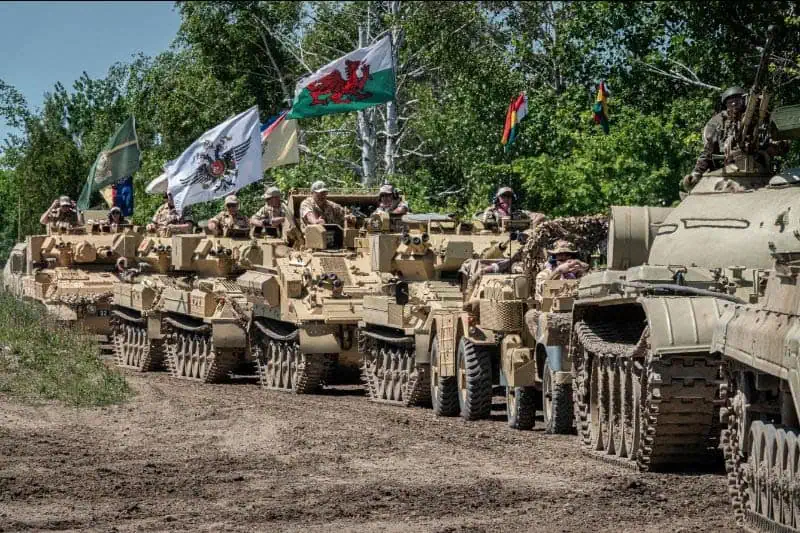
North America’s largest collection of operational historical military vehicles has grown dramatically following the donation of 20 tanks and armoured vehicles from the private collection of Alan Duffy, president of the Canadian Tank Museum since 2016. The Duffy Historical Collection, valued at more than $2 million, includes the world’s largest privately held group of British military vehicles used during the 1991 Gulf War.
The gift marks a major milestone for the museum—but also poses a challenge. “We don’t have the space to display what we have now—we’re full,” said museum executive director Jeremy Blowers, noting the newly donated vehicles will rotate in and out of public view until the first phase of a planned $30-million expansion opens in roughly two years.
Long regarded as one of Canada’s most significant private collections of operational military vehicles, the Duffy collection features historically important machines, many of which saw active service during the Gulf War. Duffy spent decades acquiring, restoring and researching the vehicles, often tracking down former operators and crews to reconnect them with the machines they once commanded.
Some of the vehicles have previously been displayed in Oshawa on loan, while others have appeared during annual public events. Donating the full collection, Duffy said, was about preserving history. “It has been my passion to restore and preserve these vehicles and to keep the memory and history alive that goes along with them. There is no better organization I can entrust this legacy to than the Canadian Tank Museum.”
The 20-vehicle donation includes several fully restored, operational machines purchased from Europe and the United States. Among them are Soviet-era vehicles such as a T-54 Main Battle Tank and a BMP-1 infantry fighting vehicle, as well as 11 British CVR(T) reconnaissance vehicles deployed during Operation Granby in the Gulf War. A British Chieftain Mk 11 and a German-built Leopard 1A5 round out the impressive list.
Blowers called the donation transformative. “Our Museum has been fortunate in the past to receive individual artifact donations, but to receive an entire private collection is an incredible boost to the size and international composition of our collection. It’s quite a gift.”
The museum, formerly known as the Ontario Regiment RCAC Museum until its 2024 rebranding, is in the early stages of a major expansion campaign. Plans call for a purpose-built exhibit building on the north side of the grounds—designed to display the full collection more accessibly—and extensive outdoor exhibition space. The upcoming board meeting on December 15 is expected to finalize the building design and set a groundbreaking date for the $15-million first phase, described by Blowers as the “perfect tank hangar.”
The new two-storey facility will feature a 3,500-square-foot footprint dedicated entirely to displays, with the existing building repurposed for storage, maintenance and administrative use. The expanded grounds will also incorporate Oshawa’s Heritage Conservation District, preserving Second World War–era structures at the Oshawa Executive Airport as part of a curated military heritage complex.
The Ontario Regiment RCAC will remain a central component of the enlarged museum, maintaining its own heritage displays alongside the growing vehicle collection. Additional amenities—including a cafeteria and offices—will be built during phase two of the expansion.
The capital campaign has already attracted substantial early support. The Dunkley Charitable Foundation pledged to match the first $4 million raised, while Duffy himself matched an additional $1 million, accelerating momentum for the ambitious project.
With its newest acquisition, the Canadian Tank Museum is poised to become an even more significant international destination for military history enthusiasts—once it has the room to show off its extraordinary new collection.