

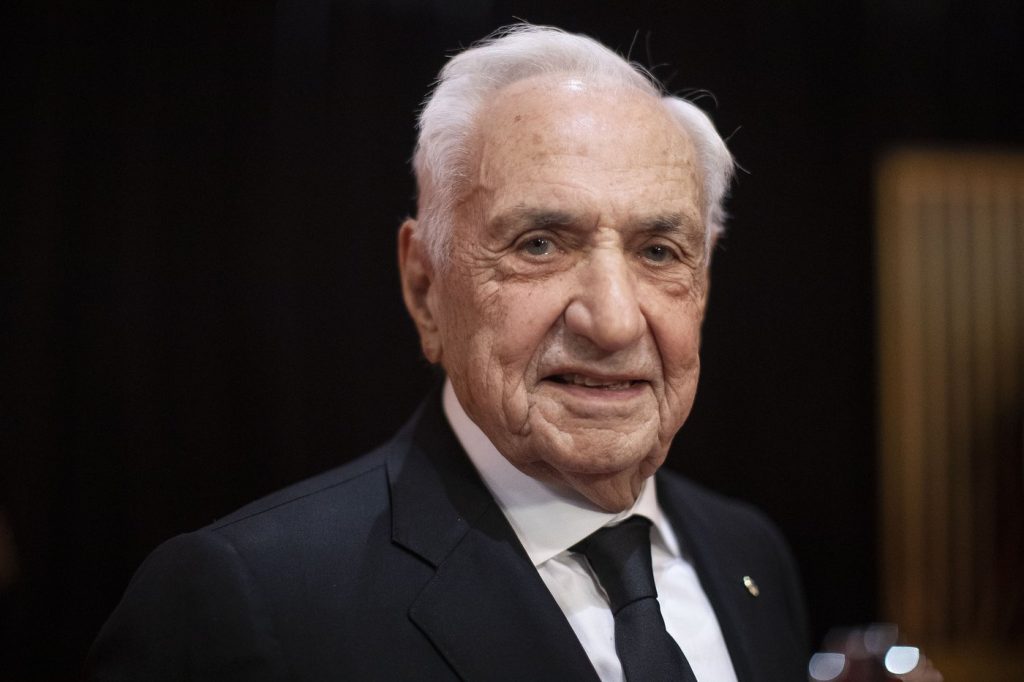
Frank Gehry, the Canadian-born architectural renegade whose bold imagination reshaped skylines around the globe, has died at the age of 96. Gehry Partners chief of staff Meaghan Lloyd confirmed that he passed away Friday morning at his home in Santa Monica, Calif., after a brief illness.
Gehry’s audacious, rule-defying designs made him one of the most influential and recognizable architects of the modern era. His creations—including Toronto’s Art Gallery of Ontario, the Guggenheim Museum Bilbao in Spain, the Walt Disney Concert Hall in Los Angeles, and Facebook’s headquarters in Menlo Park—brought sculptural energy and sweeping movement to steel, glass and concrete. His influence was so widespread that he was even immortalized as a character on “The Simpsons.”
Criticism never deterred Gehry. Introducing his early concepts for a trio of condo towers in Toronto in 2012, he recalled that many of his most celebrated works were first greeted with hostility. “In Bilbao, Spain they wanted to shoot me when they saw the Guggenheim design, and now they get $500 million a year in revenue,” he said, noting how the Walt Disney Concert Hall was famously dismissed as “broken crockery.” The Toronto project, undergoing redesigns at the time, eventually evolved into two major skyscrapers now rising in the city’s entertainment district.
Born Frank Owen Goldberg on Feb. 28, 1929, to Polish-Jewish immigrant parents in Toronto, Gehry’s earliest inspiration came from his grandmother, Leah. She would scatter oddly shaped wood scraps across the kitchen floor for young Frank to assemble into imaginary cities—a formative moment he later called “the most fun I ever had in my life” and his earliest license to play creatively.
As a teenager, Gehry attended Friday lectures at the University of Toronto and was enthralled by a speaker he later believed was Finnish design pioneer Alvar Aalto. In 1947, his family moved to Los Angeles, where Gehry drove trucks by day, studied sculpture by night, and eventually earned an architecture degree from the University of Southern California. He became a U.S. citizen in 1950.
In the mid-1950s, after pressure from his first wife, he reluctantly changed his last name from Goldberg to Gehry to shield their children from antisemitism—an act he later regretted. His early professional years were marked by financial challenges, family responsibilities, military service, and a brief stint studying urban planning at Harvard before he dropped out.
Gehry opened his Los Angeles studio in 1962, quickly establishing himself as a rising force. One of his early triumphs, the 1964 Danziger Studio and Residence, became a modernist landmark. His reputation expanded with projects like the Merriweather Post Pavilion in Maryland, praised by The New York Times as “an unqualified architectural and acoustical success.”
By the 1970s and ’80s, Gehry was experimenting boldly with unconventional materials—plywood, chain-link fencing, corrugated metal—as seen in his own Santa Monica home, a seminal work of deconstructivism. His international breakthrough arrived in the 1990s with the Guggenheim Bilbao, a flowing titanium sculpture of a building that transformed both contemporary architecture and the economic fortunes of an entire city. Other major works followed, including Barcelona’s shimmering fish sculpture “El Peix,” the Frederick Weisman Museum, and globally acclaimed cultural institutions.
In 1989, Gehry was awarded the Pritzker Architecture Prize, the profession’s highest honour. Juror Ada Louise Huxtable wrote that Gehry infused every project with joy and imagination. “One cannot think of anything he has done that doesn’t make one smile,” she observed.
Gehry continued to shape cities well into his later years, with major commissions such as the Louis Vuitton Foundation in Paris, the Gehry Tower in Hannover, and the celebrated redesign of the Art Gallery of Ontario, which blended warmth, light, and wood in a way that reflected his Canadian roots.
His lifelong appreciation for creativity led him to champion arts education.Through the Kennedy Center’s Turnaround Arts program, he taught architecture workshops to students in underserved schools, guiding them much like his grandmother once guided him. “You can get them involved with painting and making things—that tactile stuff,” he said in a 2019 interview. “My grandma’s idea was perfect.”
In 2016, former U.S. president Barack Obama awarded Gehry the Presidential Medal of Freedom, praising the architect for transforming not only buildings but the way people think about what architecture can be. “Frank’s work teaches us that while buildings may be sturdy and fixed to the ground, like all great art they can lift our spirits,” Obama said. “They can soar.”
Gehry leaves behind a legacy that transcends architecture—one built on imagination, irreverence, and a belief that the ordinary can be reshaped into something extraordinary. His buildings, scattered across continents, continue to delight, challenge and inspire.