

Rewritten Story:
A new national poll suggests most Canadians continue to trust vaccines, though confidence has declined compared with five years ago, particularly among younger adults.
The survey, conducted by Leger Healthcare and released Tuesday, found that 74 per cent of Canadian adults say they are confident in the safety and effectiveness of vaccines. Of those respondents, 42 per cent described themselves as “very confident,” while 32 per cent said they were “somewhat confident.”
At the same time, roughly one in four respondents reported being less confident in vaccines than they were before.
Confidence levels varied by age. Canadians aged 65 and older expressed the highest levels of trust in immunization and in the information available to them. In contrast, 30 per cent of respondents between the ages of 18 and 34 reported a decline in confidence.
Hesitancy was most pronounced around COVID-19 and influenza vaccines.
Among health-care providers surveyed, the leading contributors to vaccine hesitancy were concerns about safety (61 per cent), misinformation spread by social media influencers (53 per cent), and mistrust in institutions (48 per cent).
When members of the public were asked what most influenced their willingness to get vaccinated, the top factors included their belief in a vaccine’s ability to prevent serious illness (63 per cent), the severity of symptoms or risk of death from the virus (60 per cent), vaccine safety (54 per cent), and the likelihood of exposure to the virus (54 per cent).
The findings come as public health officials urge Canadians to get their flu shots amid a sharp rise in cases and pediatric hospitalizations, including three child deaths in Ontario.
Clear, transparent, and consistent communication about vaccine risks and benefits is essential to maintaining trust, said Melicent Lavers-Sailly, vice-president of research at Leger Healthcare. She noted that the growing number of information sources — particularly online — has made it harder for people to know what to believe.
“Information over the last five years about vaccines has become more fragmented,” Lavers-Sailly said. “If everybody is saying something different, it is confusing and it makes sense that you would be less confident in what you’re hearing.”
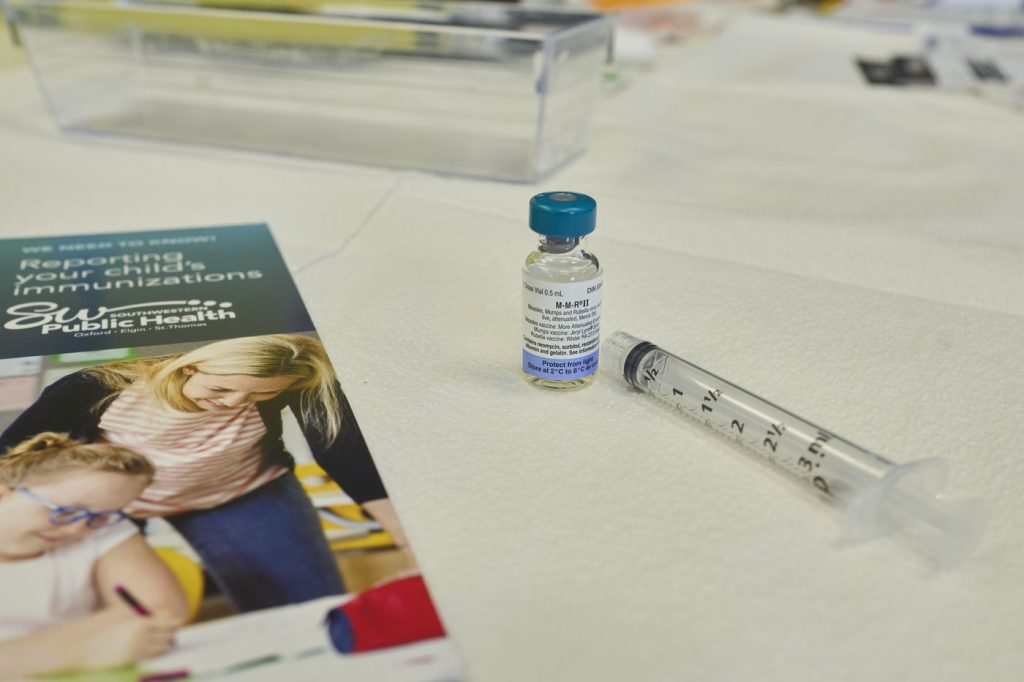
The poll found that 49 per cent of respondents said they were “very comfortable” with the measles, mumps and rubella (MMR) vaccine, while another 20 per cent said they were “somewhat comfortable.” Sixteen per cent said they were either “somewhat uncomfortable” or “not at all comfortable,” and 15 per cent said they were unsure.
Dr. Zainab Abdurrahman, president of the Ontario Medical Association, said the overall level of confidence is encouraging but warned that even small declines in trust can have serious consequences.
“Given the recent measles outbreaks, it shows that even a small drop in MMR confidence is a huge concern,” said Abdurrahman, an allergist and clinical immunologist. “The measles vaccine is one of the safest and most effective tools we have, and we need to reinforce that.”
She emphasized the importance of health-care providers engaging directly with patients to address specific concerns and counter misinformation.
According to the survey, family doctors and nurse practitioners remain the most trusted sources of vaccine information, followed by Canadian government and public health websites. However, Abdurrahman noted that the roughly six million Canadians without a family doctor may be at greater risk of losing confidence in vaccines.
“With a primary-care provider, you build a relationship over time, and there is trust there,” she said.
Many respondents also reported relying on Canadian media for vaccine information. However, those who lacked confidence in vaccines were more likely to prioritize social media or podcasts. Among respondents who said they were “not at all confident,” 22 per cent said they either did not seek out vaccine information or felt the question did not apply to them.
Seventeen per cent of respondents who expressed low confidence said they relied on U.S. government-related websites for vaccine information — a trend that concerns Dr. Cora Constantinescu, a pediatric infectious disease specialist in Calgary who runs a vaccine hesitancy clinic.
“You can’t trust the U.S. government sources like the CDC anymore,” Constantinescu said, citing recent changes to U.S. vaccine oversight, including the dismantling of the federal vaccine advisory body by U.S. Health and Human Services Secretary Robert F. Kennedy Jr., a longtime vaccine skeptic.
Despite these challenges, Constantinescu said the survey leaves room for optimism.
“What this survey shows is that most Canadians are vaccine confident, and that can maybe become a national identity,” said Constantinescu, who is vice-chair of Immunize Canada, a national coalition promoting vaccine awareness. “We choose the health of ourselves, our families, and our communities.”
Leger Healthcare surveyed 300 health-care providers online between Oct. 27 and Nov. 5, 2025, and used those findings to inform its online poll of 1,521 Canadians aged 18 and older, conducted from Nov. 14 to 17, 2025.
The Canadian Research Insights Council notes that online surveys do not have a traditional margin of error because they do not randomly sample the population. For comparison purposes, Leger Healthcare says a probability sample of this size would carry a margin of error of no more than ±2.5 percentage points, 19 times out of 20.