

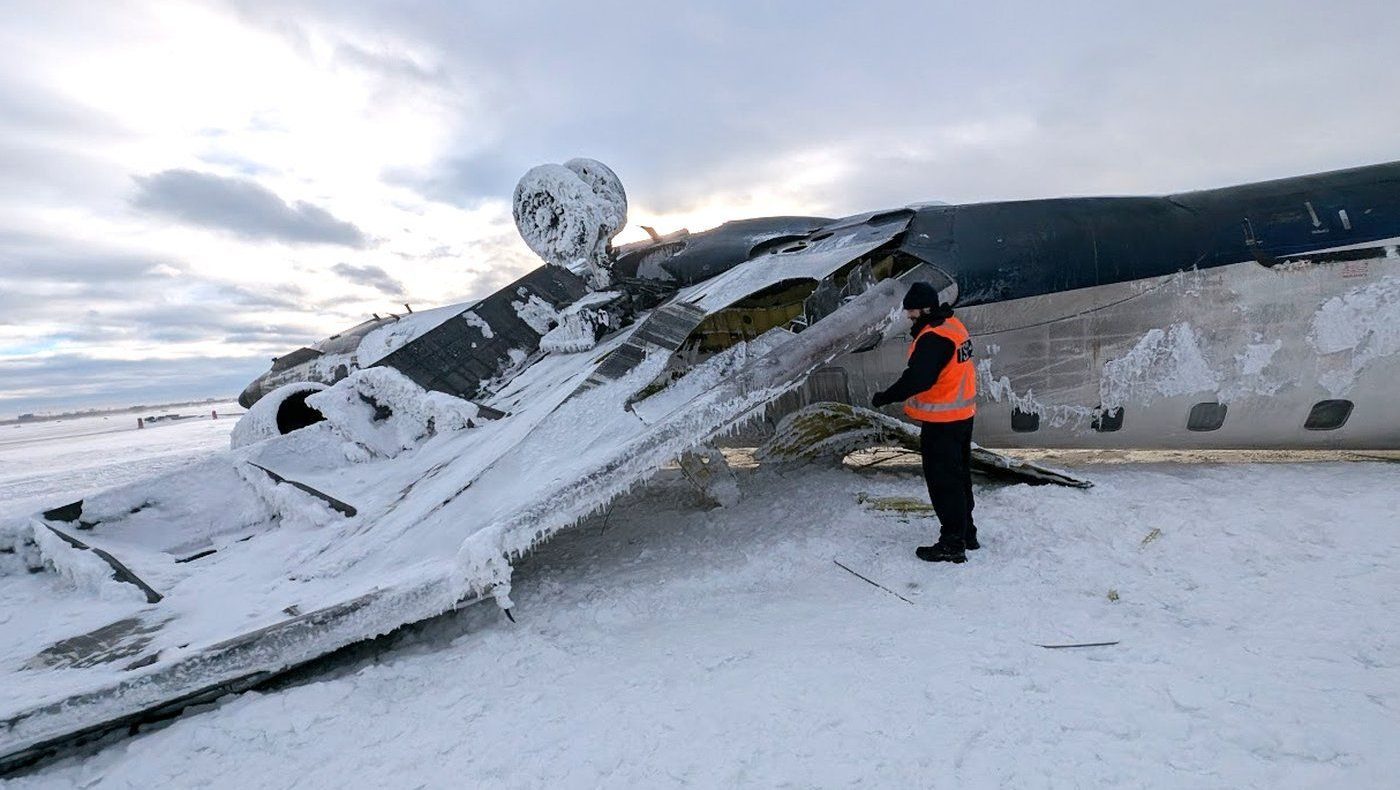
The Transportation Safety Board of Canada (TSB) has dropped its first batch of findings on the dramatic crash-landing of a Delta Air Lines plane at Toronto Pearson International Airport last month, shedding light on the chaos that unfolded on Feb. 17. The Endeavor Air flight from Minnesota, carrying 76 passengers and four crew members, ended up belly-up on the tarmac after a brutal impact. Twenty-one passengers were hospitalized but have since been discharged. Now, the TSB is piecing together what went wrong—and there’s still a long road ahead.
Lead investigator Ken Webster revealed that the CRJ-900’s wreckage was hauled to a hangar near Pearson for a deep dive into its components. The team even ran simulations to recreate the crash conditions, but Webster cautions that this is just the opening chapter. “We’re far from done,” he said in a video posted online Thursday. Early checks show the plane was within its weight and balance limits—ruling out overloading as a culprit—but the real story lies in what happened when rubber met runway.
The TSB’s initial report paints a vivid picture: as the plane slammed into the tarmac, the right main landing gear’s side-stay snapped, causing it to collapse. The right wing then buckled at its root, tearing away from the fuselage and unleashing a “cloud of jet fuel” that ignited as the aircraft skidded along. Photos from the scene show the severed wing, a stark reminder of the violence of the impact. Meanwhile, an unexplained explosion rocked the left wing area, though the cause remains a mystery for now.
Inside the cockpit, things got dicey. The door jammed shut, forcing the crew to scramble out through an emergency hatch. The flight attendants and passengers weren’t so lucky with the Emergency Locator Transmitter (ELT)—meant to ping rescuers with distress signals—which stayed eerily silent. That device is now in the hands of engineers for a closer look.
The TSB’s prelims clear the flight controls of any obvious pre-crash gremlins, with no warning messages popping up on the flight data recorder. But aviation expert Phyl Durdey, speaking to CP24, zeroed in on the descent: everything seemed routine until the plane was just 150 feet off the deck. “The descent rate spiked to 1,114 feet per minute—way beyond the 720 feet per minute the landing gear was built to handle,” Durdey said. “It’s a hard landing on steroids.”
With winds gusting up to 35 knots (65 km/h), Durdey wonders why the pilots didn’t ease off the power to slow the plunge. “Normally, you’d level out at that height, but the descent rate actually shot up. What was happening in that cockpit?” he mused. The flight data and cockpit voice recorders—now pulled from the wreckage—hold the answers, capturing every move and word from the final approach.
![Inside the CRJ-900 with carry-on luggage seen laying on the ceiling of the aircraft. (TSB)]
The TSB also dished out details on the folks in charge. The captain, an 18-year veteran at Endeavor Air, had logged 3,570 flight hours, including 764 on the CRJ-900. It was his first flight of the day—and in a week—with just 3.5 hours in the air over the past month. The co-pilot, a relative newbie with a year at Endeavor, brought 1,422 hours to the table and was wrapping up her fifth straight day on duty, starting in Cleveland. The flight attendants? One had three years with Endeavor, while the other boasted 11 years in the game.
For now, the fractured landing gear, flaming wing, and silent ELT are just pieces of a puzzle the TSB is still assembling. As Webster put it, they’re chasing every lead to figure out how a routine flight turned into a fiery slide—and how everyone still walked away.