

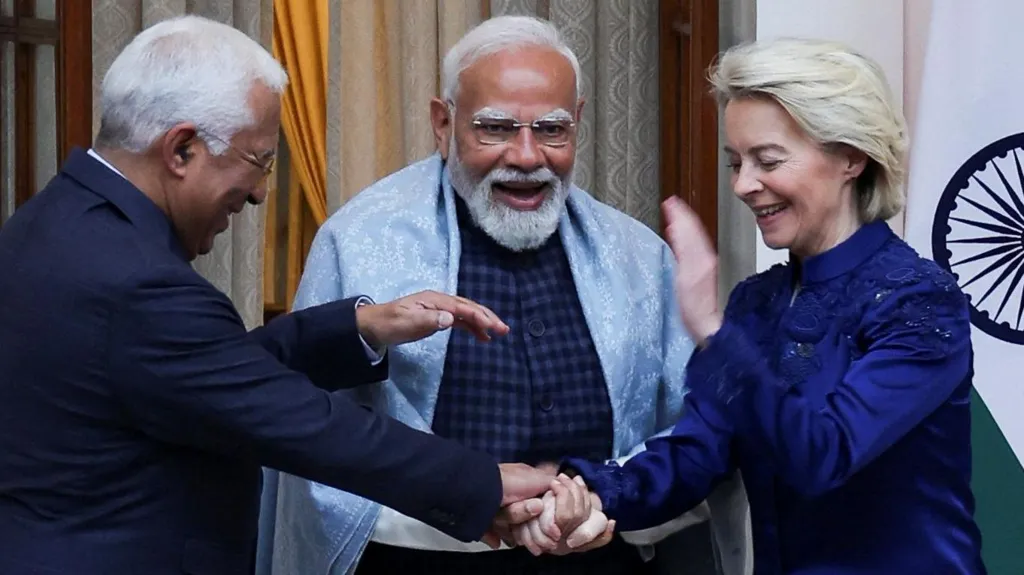
The sweeping trade agreement unveiled this week between India and the European Union is about far more than market access and tariffs — it is a geopolitical signal shaped by uncertainty surrounding U.S. President Donald Trump and his increasingly confrontational trade policies.
Indian Prime Minister Narendra Modi stood alongside European Commission President Ursula von der Leyen and European Council President António Costa in New Delhi as the leaders celebrated what they described as the “mother of all trade deals,” projecting optimism and unity. Behind the smiles, however, the agreement reflects a strategic recalibration by two major global players navigating an unpredictable international order.
The European Union is already India’s largest trading partner, with goods trade reaching more than $140 billion last year, accounting for over a tenth of India’s total trade. Yet negotiations toward a comprehensive agreement had been stalled for nearly two decades. What changed was not economics alone, but geopolitics — particularly the return of Trump to the White House and his aggressive use of tariffs as leverage.
The United States has imposed steep duties on Indian exports, including penalties tied to New Delhi’s continued purchase of Russian oil. Several European countries have also found themselves on the receiving end of tariff threats in recent months, adding urgency to Brussels’ push to diversify trade relationships and reduce dependence on Washington.
The India-EU pact comes amid a flurry of global deal-making as countries seek to hedge against U.S. unpredictability. Canada has reset trade ties with China, drawing sharp warnings from Washington. The United Kingdom is renewing engagement with Beijing. The EU recently finalized a long-delayed agreement with South America’s Mercosur bloc. In each case, Trump’s trade posture has acted as a catalyst.
For India and Europe, the agreement sends a clear message that major economies are willing to deepen cooperation rather than remain vulnerable to unilateral trade pressure. Von der Leyen framed the deal as a step toward reducing strategic dependencies at a time when trade is increasingly being weaponized, while Modi said it would strengthen global supply chains amid what he described as turmoil in the international order.
The agreement has already drawn criticism from Washington. U.S. officials have accused Europe of indirectly funding conflict by expanding trade with India, citing India’s purchases of Russian crude that is later refined and sold globally. New Delhi has consistently rejected that argument, maintaining that its energy imports are essential to meeting domestic needs.
Beyond geopolitics, the deal opens doors for Europe to access one of the world’s fastest-growing markets and offers India an opportunity to rebalance its trade strategy, reduce reliance on China, and expand defence and industrial cooperation with European partners.
Still, the agreement is far from complete. Legal teams must finalize detailed provisions, and the deal will require ratification by EU member states and the European Parliament — a process expected to be lengthy and politically complex. Issues around agriculture, intellectual property, and environmental standards remain sensitive.
Despite those hurdles, businesses on both sides have welcomed the breakthrough, particularly industries hit hard by U.S. tariffs. For India and the EU, the deal offers leverage, flexibility, and a hedge against future trade shocks.
Whether the agreement was intended to provoke Washington or not, its timing ensures that it will be interpreted as a response to Trump’s approach to global trade. How the U.S. president reacts remains uncertain — but for India and Europe, the deal is already a statement of intent.