

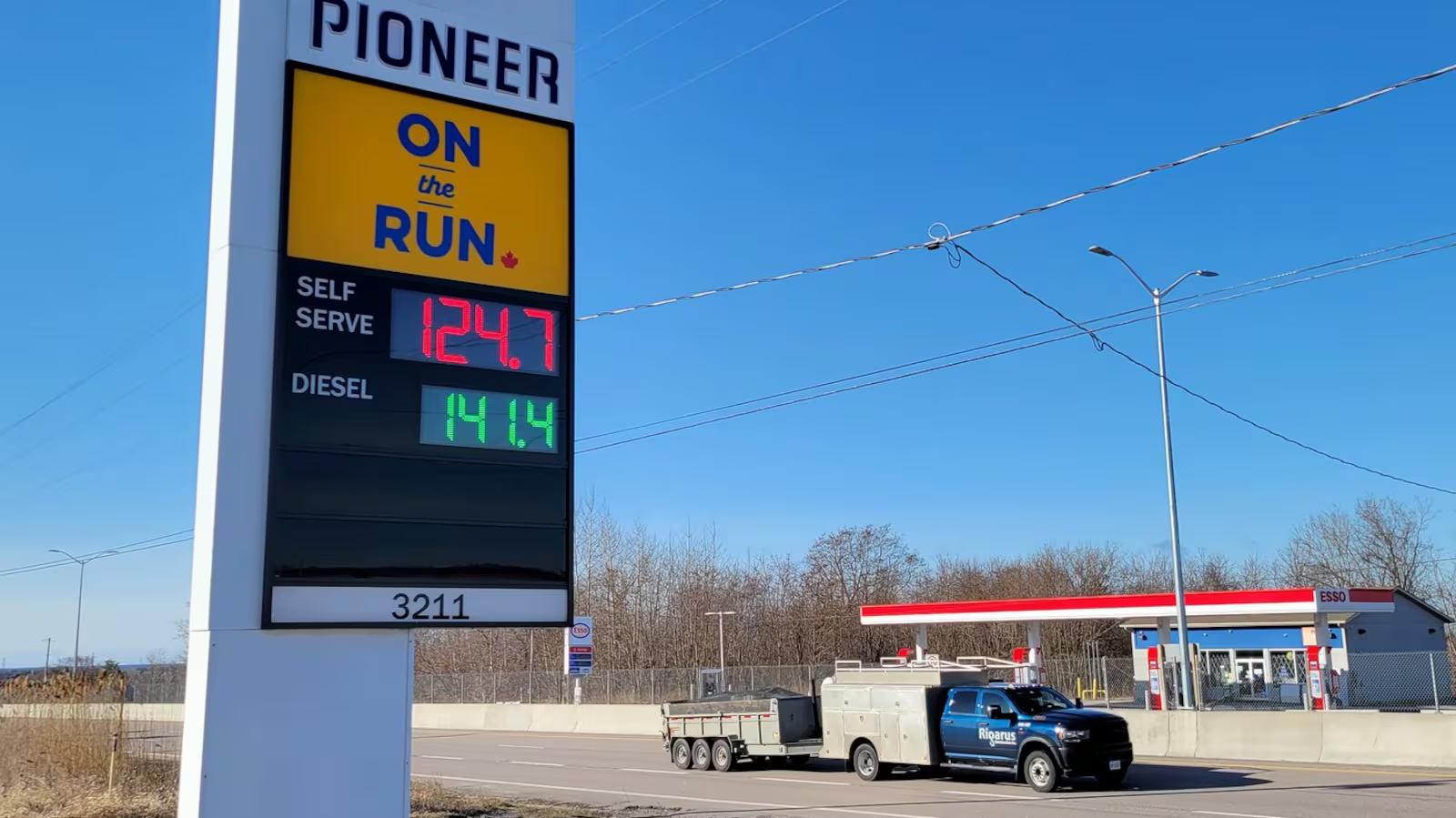
As Canadians gear up for the May long weekend and the onset of peak driving season, industry experts warn that gas prices may not follow their usual summer pattern—thanks, in part, to what’s being called the “Trump factor.”
Roger McKnight, chief petroleum analyst at En-Pro International, says that although gasoline prices typically stabilize by late spring, unpredictable comments and policy signals from U.S. President Donald Trump on tariffs and global affairs could rattle the fuel market.
“This is usually the time when pump prices settle,” said McKnight. “But when the U.S. President starts talking about new tariffs or taking positions on geopolitical tensions, markets don’t just listen—they react.”
Traditionally, Canadian consumers see a spike in fuel costs from January through mid-April as refineries shut down for seasonal maintenance and switch over to producing summer-grade fuels. Prices then plateau heading into summer. However, McKnight notes that current price levels might not hold if political uncertainty intensifies south of the border.
Meanwhile, Canadian fuel prices are still reflecting the impact of a major policy shift. On April 1, Prime Minister Mark Carney scrapped the federal consumer carbon levy, a move that removed 17.6 cents per litre from the cost of gasoline. McKnight says pump prices have dropped by approximately 15 cents per litre since the levy was eliminated, and those savings appear to be holding for now.
Despite that, other factors could limit downward movement. Refineries are currently operating at just 90 per cent capacity—unusually low for this time of year. According to McKnight, poor refining margins are prompting some producers to pull back on output.
“If refiners aren’t making decent money on the product, they’ll simply hold back,” he explained. “That could constrain supply as demand heats up.”
Adding to the uncertainty is the sluggish performance of global oil prices. West Texas Intermediate (WTI), the North American benchmark for light crude, has been hovering near US$60 per barrel in recent weeks—down from roughly US$70 six months ago.
According to the Canadian Fuels Association, crude oil accounts for about 42 per cent of the final pump price, with the remainder driven by taxes, refining, distribution, and marketing costs. While the lower crude prices have helped ease overall fuel costs, analysts caution that market volatility remains a real possibility.
With the summer travel season approaching, all eyes are now on political developments and refinery behaviour—two forces that could shape what Canadian drivers pay at the pump in the months ahead.