

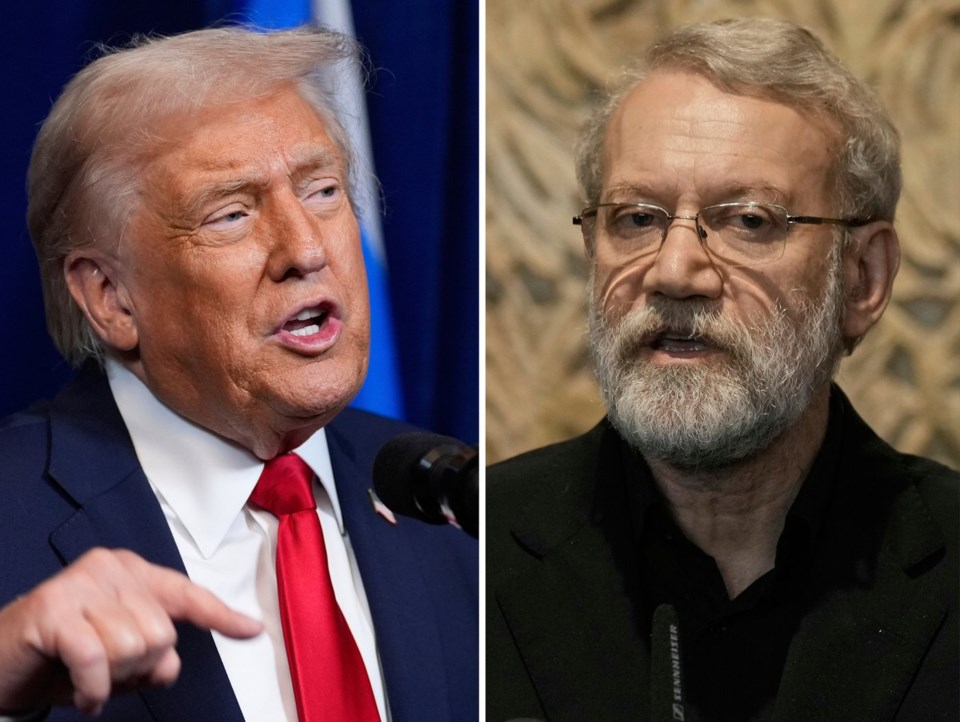
DUBAI, United Arab Emirates — U.S. President Donald Trump and senior Iranian officials exchanged sharp warnings Friday as economic protests expanded across parts of Iran, further raising tensions months after U.S. airstrikes on Iranian nuclear facilities.
Trump wrote on his Truth Social platform that if Iranian authorities “violently kill peaceful protesters,” the United States “will come to their rescue.” At least seven people have been killed in unrest linked to demonstrations that erupted following a sharp collapse in Iran’s national currency.
“We are locked and loaded and ready to go,” Trump wrote, without providing further details.
Iranian officials quickly rejected the comments. Ali Larijani, a former parliament speaker and current secretary of Iran’s Supreme National Security Council, alleged on social media platform X that the United States and Israel were fomenting the unrest. He offered no evidence, echoing claims Iranian authorities have frequently made during past protest movements.
“Trump should know that intervention by the U.S. in domestic problems corresponds to chaos in the entire region and the destruction of U.S. interests,” Larijani wrote. He added that Americans “should take care of their own soldiers,” a reference widely interpreted as pointing to U.S. military forces stationed across the Middle East.
Iran launched missiles at Al Udeid Air Base in Qatar in June after the United States struck three Iranian nuclear sites during Israel’s 12-day conflict with Iran, underscoring the volatility of the region.
Ali Shamkhani, an adviser to Iran’s Supreme Leader Ayatollah Ali Khamenei and a former national security chief, also issued a warning, saying that “any interventionist hand that gets too close to the security of Iran will be cut.”
“The people of Iran know very well the experience of being ‘rescued’ by Americans—from Iraq and Afghanistan to Gaza,” Shamkhani wrote.
The demonstrations, now in their sixth day, are the largest in Iran since 2022, when the death of Mahsa Amini in police custody sparked nationwide protests. While the current unrest has not yet reached the same intensity or geographic scale, it has drawn renewed attention to public anger over economic hardship and political repression.
The protests began after Iran’s rial plunged to roughly 1.4 million to the U.S. dollar, triggering rallies initially focused on economic grievances. In some locations, demonstrators have also chanted slogans critical of Iran’s theocratic system.
Iran’s civilian government, led by reformist President Masoud Pezeshkian, has signaled a willingness to engage with protesters. However, Pezeshkian has acknowledged limited options to stabilize the economy amid currency depreciation and sanctions.
Months after the conflict with Israel, Iran said it had halted uranium enrichment at all sites, an apparent effort to signal openness to renewed negotiations with Western powers. Talks have yet to materialize, as Trump and Israeli Prime Minister Benjamin Netanyahu have warned Tehran against rebuilding its nuclear program.
As protests continue and rhetoric intensifies, the standoff underscores how domestic unrest in Iran is increasingly intersecting with broader regional and international tensions.