

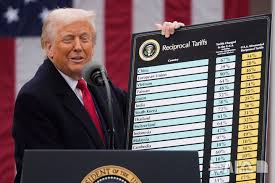
A day after U.S. and global stock markets experienced their steepest decline in years, U.S. President Donald Trump remained upbeat, dismissing the volatility as a temporary reaction to what he described as necessary economic “surgery” tied to his sweeping new tariffs.
Speaking to reporters as he departed the White House en route to his golf club in Florida for the LIV Golf Miami tournament, Trump declared, “I think it’s going very well. The markets are going to boom, the stock is going to boom, the country is going to boom.”
On Thursday, the Dow Jones Industrial Average plummeted more than 1,600 points, triggering a global selloff fueled by concerns over the far-reaching impact of the new U.S. tariff structure. The tariffs, announced Wednesday, impose a minimum 10% tax on all imports, with higher rates targeting key trading partners including China and the European Union.
Despite investor fears and the market turmoil, Trump defended the policy shift. Drawing a medical analogy, he said the U.S. economy is undergoing a vital procedure.
“It’s like when a patient gets operated on—it’s a big thing. I said this would exactly be the way it is,” he said.
Trump further emphasized that the move is intended to correct what he views as decades of trade imbalances and unfair practices by foreign nations. He maintained that companies are now pouring investment back into the U.S. to avoid the new tariffs, predicting long-term benefits from the short-term turbulence.
“Trillions of dollars are coming into our country. The rest of the world wants to see if they can make a deal.”
Later, speaking aboard Air Force One, Trump signaled that tariffs could serve as a negotiation tool moving forward.
“If a country has something phenomenal to offer, we’ll consider it,” he said. “For many years, we’ve been on the wrong side of the ball. I think it’s going to be unbelievable.”
The President’s comments come as businesses, investors, and economists brace for the broader implications of the tariffs, including potential supply chain disruptions, inflationary pressures, and slowing global trade.
With key sectors such as automotive and technology already showing signs of strain and consumer prices expected to rise, financial analysts warn that the administration’s strategy could lead to further market instability in the weeks ahead.