

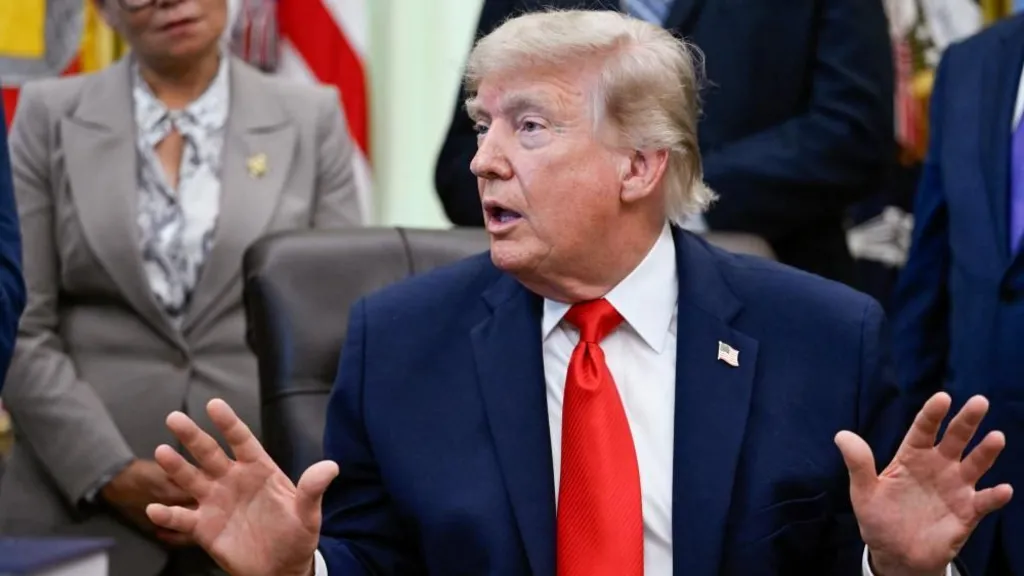
A major diplomatic breakthrough in the Middle East appeared to be within reach this weekend after U.S. President Donald Trump announced that a peace agreement between the United States and Iran was scheduled to be signed on Sunday. However, Iranian officials quickly tempered expectations by indicating that the timeline for finalizing the agreement remains uncertain.
In a message posted on social media, President Trump expressed confidence that the deal would soon be completed and declared that the strategically important Strait of Hormuz would be reopened to international shipping immediately after the agreement is signed. The waterway is one of the world’s most critical energy corridors, carrying a significant portion of global oil and liquefied natural gas exports.
Trump also referred to Iran’s stockpile of enriched uranium, suggesting that once conditions stabilize, the United States would oversee the removal and eventual destruction of what he described as the country’s remaining nuclear material. He warned that if negotiations fail to proceed smoothly, Washington retains other options, though he expressed hope that such measures would never be required.
Despite the optimistic tone from Washington, Iran adopted a more cautious position. Foreign Ministry spokesman Esmail Baghaei stated that while progress has been made, there was no certainty that the memorandum of understanding would be signed on Sunday. He emphasized that discussions were continuing and that an exact signing date had not yet been finalized.
Adding another dimension to the negotiations, a delegation from Qatar arrived in Tehran on Sunday. Qatar has played an important mediating role throughout the talks, and its latest diplomatic mission may help resolve remaining differences between the parties. Whether the visit accelerates or delays the signing remains unclear.
Pakistan, another key mediator in the negotiations, expressed optimism about the process. Prime Minister Shehbaz Sharif stated that the parties appeared closer than ever to a final agreement and suggested that preparations were already underway for an electronic signing ceremony, followed by technical discussions aimed at implementing the deal.
Iranian Foreign Minister Seyed Abbas Araghchi recently described the negotiations as being in their final stages. According to reports, the proposed agreement would help ease regional tensions and could include arrangements connected to the conflict involving Israel and Hezbollah in Lebanon. Discussions concerning Iran’s nuclear program are expected to continue separately after the broader agreement is reached.
The current diplomatic effort follows months of conflict that began with U.S. and Israeli military strikes against targets in Iran earlier this year. Iran responded with attacks against Israel and American-aligned interests in the Gulf region while effectively restricting navigation through the Strait of Hormuz. Although a ceasefire was reached in April, sporadic military exchanges have continued, keeping tensions high across the region.
The proposed agreement also highlights ongoing disagreements involving Israel and Hezbollah. While Iran reportedly views developments in Lebanon as an important component of any broader settlement, Israel has made clear that it intends to continue military operations against Hezbollah in response to attacks on northern Israeli communities. Israel is not a participant in the current U.S.-Iran negotiations.
Complicating matters further, Israeli forces carried out an airstrike on Beirut’s southern suburbs on Sunday, targeting an area widely regarded as a Hezbollah stronghold. Israel stated that the attack was conducted in response to Hezbollah rocket fire into Israeli territory. The strike underscored the fragile security environment that continues to surround the negotiations.
For President Trump, the agreement represents an opportunity to reduce tensions in a region that has increasingly challenged U.S. foreign policy objectives. While the administration remains a strong supporter of Israel, it has also sought to avoid becoming entangled in a prolonged and costly regional conflict.
Although significant progress appears to have been achieved, past negotiations have repeatedly approached completion only to stall at the final stage. As a result, diplomats and observers remain cautious until signatures are formally exchanged and implementation begins.
For now, the world is watching closely as Washington, Tehran, and regional mediators attempt to finalize what could become one of the most consequential diplomatic agreements in the Middle East in recent years.