

Prime Minister Justin Trudeau has not ruled out the possibility of sending Canadian troops to Ukraine as part of a potential ceasefire agreement, stating that “everything is on the table.”
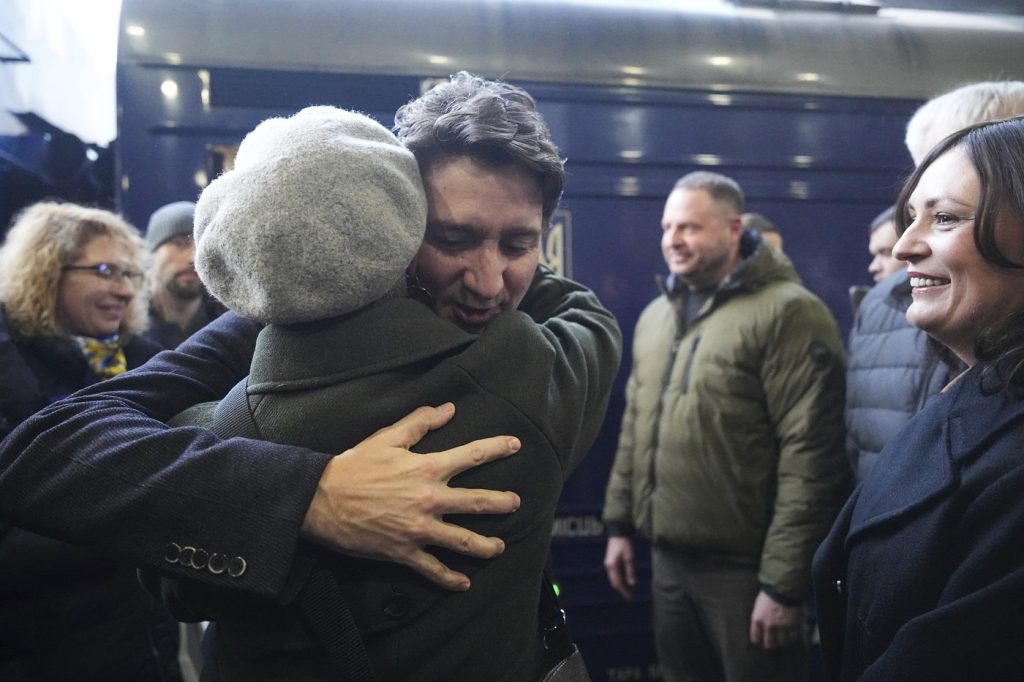
Speaking in Kyiv on Monday—the third anniversary of Russia’s full-scale invasion—Trudeau joined European leaders in reaffirming support for Ukraine and calling for a lasting peace agreement.
“We will work with our neighbors on it, but everything is on the table,” Trudeau said when asked whether Canadian troops could be deployed to Ukraine.
Pressed further, he clarified that Canada’s priority remains securing a ceasefire, and that any potential military involvement would be carefully considered.
“When we establish the way we’re going to keep a lasting peace … Canada will be involved, but we’re not at that position yet,” Trudeau added, emphasizing that sending troops is “something to take very, very seriously.”
Trudeau’s remarks come as Foreign Affairs Minister Mélanie Joly recently stated that Canada is interested in increasing its involvement in protecting Ukraine. The UK has already signaled its willingness to send troops to enforce a potential peace agreement.
During his visit, Trudeau announced additional support for Ukraine, including:
- $5 billion in aid, funded by revenue from frozen Russian assets.
- 25 additional light-armored vehicles.
- Two armored combat-support vehicles, with Ukrainian troops set to train in Germany on how to operate them.
- Four F-16 flight simulators, following Canada’s recent delivery of landing systems for the fighter jets.
Trudeau reaffirmed Canada’s commitment to training Ukrainian troops, stating that Russia “will not be allowed to end the world order that upheld sovereignty for many countries for decades.”
The meeting in Kyiv took place amid increasing tensions between the U.S. and its European allies. Many European leaders expressed frustration over Washington’s direct talks with Moscow—excluding Ukraine.
“We will have different perspectives from time to time on the best way forward,” Trudeau acknowledged. “But we are united in our values.”
Support for Ukraine remains strong among European nations, even as U.S. President Donald Trump has shifted his stance on the war. Trump has:
- Blamed Ukraine for starting the conflict.
- Questioned President Volodymyr Zelenskyy’s legitimacy.
- Indicated that a peace deal would not restore Ukraine’s 2014 borders or allow the country to join NATO.
Trump’s Defense Secretary Pete Hegseth has also suggested that the U.S. would not push for Ukraine to regain its occupied territories.
In contrast, Canada and European nations have consistently held Russia responsible for the war, insisting on Ukraine’s sovereignty and territorial integrity.
The possibility of foreign troops on the ground remains a contentious issue.
Lithuanian President Gitanas Nausėda questioned whether a ceasefire would be backed by “immediate and strong” retaliation if Russia violated it, asking whether forces would be engaging in peacekeeping or peace enforcement.
Meanwhile, Finnish President Alexander Stubb expressed frustration over the debate on “boots on the ground,” arguing that Europe should focus on air, naval, and intelligence support for Ukrainian forces instead.
European leaders also renewed calls for Ukraine to join NATO, a move that Canada has publicly supported.
This marks Trudeau’s fourth—and likely final—visit to Ukraine as prime minister, with his successor set to be chosen next month.
Canada has been one of Ukraine’s most vocal supporters, ranking fifth in overall aid contributions but only 20th in military support relative to population size, according to the Kiel Institute for the World Economy.
Trudeau, however, stressed the urgency of continued action.
“We can’t wait,” he said. “The moment to stop this war of aggression, the moment to defend democracy, the moment to stand for our shared values—is now. So let us seize it.”