

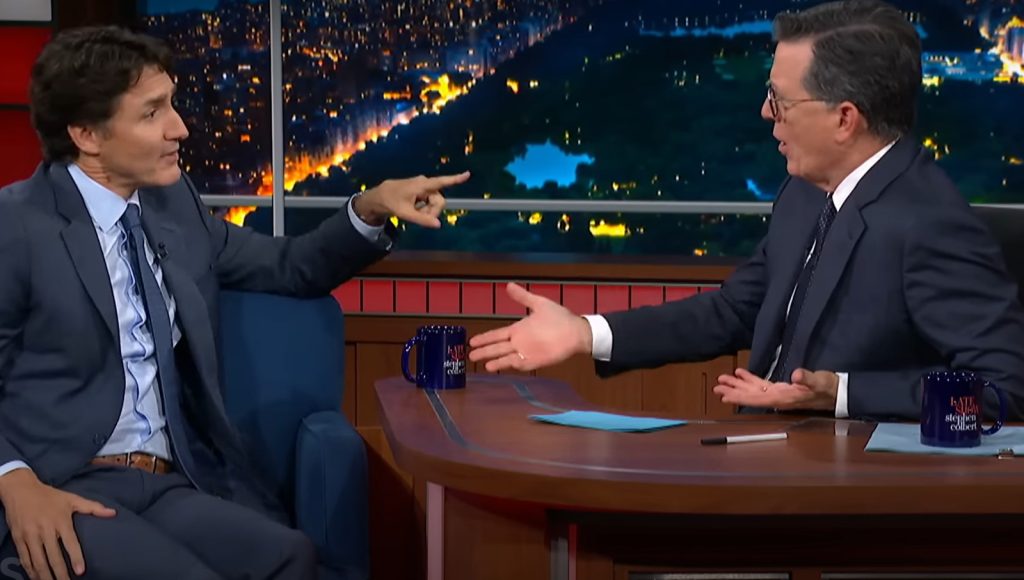
Prime Minister Justin Trudeau appeared on “The Late Show with Stephen Colbert” Monday night, where he discussed the challenges Canadians are currently facing. While the interview kicked off with light-hearted jokes about Canadian stereotypes, the conversation quickly turned serious as Trudeau acknowledged the country’s economic hardships.
“It’s a really tough time,” Trudeau admitted when asked about the looming confidence vote in Parliament. He highlighted the financial pressures many Canadians are experiencing, from skyrocketing grocery prices to unaffordable rent and gas. Speaking from New York, where he’s attending the United Nations General Assembly, Trudeau explained, “People are hurting. People are having trouble paying for groceries, paying for rent, filling up the tank.”
Trudeau pointed out that Canada’s housing crisis is more acute than in the U.S., despite the nation’s economy performing better on a macro scale. He added that the economic gains are not being felt by many Canadians at the checkout counter.
Despite the frustrations, Trudeau emphasized the importance of government investments in people. He touted key initiatives such as $10-a-day child care, dental care, and pharmacare—ensuring that essentials like diabetes medication and contraceptives are affordable or free.
With an expected vote of non-confidence in Parliament, Trudeau will return to Ottawa on Wednesday, ready to face political challenges head-on. The Conservatives have threatened to bring forward the motion against his minority government. Yet, Trudeau remains resolute, saying, “People are sometimes looking at change, but I deeply believe in continuing to fight climate change and invest in people… And I’m going to keep fighting.”
During the interview, Colbert touched on rising global trends toward fascism and xenophobia, even noting that Trudeau’s main political opponent has been called “Canada’s Trump.” When asked why such ideologies were gaining ground in a nation known for its politeness, Trudeau acknowledged that Canada isn’t immune to these issues but remained steadfast in his belief in universal health care and climate action.
Trudeau highlighted his government’s achievements, such as providing dental care to 700,000 Canadians, while pushing back against opposition claims that the program was ineffective. Conservative health critic Stephen Ellis recently criticized the initiative, arguing that most Canadians don’t qualify and that those who do may still have out-of-pocket expenses.
Colbert also broached trade disputes between Canada and the U.S., specifically the U.S. softwood lumber tariffs, which have driven up prices for American consumers. Trudeau responded humorously when Colbert quipped about Americans coming to Canada for cheaper medications: “We’re happy to try and help you out, but it would be really easier if you get universal health care,” he said to applause from the audience.
As the political landscape in Canada remains uncertain, Trudeau made it clear that he is ready to fight for the issues that matter to Canadians.