

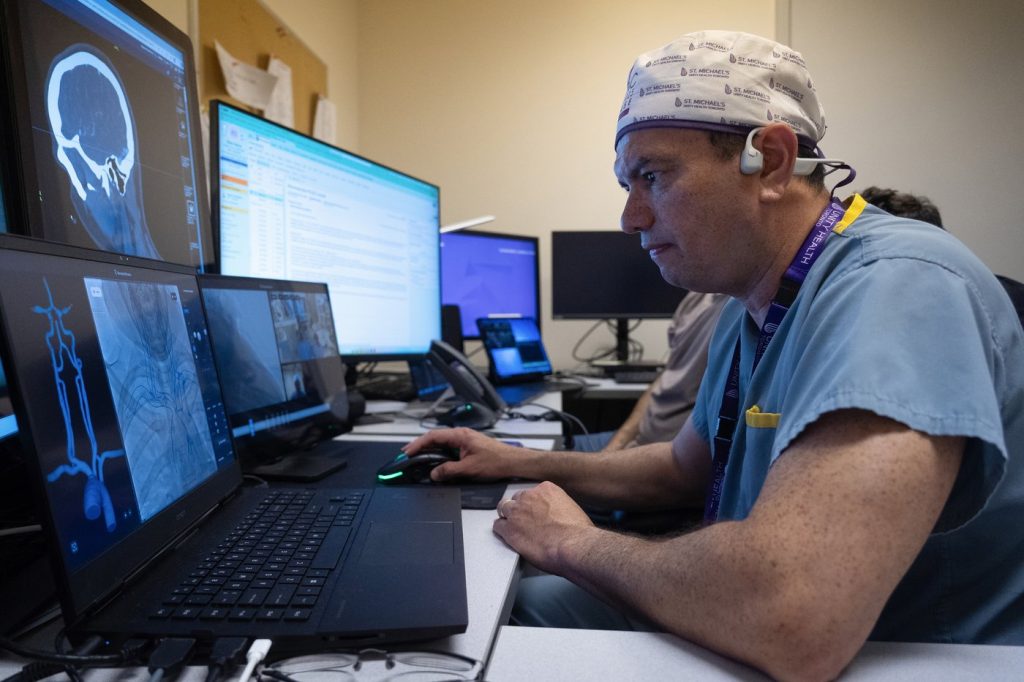
A medical team at St. Michael’s Hospital in Toronto has completed 10 brain angiograms using a robot operated remotely by a neurosurgeon — a world-first achievement that could soon transform stroke care in remote parts of Ontario.
A brain angiogram involves threading a catheter from the groin up into the brain to diagnose problems in blood vessels. Traditionally, surgeons stand beside the patient and manually guide the catheter. In this groundbreaking series, Dr. Vitor Mendes Pereira controlled the catheter from a computer connected to the robot through an ultra-fast fibre optic network. He began from across the operating room, then from another room, and eventually from St. Joseph’s Health Centre, six kilometres away.
Pereira said the remote procedures felt no different from being physically beside the patient. The next phase aims to put more than 600 kilometres between doctor and robot — the distance between Toronto and Sault Ste. Marie. St. Michael’s plans to apply to Health Canada for approval to begin a clinical trial using the technology to perform endovascular thrombectomies, the life-saving procedure where surgeons remove a blood clot from the brain during an acute stroke.
Currently, stroke patients in Sault Ste. Marie must be transported to Sudbury for this treatment, often facing delays of one to three hours or more. Air ambulances can also take time to arrive, and every minute lost increases long-term disability or risk of death. “Time is brain,” said Dr. Laura Stone, who oversees Sault Area Hospital’s emergency department.
With robotic technology on site, technologists in the Sault would set up the equipment and insert the catheter, while Pereira operates remotely from Toronto to remove the clot in real time. St. Michael’s research team, led by technologist Nicole Cancelliere, will train staff at the Sault hospital in preparation for this shift.
Dr. Michael Kutryk, who leads cardiology at Sault Area Hospital and works at St. Michael’s, said the potential impact is enormous — turning a situation where a patient might face paralysis or speech loss into one where they could walk out of the hospital just days later. Because the Sault sees only about a dozen thrombectomy cases a year, hiring a full-time specialist isn’t feasible, making robotic intervention a practical and potentially life-saving alternative.
Kutryk expects the first remote thrombectomies in the Sault could begin as early as late next year or early 2027. The main concern is maintaining a flawless internet connection, but the system includes rigorous testing and automatic backup networks. If anything disrupts the robot’s response, the procedure can be halted and traditional stroke protocols resumed.
Although Sault Ste. Marie is the first partner hospital, the research team believes this technology could soon benefit patients in remote communities across Canada and beyond. What sounds futuristic today, Kutryk said, will soon be routine.
The robot used in the procedures was created by Remedy Robotics, a San Francisco-based medical technology company specializing in cardiovascular tools.