

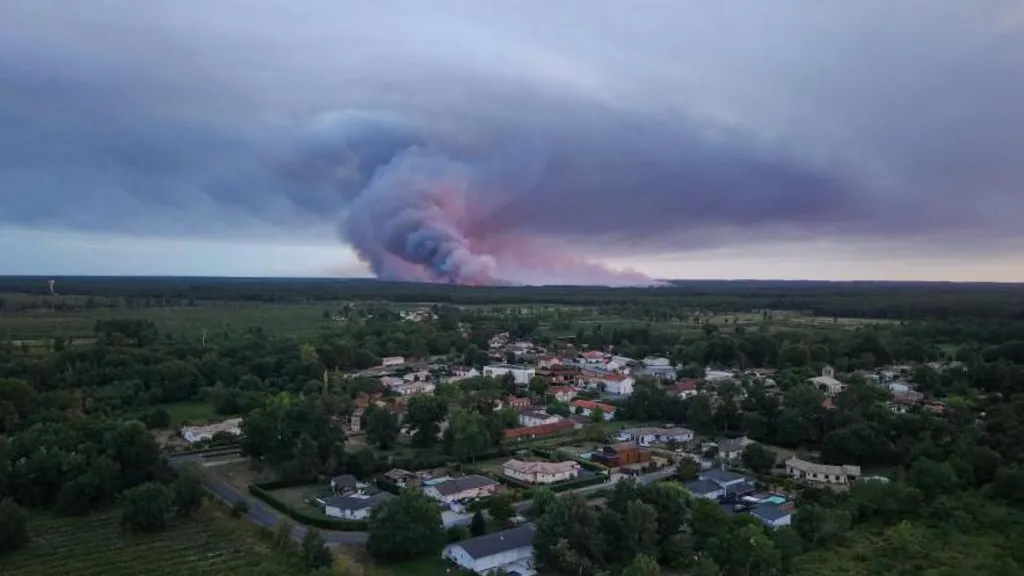
Bordeaux, France, July 27: As firefighters continue battling one of France’s most destructive wildfire outbreaks in recent years, scientists are drawing attention to a rare but dangerous weather phenomenon known as pyrocumulonimbus, or fire-generated thunderstorms, which can dramatically intensify wildfires and make them far more difficult to control.
The phenomenon has emerged during the massive wildfire burning in the Gironde region near Bordeaux, where tens of thousands of residents have been evacuated as flames continue to spread through forests already parched by prolonged heat and drought.
French fire authorities say the wildfire has generated an unprecedented pyrocumulonimbus cloud, marking what is believed to be the first documented occurrence of the phenomenon in France.
What is a Pyrocumulonimbus?
A pyrocumulonimbus cloud forms when an intense wildfire produces enormous amounts of heat, causing air above the flames to rise rapidly into the atmosphere.
The rising air carries smoke, ash and water vapour high into the sky. As the air cools, the water vapour condenses to form clouds.
If atmospheric conditions are unstable and the fire is sufficiently intense, the cloud can continue growing into a towering cumulonimbus—the same type of cloud that produces thunderstorms.
Unlike ordinary thunderstorms, however, these storm clouds are created by the wildfire itself.
Why Are They Dangerous?
Fire-generated thunderstorms can dramatically increase the intensity and unpredictability of a wildfire.
Powerful winds generated within the storm can scatter burning embers over long distances, igniting new fires well ahead of the main fire front.
The storm can also produce lightning strikes capable of sparking additional wildfires while rapidly changing wind patterns complicate firefighting efforts and place emergency crews at greater risk.
During Australia’s devastating 2019–2020 Black Summer bushfires, authorities reported that embers carried by similar firestorms ignited new fires as far as 30 kilometres (18 miles) ahead of the main blaze.
NASA famously described pyrocumulonimbus clouds as “the fire-breathing dragon of clouds” because of their ability to inject massive amounts of smoke into the upper atmosphere while generating lightning, strong winds and other severe weather.
France Faces Extreme Conditions
The current wildfire emergency follows weeks of record-breaking heat across much of Europe.
High temperatures, exceptionally dry vegetation and strong winds have created ideal conditions for rapidly spreading fires across France, Spain and parts of the United Kingdom.
Although firefighters reported that conditions around the Gironde wildfire stabilized overnight, officials warned that another heatwave expected later this week—with temperatures approaching 40°C (104°F)—could further complicate containment efforts.
Authorities believe the Gironde wildfire could continue burning for several weeks and may require months before it is fully extinguished.
A Growing Concern Linked to Climate Change
Scientists say pyrocumulonimbus events remain relatively uncommon but are becoming more likely as climate change contributes to hotter temperatures, prolonged droughts and more frequent extreme wildfire conditions.
Similar fire-generated thunderstorms were observed during major wildfires in California in 2021, where towering smoke clouds developed above large fires that burned more than one million hectares of land.
Researchers caution that as extreme heat events become more frequent, the conditions necessary for these self-generated firestorms may also become increasingly common.
Challenges for Firefighters
For emergency responders, pyrocumulonimbus clouds represent one of the most dangerous developments in wildfire behaviour.
Because the fires effectively create their own weather systems, conditions on the ground can change within minutes, making fire behaviour far less predictable than under normal circumstances.
Experts say understanding these rare atmospheric phenomena is becoming increasingly important as firefighters around the world confront larger, faster-moving and more intense wildfires driven by a combination of extreme weather and changing climate conditions.