

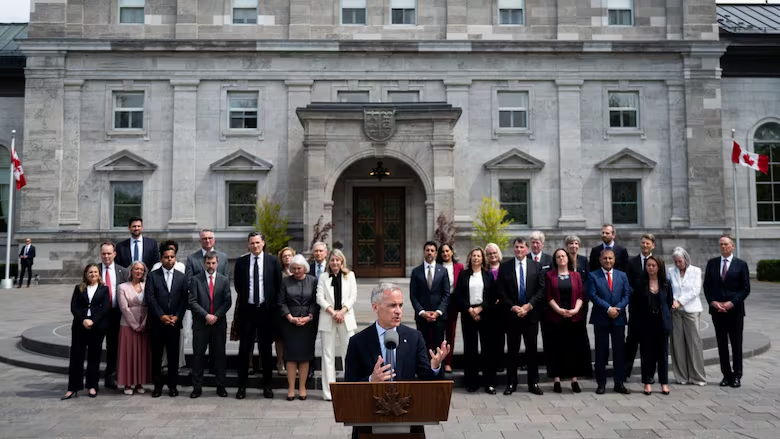
Prime Minister Mark Carney has revealed a major shake-up of the federal cabinet, bringing in 24 new ministers and secretaries of state — 13 of whom were elected just weeks ago — in a dramatic effort to mark a new era for the Liberal government and signal a break from the Justin Trudeau years.
Standing outside Rideau Hall in Ottawa following the swearing-in ceremony on Tuesday, Carney said the new cabinet reflects Canadians’ demand for fresh ideas and faster action on pressing economic and social challenges.
“This is a team built for a hinge moment in Canada’s history,” Carney told reporters. “We’re going to move quickly and decisively on affordability, housing, trade, and infrastructure. Half of this ministry is new — for me, that’s the perfect balance of experience and fresh energy.”
The new ministry includes 28 full ministers and 10 secretaries of state, a previously dormant junior minister designation Carney is reviving to increase cabinet agility and delegate decision-making authority more widely. Ministers will be empowered to lead within their portfolios without heavy oversight from the Prime Minister’s Office.
Among the most notable appointments are Tim Hodgson, a Bay Street executive and Carney ally from his Bank of Canada days, as Minister of Natural Resources and Energy; former Vancouver mayor Gregor Robertson as Housing Minister; and Mandy Gull-Masty, a former Cree Grand Chief from northern Quebec, as Indigenous Services Minister. Rebecca Alty, the former mayor of Yellowknife, becomes Minister of Crown-Indigenous Relations.
Shafqat Ali, MP for Brampton Centre, becomes President of the Treasury Board, and journalist-turned-politician Evan Solomon will serve as Minister of Artificial Intelligence — a newly created portfolio. Nova Scotia MP Lena Metlege Diab is the new Immigration Minister.
Veterans like François-Philippe Champagne (Finance and Revenue) and Dominic LeBlanc (Canada-U.S. and Intergovernmental Affairs) retain prominent roles, while others have been reassigned. Anita Anand becomes Foreign Affairs Minister, Sean Fraser takes over Justice, and Patty Hajdu moves to Employment. Chrystia Freeland, Trudeau’s former deputy, remains in cabinet as Transport and Internal Trade Minister.
Meanwhile, several high-profile Trudeau-era ministers, including Bill Blair, Jonathan Wilkinson, and Ginette Petitpas-Taylor, have been removed entirely. Carney has also sidelined some newer Trudeau appointees like Nathaniel Erskine-Smith, prompting backlash from within the caucus. Erskine-Smith posted on social media that it was “impossible not to feel disrespected” after being removed from cabinet just months after being appointed.
Carney’s cabinet also reflects a regional balancing act. While Ontario and Quebec dominate with 11 and 7 ministers respectively, only one minister — Eleanor Olszewski — represents Alberta, and Saskatchewan has no full ministers but is represented by Secretary of State Buckley Belanger. British Columbia and Nova Scotia each have two ministers.
In an effort to improve cabinet efficiency, Carney is also implementing a tiered structure. Secretaries of state, including Brampton’s Ruby Sahota (Crime Reduction) and B.C. MP Stephen Fuhr (Defence Procurement), will report to senior ministers and be invited to cabinet meetings on an as-needed basis.
The prime minister is under pressure to deliver, facing trade tensions with the U.S., affordability concerns at home, and a stalling housing market. Carney promised swift action on a middle-class tax cut by Canada Day, dismantling interprovincial trade barriers, boosting home construction, and launching infrastructure projects of “national significance.”
Conservative Leader Pierre Poilievre dismissed the cabinet as “more of the same” and criticized key appointments, saying former Vancouver mayor Gregor Robertson oversaw a housing affordability crisis and Sean Fraser was responsible for “uncontrolled population growth” as Immigration Minister.
Still, Poilievre hinted his party may support Liberal legislation on a case-by-case basis. “We’ll stand with him when he’s right and stand against him when he’s wrong,” he said.
Carney, who won the Liberal leadership and general election within a two-month span, is now betting on bold change — and a leaner, faster cabinet — to reboot the Liberal brand ahead of key legislative fights and a volatile global landscape.