

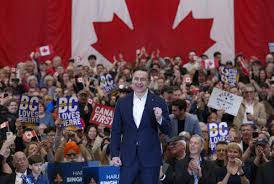
Conservative Leader Pierre Poilievre is drawing headline-grabbing crowds on the campaign trail — including an estimated 15,000 people at a rally in Edmonton this week. But while Poilievre points to these massive turnouts as proof of political momentum, experts say crowd size doesn’t necessarily translate to votes on election day.
At a news conference Tuesday, Poilievre once again highlighted the scale of his campaign events, calling them a “movement like we’ve never seen” and suggesting the numbers reflect Canadians’ hunger for change. “They want to put our country first for a change,” he told reporters.
However, political analysts and pollsters caution against reading too much into the crowds.
“Crowd sizes are not a good measure of political support,” said Nathaniel Rakich, former elections analyst with FiveThirtyEight. “Polls are scientific… crowd sizes are not.”
Despite the impressive visuals, polling continues to show the Liberals leading nationally, with a four- to six-point edge depending on the source. Poilievre’s rallies may generate media buzz and energize supporters, but analysts say those attendees make up a small fraction of the electorate.
“It’s the people that don’t attend rallies who end up deciding elections,” said Éric Grenier, poll analyst and founder of The Writ newsletter.
Grenier added that if every person who’s attended a Poilievre rally so far voted Conservative, they would still represent about 1% of the total Conservative vote. In contrast, swing voters, who often don’t show up at rallies, are the ones who ultimately shape the outcome at the ballot box.
Political history offers plenty of cautionary tales. In 2024, U.S. Vice President Kamala Harris drew crowds averaging over 13,000 people — nearly double that of Donald Trump — yet still lost the presidential election. In Canada, Pierre Trudeau famously filled Maple Leaf Gardens with 20,000 people in 1979, only to lose the election weeks later.
“It wouldn’t be unusual for the candidate with the bigger crowd sizes to lose,” Rakich said.
Poilievre’s rallies are undoubtedly a sign of organizational strength and a highly motivated base. But analysts argue that excitement doesn’t always equal expansion.
“These events show Pierre Poilievre can mobilize his core. But it’s unclear if that energy is reaching undecided or moderate voters,” said Grenier. “Rallies don’t reveal what the swing vote thinks.”
He added that Liberals may not be pursuing similar crowd sizes — either by choice or due to different campaign strategies — but their polling strength suggests their appeal remains strong across diverse voter blocks.