

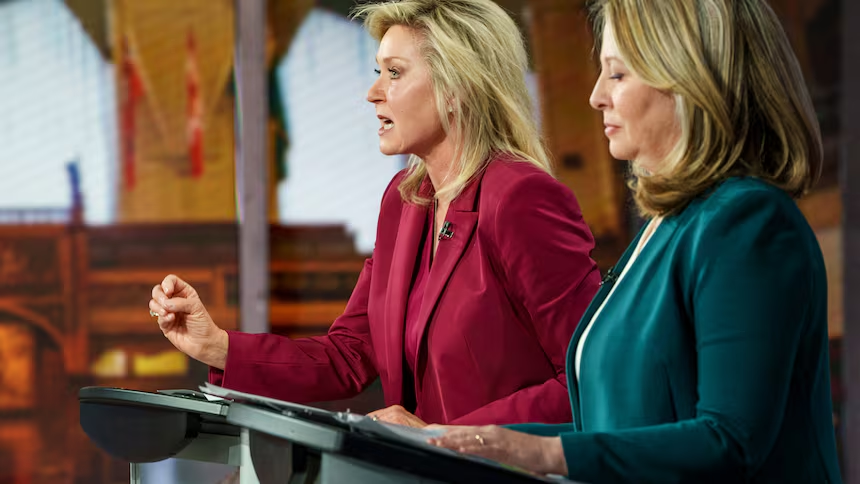
Ontario’s two main opposition parties are beginning a period of rebuilding after a difficult 2025, with the New Democrats working to regain momentum following a lukewarm leadership review and the Liberals preparing to select a new leader.
Both parties suffered setbacks after losing a snap provincial election to Premier Doug Ford and his Progressive Conservatives earlier this year. The fallout from that defeat has since played out through internal leadership reviews that exposed dissatisfaction among party members.
In September, delegates of the Ontario New Democratic Party delivered a tepid 68 per cent endorsement of Official Opposition Leader Marit Stiles. The result prompted Stiles to reshuffle her inner circle and reassess her approach. One week earlier, Ontario Liberal Party leader Bonnie Crombie announced she would step down after receiving just 57 per cent support in her own leadership review.
Stiles told CBC News she has since focused on reconnecting with voters across the province, including those who did not participate in the last election.
“My real concern is how we connect with the 55 per cent of Ontarians who didn’t vote,” she said, noting she has spent recent months travelling extensively outside traditional party circles.
Election losses still reverberating
Ford secured his third consecutive majority government in February, while both opposition parties struggled during the winter campaign. The Liberals finished second in the popular vote and gained four seats but remain third in overall seat count, and Crombie failed to win her own riding. The NDP retained enough seats to remain the Official Opposition, though its share of the popular vote declined from the previous election.
Stiles said her focus in the coming years will be holding the government accountable, particularly on rising unemployment.
“My job as opposition leader is to deliver more for the people of Ontario and to hold the government to account,” she said.
Liberals move toward a leadership contest
With Crombie’s departure, Liberal parliamentary leader John Fraser said the party is laying the groundwork for a leadership contest. A five-member committee is reviewing potential rules, timelines, and voting methods.
“It’s an important process,” Fraser said. “You want to make sure the race is fair and the rules are up to date.”
In December, former federal cabinet minister Karina Gould ruled herself out of the race, leaving uncertainty about who will step forward. Liberal strategist Charles Bird said he nevertheless expects the party to choose a new leader by the end of 2026.
Bird cautioned that whoever wins can expect an aggressive advertising campaign from the Progressive Conservatives, similar to what Crombie faced shortly after becoming leader in 2023.
“That might argue for moving sooner rather than later,” Bird said, “so a new leader has time to define themselves before others do it for them.”
Opportunity for the NDP
Political observers say the Liberals’ leadership search could create an opening for Stiles and the NDP. Former Liberal cabinet minister John Milloy said the Liberals must do serious introspection after three straight election losses.
“The party has to decide what it means to be an Ontario Liberal in 2026,” Milloy said, adding that rebuilding will require listening to members, experts, and voters well before the next election.
Trent University political science professor Cristine de Clercy said leadership contests often leave lingering divisions that new leaders must work to heal.
While the Liberals focus inward, NDP strategist Erin Morrison said Stiles has an opportunity to position her party as the main alternative to Ford’s government.
“The timing could not be better for Stiles,” Morrison said, adding that the leader appears to have taken the message from her party’s review seriously and adopted a more direct, unscripted style.
McMaster University political science professor Peter Graefe said the year ahead will test whether Stiles can overcome a long-standing perception challenge.
“For many voters who don’t closely follow Ontario politics, the Liberals are still seen as the default alternative,” Graefe said, despite the NDP having served as Official Opposition for much of the past decade.
As both parties regroup, the coming year is expected to shape not only their leadership but also their credibility with voters ahead of the next provincial election.