

Rescue teams in Nepal and Tibet are racing against time to find survivors after a catastrophic Himalayan flash flood killed hundreds of people and left more than 1,500 missing, while authorities warn that a newly formed lake upstream could unleash another dangerous wave of flooding.
Nepalese police said Friday that the death toll in the country had climbed to 469, up sharply from 390 a day earlier, as rescue workers continued recovering bodies from mud, collapsed buildings and debris. Chinese authorities have so far reported three deaths in Tibet, although the scale of destruction across the border region remains extensive.
The danger is not over. Nepalese and Chinese officials have warned communities downstream about a lake that formed following Wednesday’s disaster and has already begun overflowing. Residents in vulnerable areas have been advised to immediately move to higher and safer ground.
China’s Ministry of Water Resources estimates that the newly formed lake contains approximately two million cubic metres of water and could receive another three million cubic metres over the coming three days.
The lake’s natural barrier is located more than 10 kilometres from Gyirong Port, the key China-Nepal border crossing that was overwhelmed by mud and floodwaters. The lake sits at an elevation of roughly 2,950 metres, about 1,000 metres above the border facility, increasing concerns about the potential force of any sudden release of water.
The Nepal Army has deployed personnel to inspect the Bhotekoshi River and monitor the possibility of additional flooding.
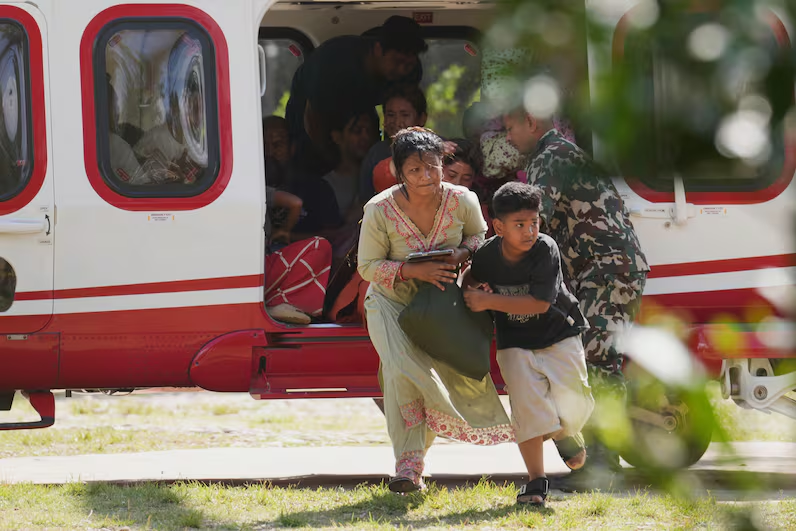
Thousands of people have already been evacuated from areas devastated by the disaster. Nepal’s National Disaster Risk Reduction and Management Authority says more than 3,250 people have been airlifted by helicopter, including injured survivors and residents stranded in isolated communities.
Foreign tourists, trekkers and religious pilgrims are among those still unaccounted for.
Global Affairs Canada says 30 Canadians and permanent residents are among the missing. Ten Toronto residents who were trekking in the affected region have also not been accounted for, according to a representative of the organization that arranged their trip.
The region attracts visitors from around the world because of its spectacular Himalayan landscape and its proximity to Mount Kailash in Tibet, considered sacred by Hindus, Buddhists and followers of several other religious traditions.
Nepalese military teams are also attempting to reach people believed to be trapped inside a tunnel at the Upper Trishuli-1 Hydropower Project near the Nepal-China border. Thick mud has covered much of the area, making it difficult for rescuers to identify the tunnel’s entrances and exits.
Images and video from the disaster zone show an extraordinary level of destruction. Powerful floodwaters swept away buildings, bridges and vehicles, leaving entire communities buried beneath thick layers of brown mud and broken concrete.
One survivor, customs officer Karbir Gaire, described the speed with which the disaster struck the village of Timure, near the Chinese border.
Gaire said he was working at his computer Wednesday morning when he felt the ground shake and suddenly saw what appeared to be a dark wall moving rapidly toward the community.
He and several others immediately ran from the building and climbed uphill. Within seconds, the flood swept through the area.
Gaire said the brief warning gave him enough time to escape, but 15 of his colleagues remain missing. He described the disaster as more like a tsunami than an ordinary flood.
Before the destruction, Timure was a busy community of more than 1,500 residents, with government offices, hotels, restaurants, banks, schools, shops and homes.
Families across several countries are now desperately waiting for information about relatives who were travelling or living in the region.
New York restaurant owner Rajan Tamang said his mother and sister were killed in the disaster, while other family members and friends remain missing. He said many residents had little or no warning before the flood reached their homes.
In India, Vishnuram Ramaswamy said he last spoke with his mother and two sisters as they travelled toward Mount Kailash on pilgrimage. They told him they were heading toward the border and would call after reaching their hotel. He has been unable to contact them since.
Indian officials and travel organizers are working to locate pilgrims who were in the region when the disaster occurred. Dozens of members of at least one pilgrimage group were reportedly caught in the flooding near the border immigration facilities.
Nepal’s tourism authorities estimate that more than 500 foreigners are among those still missing.
International assistance is beginning to arrive as the scale of the catastrophe becomes clearer. Rescue teams and emergency personnel from several countries are supporting Nepalese and Chinese authorities.
U.S. President Donald Trump described the destruction as terrible and said Washington had offered Nepal whatever assistance it required.
Scientists studying satellite images believe the disaster may have begun when bedrock beneath a glacier high in the Himalayan mountains collapsed, bringing part of the glacier down with it.
The combination of rock, ice and rapidly released meltwater is believed to have surged into rivers and valleys below, creating the enormous torrent that swept through settlements and infrastructure along the Nepal-China border.
With hundreds already confirmed dead and more than 1,500 people still missing, the disaster is shaping up to be one of the region’s deadliest natural catastrophes in recent years.
The immediate focus remains on finding survivors, but authorities are now facing a second emergency: preventing further loss of life if the newly formed mountain lake releases another massive volume of water into communities already devastated by the first flood.