

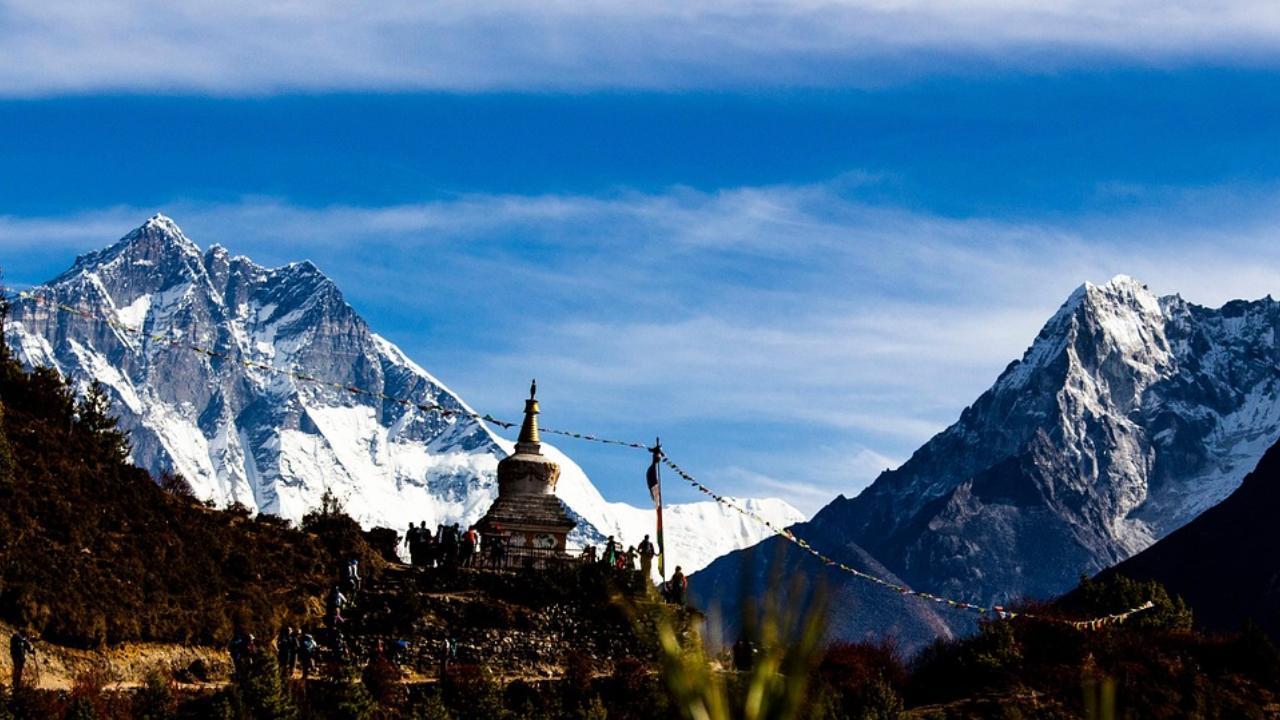
Mount Everest’s snow cover receded by 150 meters this winter, indicating a lack of significant snowfall and rising temperatures, researchers have found using NASA satellite images.
Glaciologist Mauri Pelto, a professor of environmental science at Nichols College, US, analyzed images from October 2023 to January 2025 and observed a steady rise in Everest’s snow line over the past two winters.
At 8,849 meters above sea level, Mount Everest is the world’s tallest peak, situated between Nepal and Tibet. The snow line refers to the elevation at which snow remains permanently. When the snow line rises, it signals warming temperatures, as snow melts at lower altitudes.
Pelto noted that warmer and drier winters—including those in 2021, 2023, 2024, and 2025—are responsible for the reduction in snow cover, higher snow lines, and increased glacial retreat.
While minor snowfall events occurred early in the winter, the snow did not persist, suggesting that glaciers above 6,000 meters on Everest continue to shrink.
Pelto explained that snow loss at high altitudes is mainly due to sublimation—a process where ice directly evaporates into the atmosphere. Sublimation has been observed to cause snow loss of up to 2.5 millimeters per day, significantly impacting glacial mass balance.
In December 2024, Nepal experienced 20-25% of its usual winter precipitation, with drier conditions particularly affecting Koshi Province. Above-average temperatures led to extreme droughts, further accelerating glacial retreat.
By January 28, 2025, the average snow line on Everest had reached 6,100 meters, 150 meters higher than its position on December 11, 2024.
Pelto compared this winter to previous seasons, noting that while the high snow lines of 2020-21 resulted from an extraordinary January heatwave, the 2023-2024 winter saw consistently high temperatures and minimal snowfall, leading to a similar outcome.
With less than 25 millimeters of precipitation recorded at Everest Base Camp between January and March 2024, researchers warn that continued warming and low snowfall could accelerate glacial retreat in the Himalayas.