

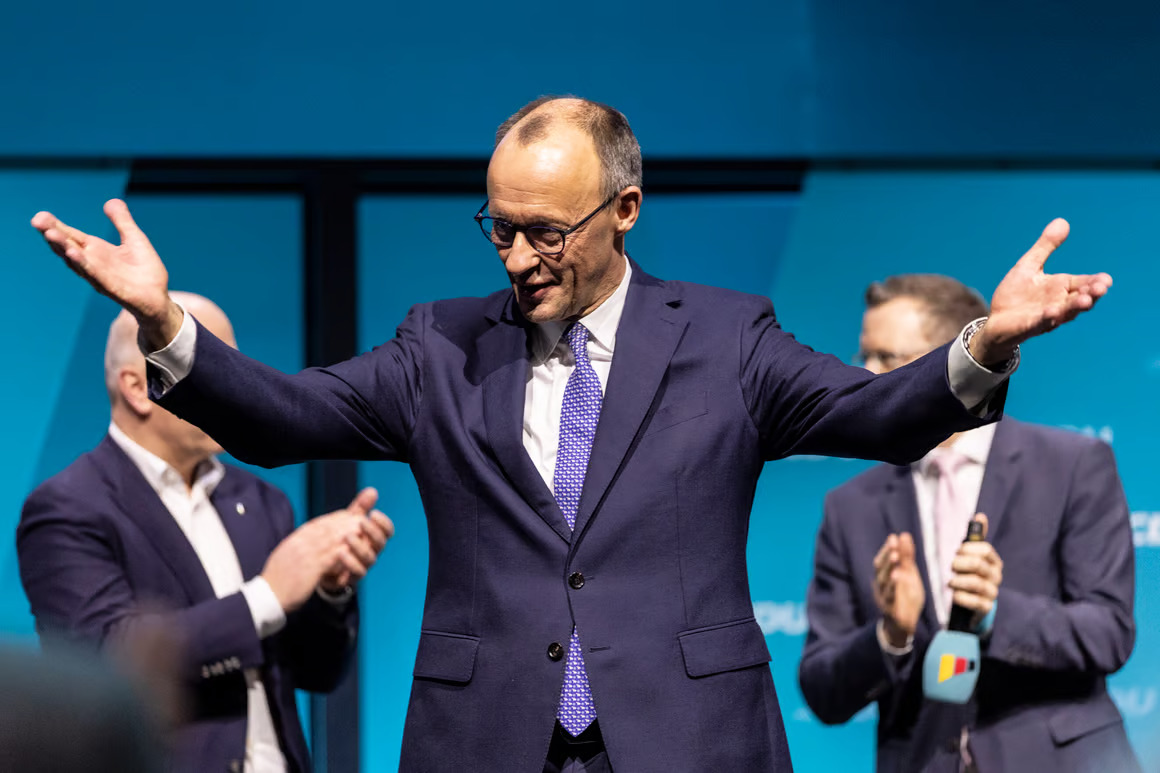
AfD’s record-breaking result sends shockwaves across Europe, while coalition talks loom for conservatives.
Friedrich Merz’s conservative alliance has won Germany’s national parliamentary election, while the far-right Alternative for Germany (AfD) secured its best-ever result in a postwar national vote.
Merz’s Christian Democratic Union (CDU) and its Bavarian sister party, the Christian Social Union (CSU), are projected to lead with 29 percent of the vote, according to early results. Declaring victory in Berlin shortly after projections were released, Merz emphasized the urgency of forming a government.
“The world won’t wait for us,” he told party supporters. “Germany must be governed reliably again.”
Meanwhile, the far-right AfD made history by finishing second with 20.2 percent, nearly doubling its 2021 result. The party’s co-leader and chancellor candidate, Alice Weidel, called it an “historic success” and vowed to pressure mainstream parties into adopting more hardline policies.
Despite the AfD’s strong showing, Merz has ruled out any coalition with the party.
The final election outcome hinges on the fate of smaller parties, which could determine how easily Merz can form a coalition.
- The Left party (8.5%) is set to enter the Bundestag.
- The Free Democrats (FDP) are at 4.9%, making their entry uncertain.
- The populist-left Sahra Wagenknecht Alliance (BSW) stands at 4.8%, just below the threshold.
If two or more of these smaller parties clear the 5% hurdle, coalition talks could become far more complex for Merz. If not, he may have an easier path to forming a two-party government.
The election marks a major shake-up in Germany’s postwar politics. The center-left Social Democratic Party (SPD) of Chancellor Olaf Scholz suffered a historic defeat, sinking to just 16 percent—the worst result in its modern history.
“This is a bad election result, and I take responsibility,” Scholz said. He also warned against normalizing the AfD’s success: “We must never accept an extreme right-wing party gaining such results.”
The Greens, Scholz’s coalition partner, came in fourth with 13.3 percent.
Merz, a longtime rival of former Chancellor Angela Merkel, is set to become Germany’s first center-right leader since Merkel stepped down in 2021. His leadership comes at a critical moment, as the European Union faces geopolitical uncertainty, the resurgence of far-right movements, and shifting U.S. foreign policy under Donald Trump.
With the AfD poised to become the main opposition force and coalition talks ahead, Germany’s political future remains uncertain.