

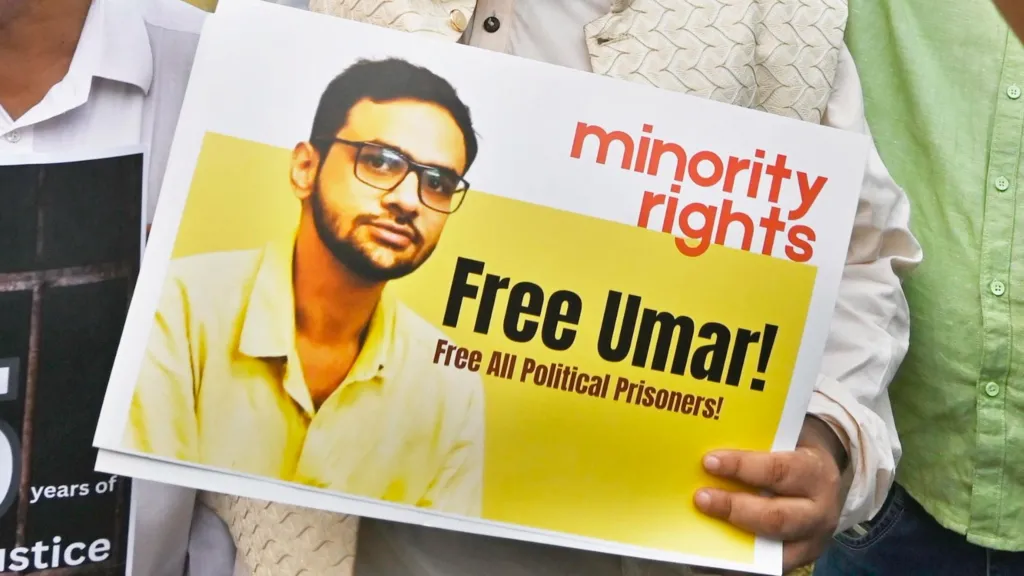
Two prominent Indian student activists have been denied bail by the Supreme Court after spending more than five years in prison without their trial beginning, a decision that has renewed domestic and international scrutiny of India’s pre-trial detention practices.
On Monday, the Supreme Court of India rejected bail pleas filed by Umar Khalid and **Sharjeel Imam the 2020 Delhi riots.
The two men were accused by police of conspiring to incite the violence that left 53 people dead, most of them Muslims. Both have denied the allegations and have consistently maintained their innocence. They were charged under India’s Unlawful Activities (Prevention) Act (UAPA), a stringent anti-terror law under which bail is difficult to obtain and lengthy pre-trial detention is common.
In its order, a two-judge bench said the bail petitions of the seven accused before the court could not be considered collectively, as they were not on “equal footing as regards culpability,” according to legal news outlet Bar and Bench. The judges said the charges against Khalid and Imam were distinct from those faced by the other accused and warranted separate consideration.
While denying bail to Khalid and Imam, the court granted bail to five other activists arrested in the same case: Gulfisha Fatima, Meeran Haider, Mohd Saleem Khan, Shadab Ahmed and Shifa ur Rehman. The court also ruled that Khalid and Imam may apply for bail again only after one year.
The riots occurred amid months-long protests against India’s Citizenship Amendment Act, legislation that the United Nations has described as “fundamentally discriminatory.”
Khalid, 37, completed his PhD at Jawaharlal Nehru University in 2019. Imam, also 37, was a doctoral scholar at the same university at the time of his arrest. Khalid’s bail applications have been rejected at least five times over the past five years, though he was granted temporary release on two occasions to attend family weddings in 2024 and 2025. Imam’s bail pleas have been rejected at least twice previously.
The prolonged detention of the activists has drawn widespread attention in India and abroad. In 2022, a report by a former Supreme Court judge, three retired high court judges and a former federal home secretary said there was no substantiated evidence to justify invoking terrorism charges against the activists.
More recently, a group of U.S. lawmakers wrote to India’s ambassador in Washington expressing “continued concern” over what they described as the activists’ prolonged pre-trial detention.
The activists approached the Supreme Court in September 2025 after the Delhi High Court refused them bail. In their submissions, they argued that spending more than five years in custody without trial amounted to “punishment without trial,” a claim that continues to fuel debate over the use of anti-terror laws and the pace of justice in high-profile cases.