

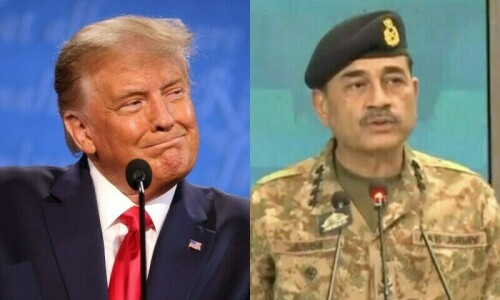
In an unprecedented move, U.S. President Donald Trump hosted Pakistan’s Chief of Army Staff, Field Marshal Syed Asim Munir, at the White House on Wednesday, marking the first time a serving Pakistani army chief—without holding political office or ruling under martial law—was formally received by a sitting American president.
The high-level meeting took place in the Cabinet Room over lunch and later continued into the Oval Office, lasting over two hours—well beyond the one-hour slot initially planned. According to a statement by Pakistan’s military media wing, ISPR, the extended discussions reflected the “depth and cordiality” of the exchange.
Also present were U.S. Secretary of State Senator Marco Rubio and Special Representative for Middle Eastern Affairs Steve Witkoff. From Pakistan’s side, National Security Advisor Lt Gen Muhammad Asim Malik, who also serves as the country’s intelligence chief, accompanied Field Marshal Munir.
The two leaders focused heavily on strengthening joint counterterrorism efforts, with President Trump praising Pakistan’s ongoing contributions to regional peace and security. Both sides reaffirmed their commitment to deepening cooperation in defense and counterterrorism.
Beyond security, the talks explored ambitious avenues for expanding bilateral trade and collaboration in sectors such as economic development, artificial intelligence, energy, cryptocurrency, and emerging technologies. Trump expressed keen interest in forging a “long-term strategic partnership” with Pakistan built on shared interests and mutual benefit.
Field Marshal Munir also extended a formal invitation to President Trump on behalf of Pakistan’s government for an official visit, signaling the growing warmth in bilateral relations.
The conversation turned personal when Trump acknowledged Munir’s role in preventing an escalation between Pakistan and India during a recent regional standoff. “I wanted to thank him personally for not going to war,” Trump told reporters. He also commended Indian Prime Minister Narendra Modi, stating, “We’re working on a trade deal with both India and Pakistan. These two very smart people decided not to push a conflict that could have been nuclear.”
Trump hinted that Pakistan’s familiarity with Iran might be key in navigating current tensions in the Middle East. “They know Iran very well… and they’re not happy about anything,” he said, adding that Pakistan is not hostile to Israel either.
The meeting drew praise back in Pakistan. Defence Minister Khawaja Asif called it a “milestone” in U.S.-Pakistan relations and credited the hybrid civil-military leadership of Prime Minister Shehbaz Sharif and Field Marshal Munir for the diplomatic breakthrough. “This is the most important turning point in the 78-year history of relations,” Asif posted on social media.
Trump, meanwhile, appeared to bask in the moment, stating he was “honoured” by the visit. White House spokeswoman Anna Kelly later confirmed that Trump had received Munir after being nominated by Pakistani officials for the Nobel Peace Prize for his role in de-escalating India-Pakistan tensions.
Though the visit was not arranged through traditional diplomatic channels, sources in Washington said months of behind-the-scenes efforts by businessmen, Republican-linked lobbying firms, and advisers with crypto and tech interests helped pave the way.
Diplomats noted that this marks a departure from past norms. While previous Pakistani military rulers like Ayub Khan, Ziaul Haq, and Pervez Musharraf met U.S. presidents after taking over their country’s leadership, Munir’s face-to-face with Trump as a serving army chief is historic.
Analysts say the meeting could signal a realignment of U.S. regional strategy and Pakistan’s role in it — one that extends beyond traditional security matters into emerging economic and technological domains.