

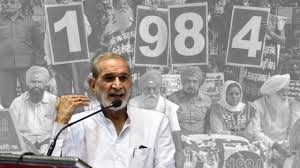
Justice After 40 Years: Sajjan Kumar Convicted in 1984 Anti-Sikh Riots Case
In a landmark ruling, Delhi’s Rouse Avenue Court on Wednesday, February 12, 2025, convicted former Congress MP Sajjan Kumar in connection with the 1984 anti-Sikh riots, delivering long-awaited justice to the victims’ families after four decades.
The conviction relates to the murder of a Sikh father-son duo in Saraswati Vihar on November 1, 1984, during the violent aftermath of Prime Minister Indira Gandhi’s assassination. The court held Kumar directly responsible for inciting and leading a mob, reinforcing previous allegations of his active role in orchestrating attacks on Sikhs.
“He was not only a participant but had also led the mob,” the court stated in its judgment.
The 1984 anti-Sikh riots remain one of the most harrowing events in India’s history, with thousands of Sikhs brutally killed in targeted mob violence, looting, and arson. Following Indira Gandhi’s assassination by her Sikh bodyguards, riots erupted across Delhi and other parts of India, leaving Sikh homes and businesses destroyed.
According to court records, Sajjan Kumar not only encouraged but actively led violent groups that targeted Sikh communities, a charge that the Special Investigation Team (SIT) on 1984 riot cases had pursued rigorously in recent years.
The conviction was welcomed by Sikh organizations and human rights activists, many of whom have fought tirelessly for decades to bring those responsible to justice.
Jagdip Singh Kahlon, General Secretary of the Delhi Sikh Gurudwara Management Committee (DSGMC), hailed the ruling as a long-overdue step toward accountability.
“Sajjan Kumar, who led the Sikh massacre 40 years ago, has been convicted, and justice is finally being served. I thank the court, as well as Prime Minister Narendra Modi and Home Minister Amit Shah, for forming the SIT that reopened these cases. We remain hopeful for justice in the Jagdish Tytler case as well,” Kahlon stated.
While the conviction of Kumar is being seen as a significant step toward justice, Sikh leaders and victim advocacy groups continue to demand accountability for other politicians and officials allegedly involved in the 1984 violence.
Kumar’s legal team, led by advocate Anil Sharma, argued that his name had not surfaced in the initial police investigation and that witness testimony implicating him was influenced over time.
However, Additional Public Prosecutor Manish Rawat countered this by stating that the key witness was initially unaware of Kumar’s identity but later identified him, leading to fresh evidence being presented in court.
Senior advocate H.S. Phoolka, who has long championed justice for the 1984 riot victims, highlighted the failure of early investigations and reiterated that the violence was not spontaneous but a coordinated attack on Sikhs.
The 1984 riots resulted in the deaths of approximately 2,700 Sikhs in Delhi alone, with thousands more affected across India. Despite multiple commissions and inquiries, convictions of high-profile politicians and leaders accused of instigating the violence have been slow and inconsistent.
Sajjan Kumar’s political career, which began in 1977, was overshadowed by persistent allegations of his role in the riots. He was previously convicted and sentenced to life imprisonment in 2018 in another case related to the riots.
This latest conviction is a major victory for victims’ families who have spent decades seeking justice, but for many, it is only one step in a larger fight to hold all those responsible accountable.