

As Ontario heads into an early election set for February 27, 2025, a new Nanos survey commissioned by CTV News reveals that health care is the top issue for voters, surpassing economic concerns and even Premier Doug Ford’s decision to call the election over U.S. President Donald Trump’s proposed tariffs.
According to the poll, 28.1% of Ontarians cite health care as their most important election issue, followed by economic policies at 21.5%. Concerns about Trump’s tariffs rank third, influencing 14.2% of voters.
Despite having a majority government, Ford called an early election, arguing that a fresh mandate is needed to address the potential economic fallout from Trump’s proposed 25% tariff on Canadian goods. That tariff, originally set for February 4, was postponed for a month following an eleventh-hour meeting between Trump and Prime Minister Justin Trudeau.
With health care emerging as the dominant concern for Ontario voters, all major parties have outlined their plans to tackle the crisis in primary care access. The Progressive Conservatives (PCs), Liberals, NDP, and Greens have all pledged to increase access to family doctors, following recent reports that 2.5 million Ontarians are without a family physician—a number expected to rise to 4 million within a year.
Just as the election campaign began, the Ontario Medical Association (OMA) issued an open letter to party leaders, urging them to prioritize health care reforms.
“Our healthcare system is in crisis,” the OMA wrote. “Let’s ensure that whether you live in northern and rural Ontario or in an urban centre, everyone in this province has access to physician care.”
In response, the Ford government unveiled a plan to connect every Ontarian with a primary care provider, just two days before the election was called.
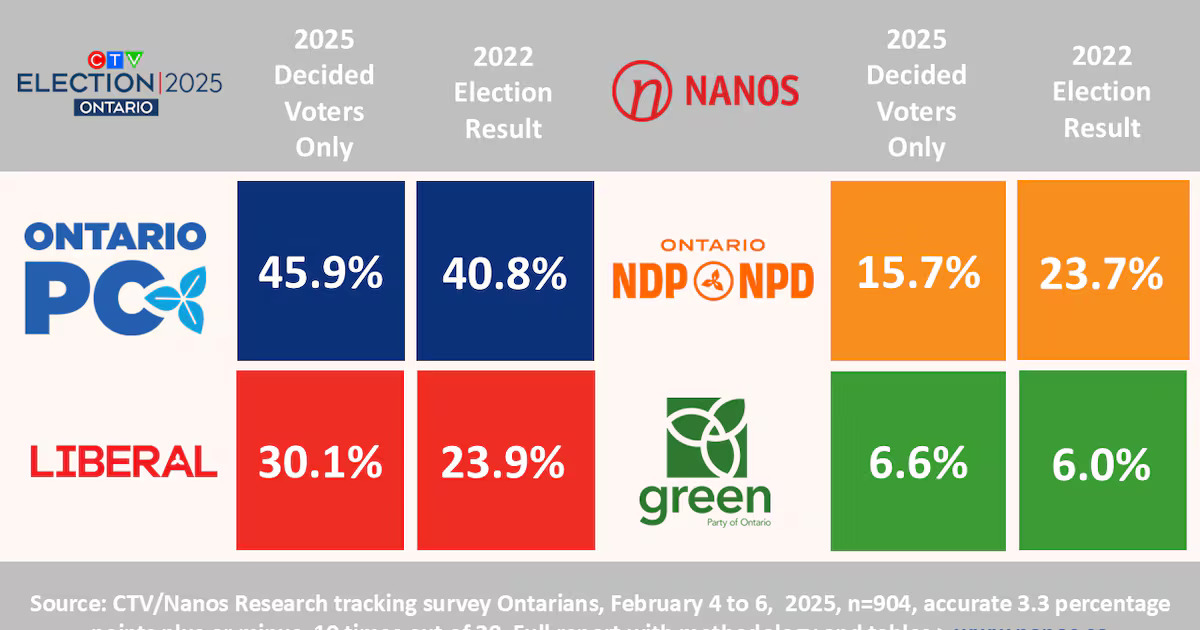
While the PCs continue to lead in the polls, the Ontario NDP is the only party to gain support over the past two days, increasing from 15.7% to 19.9%.
- The PCs hold 44.1% support, maintaining a 16-point lead over the Liberals.
- The Liberals sit at 28.1%, with leader Bonnie Crombie losing two percentage points overnight.
- The NDP is now at 19.9%, gaining traction following their pledge to introduce a monthly tax-free grocery rebate for lower- and middle-income families.
- The Greens remain at 3.2% support.
The PCs have lost ground in Toronto, where their support fell from 39.9% to 34.6% overnight. Meanwhile, the Liberals gained support in the city at 32.6%, while the NDP rose to 28.9%.
Across the broader Greater Toronto Area (GTA), Ford’s PCs continue to dominate with 50.3% support, compared to the 30.7% for the Liberals.
Ford remains the preferred choice for premier, holding steady at 38.2% support, followed by:
- Bonnie Crombie (24.8%)
- Marit Stiles (15.6%)
- Mike Schreiner (5%)
With health care dominating the election discourse, all parties will be expected to present detailed plans to address the physician shortage and improve access to care. As the campaign heats up, voters will be weighing party commitments on affordability, economic recovery, and Ontario’s trade relationship with the U.S..
The Nanos survey was conducted between February 6 and 8, polling 904 Ontarians. It carries a margin of error of ±3.3 percentage points, 19 times out of 20.
For more details on the election campaign and voter priorities, visit Elections Ontario.