

Several European leaders moved swiftly Tuesday to push back against U.S. President Donald Trump’s comments suggesting the United States should take control of Greenland, reaffirming that the strategically important Arctic territory “belongs to its people.”
In a joint statement, leaders from France, Germany, Italy, Poland, Spain and the United Kingdom joined Danish Prime Minister Mette Frederiksen in defending Greenland’s sovereignty. Greenland is a self-governing territory within the Kingdom of Denmark and part of the NATO alliance.
“Greenland belongs to its people,” the statement said. “It is for Denmark and Greenland, and them only, to decide on matters concerning Denmark and Greenland.”
The response followed renewed remarks by Trump arguing that U.S. control of Greenland is necessary to ensure security in the Arctic amid what he described as growing Russian and Chinese activity in the region.
“It’s so strategic right now,” Trump told reporters Sunday. “We need Greenland from the standpoint of national security, and Denmark is not going to be able to do it.”
White House deputy chief of staff Stephen Miller echoed that view Monday, saying the president believes Greenland should be part of the United States’ broader security framework. Speaking to CNN, Miller questioned Denmark’s authority over the territory but said there was no need to consider the issue in the context of military intervention.
“Nobody is going to fight the U.S. militarily over the future of Greenland,” Miller said.
Frederiksen sharply rejected the premise, warning that any U.S. attempt to seize Greenland would amount to an attack on a NATO ally.
“If the United States chooses to attack another NATO country militarily, then everything stops,” she told Danish broadcaster TV2. “That includes NATO and the security framework that has existed since the end of the Second World War.”
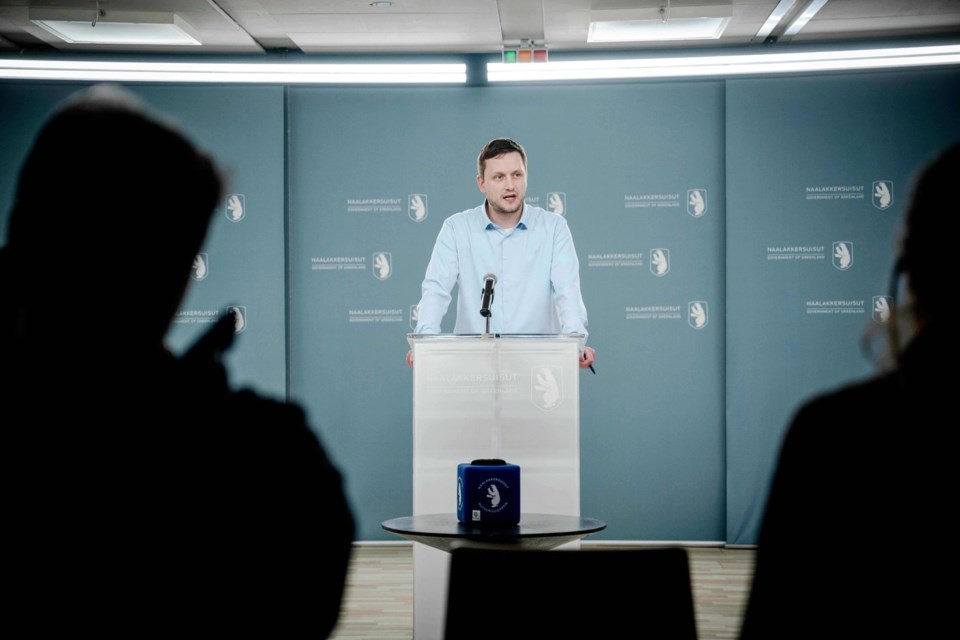
Greenland Prime Minister Jens-Frederik Nielsen sought to lower tensions while firmly rejecting the idea of a takeover.
“We are not in a situation where we think there might be a takeover of the country overnight,” Nielsen said, emphasizing Greenland’s desire for continued cooperation with the United States.
Greenland has long held strategic importance due to its location in the Arctic, where more than two-thirds of its territory lies within the Arctic Circle. The U.S. Department of Defense operates the Pituffik Space Base in northwestern Greenland under a 1951 defence agreement with Denmark, supporting missile warning, missile defence and space surveillance for the U.S. and NATO.
The island also plays a key role in monitoring the GIUK Gap—Greenland, Iceland and the United Kingdom—a critical chokepoint for tracking Russian naval movements in the North Atlantic.
In addition to its military significance, Greenland is rich in natural resources, including rare earth minerals vital to modern technologies and renewable energy systems. The U.S. Geological Survey has also identified potential offshore oil and natural gas deposits.
Tensions intensified after a weekend social media post by Katie Miller, wife of the White House deputy chief of staff, featuring a stylized map of Greenland in U.S. flag colours with the caption “SOON.” Trump’s subsequent comment that “we’ll talk about Greenland in 20 days” heightened concern in Denmark and across Europe.
U.S. lawmakers from both parties urged restraint. Representatives Steny H. Hoyer and Blake Moore, co-chairs of the Congressional Friends of Denmark Caucus, warned that talk of annexation was “needlessly dangerous.”
“An attack on Greenland — a crucial part of that alliance — would tragically be an attack on NATO,” they said, noting Denmark has already allowed the U.S. broad access for defence operations on the island.
Security analysts in Denmark have also questioned Trump’s claims about the scale of Russian and Chinese activity in the region, warning that inflammatory rhetoric risks destabilizing relations among NATO allies.