

On any given day, a purple-marked box truck cruises between Toronto and Brampton with no one at the wheel — a sight that signals a technological leap on Canadian roads.
The vehicle, owned by California-based Gatik Inc., is packed with over two dozen sensors, including cameras, radar, and lidar systems that allow it to navigate city streets autonomously. It delivers groceries from a Loblaw warehouse in Etobicoke to the company’s headquarters 25 kilometers away — all without human intervention, although a safety driver remains on board for now.
Gatik has been quietly expanding its footprint in Canada since 2020, when it first deployed a self-driving truck for Loblaw. Five of its six Isuzu box trucks in Ontario now operate daily, moving goods along fixed GTA routes. The company’s growing presence reflects a broader trend: Canada is quickly becoming a key player in the race to commercialize autonomous trucking.
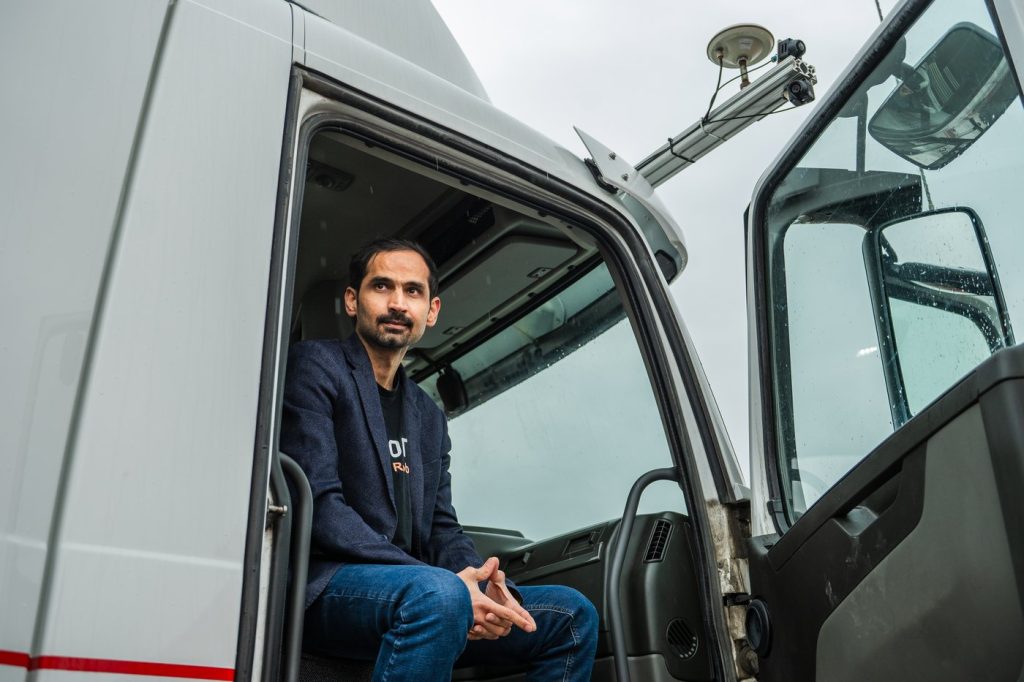
Across the country, homegrown companies are also making strides. Toronto-based NuPort Robotics is collaborating with Canadian Tire to test autonomous trucks inside a distribution hub north of the city. NuPort’s trucks, which operate like cargo taxis, are currently confined to private property but are expected to move onto public roads within a few years.
Meanwhile, Toronto’s Waabi Innovation Inc. is racing toward a bold milestone — launching the first fully driverless long-haul truck in Texas by year’s end. Founded by computer science professor Raquel Urtasun, Waabi runs a dozen trucks between Dallas and Houston for Uber Freight. The company is backed by a powerful roster of partners including Uber, Nvidia, Volvo, and Porsche, and has raised $375 million to develop its cutting-edge AI driving system.
These vehicles are more than just high-tech novelties. Proponents say autonomous trucks could help solve the trucking industry’s deepening driver shortage — projected to hit 40,000 vacancies per year in Canada by 2030 — while offering up to 20 percent in fuel savings. And with the U.S. road freight market worth nearly a trillion dollars annually, the potential economic windfall is enormous.
Ontario is currently the only province allowing autonomous vehicle testing, including trucks without a driver on board, under a special pilot program. Still, widespread rollout faces familiar roadblocks: snowy weather, visual sensor challenges, and a slow-moving regulatory landscape.
Critics raise safety concerns, especially in tricky conditions like snow, fog, and steep terrain. Though robotic trucks don’t get tired or distracted, they can still make costly errors. In 2022, a TuSimple autonomous truck made an abrupt left turn on an Arizona highway and struck a barrier. While no one was hurt, the incident exposed the delicate balance between human oversight and software reliability.
Studies have found that autonomous vehicles generally crash less often than those driven by humans, but they perform worse during low-light situations and left turns. Some systems also struggle to detect pedestrians, especially children or those with darker skin tones — raising serious questions about their real-world readiness.
Still, Urtasun remains confident in Waabi’s approach. Her company uses an advanced generative AI model, which she dubs “AV 2.0.” Instead of relying solely on real-world miles, Waabi’s algorithms simulate endless driving scenarios, allowing the system to “reason” through problems and choose the safest action within a split second — similar to how ChatGPT revolutionized language learning.
Yet even advocates concede that perfect safety isn’t realistic. “We can’t defy the laws of physics,” said Gatik’s Rich Steiner. “If a dog jumps out in front of a truck going 45 miles per hour, there’s only so much you can do.”
And with Canada’s notoriously cautious regulatory pace, full commercial deployment could still be years away. “Canada doesn’t move very fast when it comes to regulation,” Urtasun said. “But self-driving trucks aren’t a question of if — only when.”
For her, autonomous driving isn’t just a profession. “It’s an obsession,” she said. “It’s in my head 24-7.”