

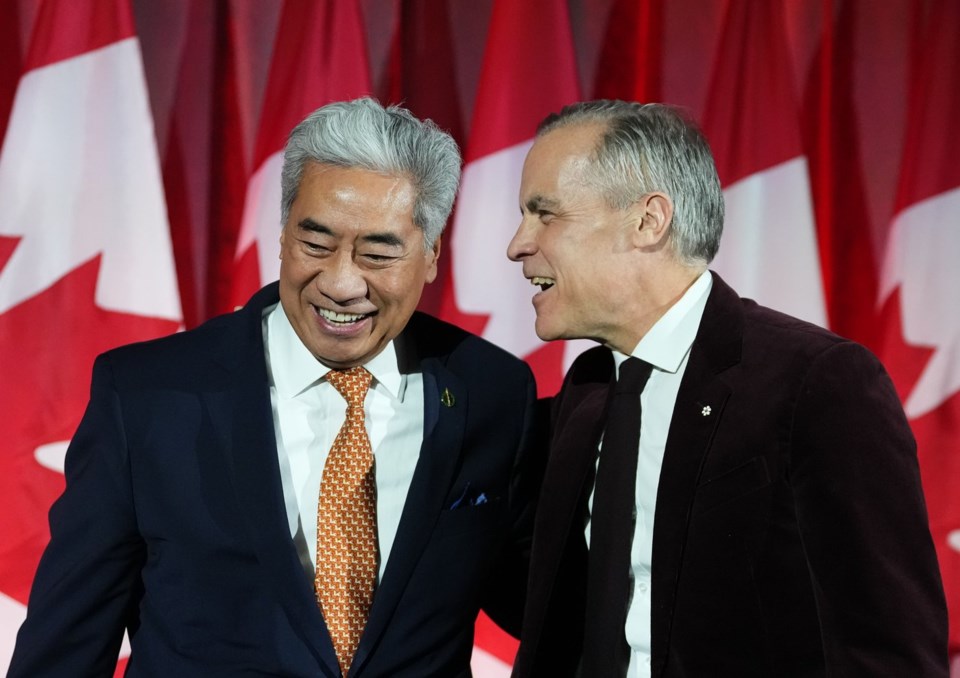
OTTAWA — Michael Ma became the second Conservative MP in as many months to cross the floor to the Liberal caucus on Thursday, a move that brought Prime Minister Mark Carney’s minority government to within one seat of a majority and reignited debate over a long-standing and controversial parliamentary tradition.
Ma’s decision follows the surprise defection of Nova Scotia MP Chris d’Entremont in early November and has once again put the spotlight on floor-crossing — the practice of MPs switching party allegiance between elections. While it often draws sharp criticism from voters and rival parties, the practice is far from new. More than 300 members of Parliament have changed political affiliation while in office since Confederation in 1867.
The first recorded instance dates back to 1868, when Nova Scotia MP Stewart Campbell left the Anti-Confederates to join the Liberal-Conservatives under Sir John A. Macdonald. According to the Dictionary of Canadian Biography, Campbell’s decision was so unpopular that he was later pelted with eggs at a social event.
Data from the Library of Parliament shows that in just the past 25 years, 80 MPs have crossed the floor. Such moves often follow leadership changes or major realignments within parties. In 2000, Quebec MPs David Price and Diane St-Jacques left the Progressive Conservatives to join the Liberals shortly after Joe Clark returned to Parliament as PC leader, citing concerns their seats could otherwise fall to the Bloc Québécois. That same month, André Harvey, a former Progressive Conservative who had been sitting as an Independent, also joined the Liberals.
One of the most high-profile defections came in 2003, when Scott Brison crossed from the Progressive Conservatives to the Liberals days after the PCs merged with the Canadian Alliance to form today’s Conservative Party. Brison said the new party no longer reflected his values, noting the PC party he grew up with had effectively disappeared. Two years later, Belinda Stronach — who had sought the Conservative leadership — crossed to the Liberals, saying then-leader Stephen Harper failed to reflect the needs of all regions of the country.
Floor-crossing has cut both ways. In 2006, David Emerson stunned voters by joining the Conservatives and accepting a cabinet post just two weeks after being elected as a Liberal. While the move triggered an ethics inquiry, it ultimately found no rules were broken. More recently, Ontario MP Eve Adams left the Conservatives for the Liberals in 2015, saying she no longer felt aligned with her former party, while Leona Alleslev made the reverse move in 2018, citing dissatisfaction with Liberal policies on the economy, defence and foreign affairs.
In 2021, Fredericton MP Jenica Atwin left the Greens to join the Liberals, arguing internal turmoil in the Green Party made it difficult to serve her constituents effectively. Her move underscored another reality of floor-crossing: MPs often say they are acting in the best interests of their riding, even as critics accuse them of betraying voters.
According to the Library of Parliament, of the 307 MPs who have changed affiliation since Confederation, 158 switched directly from one party to another, while 149 sat as Independents either before or after making the change.
Public opinion on the practice remains deeply divided. A 2018 Angus Reid Institute poll found about four in 10 Canadians believe MPs should not be allowed to switch parties between elections, while a similar proportion said it should be permitted. Those opposed often argue MPs should resign and re-run in a byelection, while supporters tend to favour allowing them to continue serving as Independents.
Angus Reid Institute president Shachi Kurl has described floor-crossing as rare but highly divisive, particularly for voters who cast ballots based on party or leader rather than the individual candidate. She noted that MPs who cross the floor often face intense backlash and frequently choose not to run again.
“These types of moves are often one and done,” Kurl said. “It has the potential to be politically career-ending.”
As Ma’s defection pushes the Liberals closer to a majority, the episode serves as a reminder that while floor-crossing is woven into Canada’s parliamentary history, it remains one of the most contentious choices an elected official can make.