

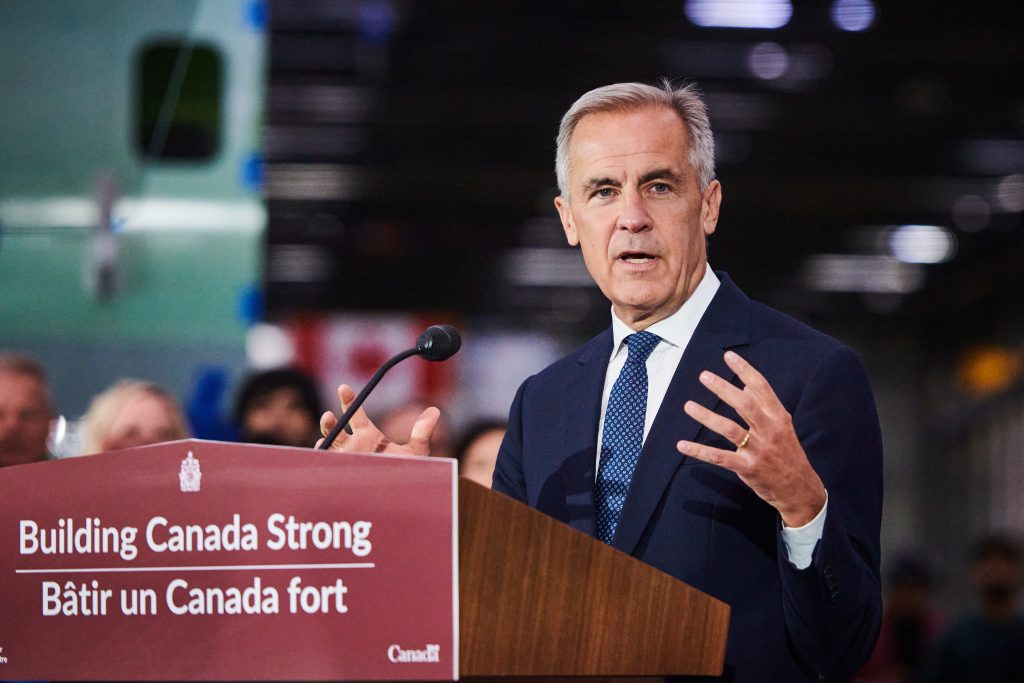
Prime Minister Mark Carney announced sweeping measures on Friday to support Canadian industries hit hard by U.S. tariffs, unveiling a $5 billion fund aimed at helping businesses adapt, diversify, and stay competitive on the global stage. Speaking at an aerospace plant in Mississauga, Carney said the fund will be open to all sectors, though industries most affected by the tariffs—such as steel, automobiles, lumber, and aluminum—will be given priority.
Alongside the relief fund, Carney introduced a new “Buy Canadian” policy requiring federal defence and construction projects to source materials domestically, beginning with steel and softwood lumber. Industry groups quickly voiced support. The Canadian Steel Producers Association said Canadian companies could replace more than 80 percent of imported steel, while the Forest Products Association of Canada welcomed the plan as a potential lifeline for an industry employing 200,000 people.
The government also announced targeted sectoral support, including a $370 million incentive for canola production, and a one-year delay to the electric vehicle sales mandate. Small and medium-sized businesses will benefit from expanded loans, with the Business Development Bank of Canada raising its ceiling from $2 million to $5 million. Flavio Volpe, president of the Automotive Parts Manufacturers’ Association, said this kind of liquidity was essential at a time when private lenders were shutting their doors to suppliers caught in the crossfire of Washington’s trade actions.
Employment insurance is also getting a major boost, with more than $2 billion earmarked to extend temporary measures, waive waiting periods, and add 20 extra weeks of support for long-tenured workers—a change expected to help nearly 190,000 people. Critics, however, argued that limiting extra support to this group unfairly leaves many others behind.
In addition, the government pledged $450 million in agreements with provinces and territories to retrain up to 50,000 workers, $550 million to expand its regional tariff response initiative, and $382 million for new “workforce alliances” designed to bring together unions, employers, and industry groups to strengthen Canada’s labour market resilience.
Carney framed the announcements as part of a broader industrial strategy to build an economy less dependent on the U.S. and better prepared for global disruptions. “Tariff-exposed sectors like steel, lumber, aluminum and copper will be central to our future competitiveness in a world of major infrastructure investment, defence and security, and unprecedented acceleration in home building,” he said.
The measures come as Ottawa continues tense trade talks with U.S. President Donald Trump’s administration, which has levied tariffs on Canadian goods as part of a wider global strategy. While opposition voices welcomed the relief package, interim NDP leader Don Davies said more must be done to create new jobs and bring down unemployment.
Carney, however, stressed that Canada must seize the moment to retool its economy. “We cannot rely on trade with the U.S. as we did in the past,” he said. “This is about building an economy that is more resilient, more competitive, and more Canadian.”