

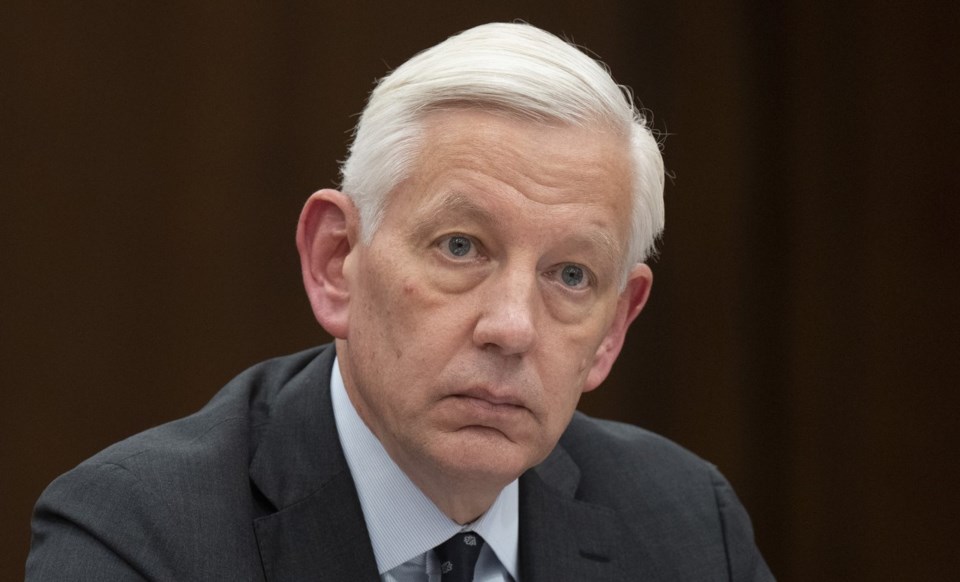
OTTAWA — Prime Minister Mark Carney is reshaping the leadership of Canada’s federal investment agency, appointing former ambassador and prominent business executive Dominic Barton as chair of Invest in Canada just weeks before a major Toronto summit aimed at attracting billions of dollars in new investment.
Barton, one of the best-known figures in Canadian corporate and public-policy circles, will serve a three-year, part-time term as chair of the agency’s board of directors.
The appointment comes as the Carney government seeks to attract more foreign capital into Canadian energy, infrastructure, technology, industrial and other major projects while strengthening the country’s economic independence and resilience.
Barton spent much of his career with global consulting firm McKinsey & Co. and currently chairs mining giant Rio Tinto and investment firm LeapFrog Investments.
His connection to Invest in Canada stretches back a decade. In 2016, former prime minister Justin Trudeau appointed Barton to chair the federal government’s economic advisory council. Among the council’s recommendations was the creation of a dedicated federal agency to attract foreign direct investment, which ultimately led to Invest in Canada.
Barton later became Canada’s ambassador to China, serving from 2019 until 2021 during one of the most difficult periods in modern Canada-China relations.
His tenure coincided with the detention of Canadians Michael Kovrig and Michael Spavor. When Barton stepped down as ambassador, Trudeau credited him with helping secure their release.
Along with Barton’s appointment, Carney has named Gurinder Grewal, founder and managing partner of MEM Growth Partners, as the new chief executive of Invest in Canada.
Carney highlighted Grewal’s experience investing capital in energy, industrial development, infrastructure and technology, areas that are expected to feature prominently in the government’s economic strategy.
The leadership overhaul comes only two weeks before Carney is scheduled to host his inaugural investment summit in Toronto.
The gathering is expected to bring together major international investors and leaders of some of Canada’s largest investment funds, with the government pitching Canadian projects and attempting to attract substantial new capital.
Carney says Barton and Grewal have the experience necessary to connect Canada’s economic strengths with new investors and help generate billions of dollars in additional investment.
The prime minister has framed that investment as part of a broader effort to build a stronger, more independent and more resilient Canadian economy.
The changes also involve significant departures from Invest in Canada’s existing leadership.
Outgoing board chair Karl Tabbakh will remain as a director to assist with the transition, while chief executive Laurel Broten, a former Ontario Liberal cabinet minister, is leaving the agency.
Broten had served for almost four years in a position that normally carries a five-year term.
Dominic LeBlanc, the federal minister responsible for Invest in Canada, announced that he had accepted Broten’s resignation effective Sept. 1. No public explanation was provided for her departure.
The Prime Minister’s Office also declined to elaborate, referring questions to LeBlanc’s statement thanking Broten for her service.
Questions have meanwhile emerged about Invest in Canada’s role in organizing the upcoming Toronto summit.
A source familiar with the preparations said the agency’s involvement has largely consisted of several staff members assisting with logistics, while the Prime Minister’s Office, other government departments, the Canada Pension Plan Investment Board and the Public Sector Pension Investment Board have played major roles in planning the event.
The appointment of Barton has also immediately drawn political criticism.
Conservative Leader Pierre Poilievre portrayed Barton as a longtime Liberal insider and strongly criticized both his record at McKinsey and his previous relationship with the Trudeau government.
Poilievre pointed to controversies surrounding federal contracts awarded to McKinsey and criticized the consulting firm’s work during Barton’s leadership, including its involvement with Purdue Pharma during the opioid crisis.
He also attacked Barton’s record involving China, accusing him of being too accommodating toward Beijing and questioning his previous dealings with Chinese state-owned enterprises.
The Conservative leader characterized Invest in Canada as an agency that could direct government support toward politically connected corporations, an allegation that places the appointment squarely into the broader political debate over government incentives and corporate subsidies.
The government, however, is presenting the leadership change from a very different perspective.
Carney is betting that Barton’s international connections, corporate experience and familiarity with global capital markets, combined with Grewal’s investment background, can help Canada compete more aggressively for international money.
That task has become increasingly important as Canada attempts to diversify its economic relationships, accelerate major projects and reduce vulnerabilities exposed by international trade disputes.
The timing makes the Toronto summit an early test of the new strategy.
Rather than simply promoting Canada as an attractive destination for investment, the government will be under pressure to demonstrate that it can convert meetings with major global investors into actual commitments for Canadian projects.
Barton’s appointment therefore represents more than a change at the top of a federal agency. It signals Carney’s intention to place investment attraction at the centre of his economic agenda.
The key measure of success will ultimately be straightforward: whether the new leadership can turn Canada’s economic potential into billions of dollars of new investment, projects and jobs.