

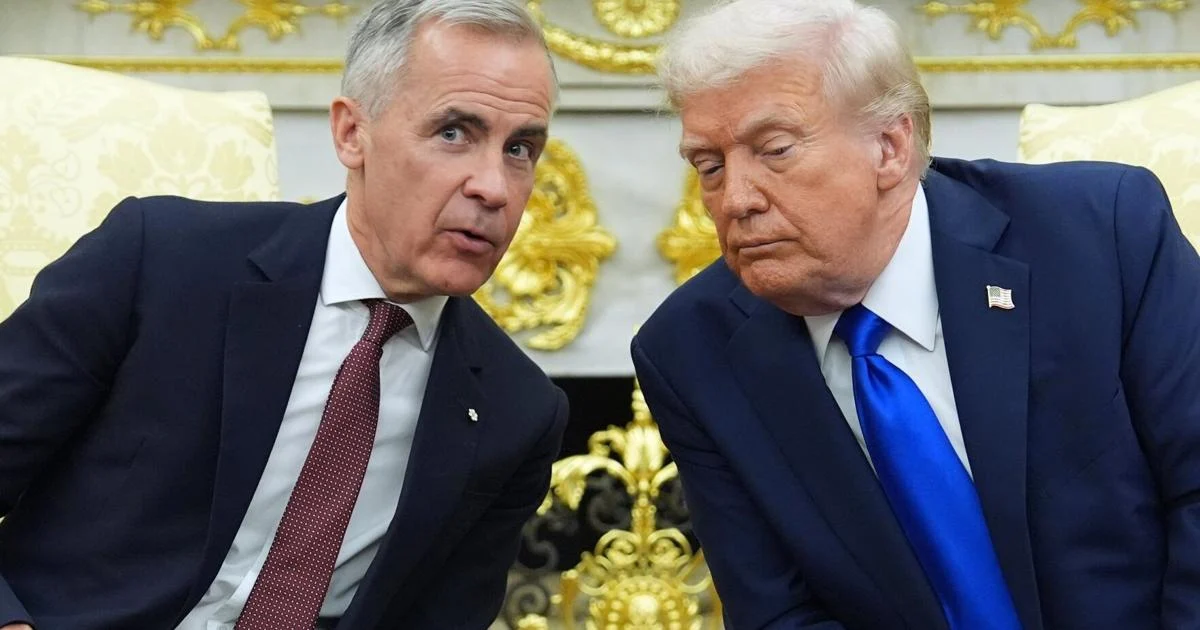
Ottawa — Prime Minister Mark Carney is embarking on his first trip to Asia as Canada’s leader amid escalating trade tensions with Washington, following U.S. President Donald Trump’s sudden termination of trade negotiations on Thursday night.
Just hours before Carney’s scheduled departure, Trump took to social media to announce that “ALL TRADE NEGOTIATIONS WITH CANADA ARE HEREBY TERMINATED,” claiming that Ontario’s anti-tariff ad campaign misused the voice and image of former U.S. president Ronald Reagan. The Reagan Foundation has since stated that Ontario “misrepresented” the former president’s 1987 speech and did not seek permission to use it.
Undeterred, Carney departed Friday for Kuala Lumpur, Malaysia, where he will attend the Association of Southeast Asian Nations (ASEAN) summit before making stops in Singapore and South Korea for the Asia-Pacific Economic Cooperation (APEC) conference.
Government officials say Carney may meet both Trump and Chinese President Xi Jinping on the sidelines of APEC — a symbolic moment, as Canada seeks to diversify trade ties beyond the United States. “This prime minister wishes to pursue a strategic relationship with China,” a senior official said, emphasizing that Canada’s economic security will depend on “building robust investment and screening arrangements to protect national interests.”
The visit marks a notable thaw in Canada-China relations after years of tension over alleged foreign interference during the Trudeau era. The Canada China Business Council (CCBC) welcomed Carney’s efforts to reset the relationship, noting the importance of resolving ongoing trade disputes between the two nations.
After Canada imposed 100 per cent tariffs on Chinese-made electric vehicles and 25 per cent on steel and aluminum, Beijing retaliated with crippling tariffs on Canadian canola products — a major export for Prairie provinces. The Chinese ambassador to Canada, Wang Di, recently signaled openness to lifting those tariffs if Canada drops its levies on EVs.
“Repairing the relationship will take time and patience,” said Bijan Ahmadi, executive director of the CCBC. “But a meeting between Carney and Xi would be an important step toward recalibrating ties and reducing Canada’s overreliance on the U.S.”
That reliance has become increasingly risky amid Trump’s unpredictable tariff policies. Goldy Hyder, president of the Business Council of Canada, said Carney’s focus on Asia reflects a necessary pivot: “Canada needs to go where the puck is going. Asian economies are young, dynamic, and growing fast — and that’s where the next wave of opportunity lies.”
Carney’s nine-day trip will focus on expanding trade partnerships and positioning Canada as a reliable partner in the Indo-Pacific, even as uncertainty clouds North American relations.
Speaking to reporters before his departure, Carney remained cautious but optimistic. “We’re in ongoing discussions with the Americans,” he said when asked about potential progress on steel and aluminum tariffs. “I’m looking forward to seeing the president at APEC, and many other leaders. One of the core elements of our strategy is diversifying trade — that’s why we’re going to Asia.”
With the U.S. pulling back and China showing signs of engagement, Carney’s mission could mark the start of a strategic realignment in Canada’s global trade policy — a move to secure the nation’s economic footing “where the puck is going,” not where it has been.