

Canadian consumers are increasingly calling for stronger protections after owners of brand-new vehicles reported serious mechanical, electrical and software problems that kept their cars and trucks in repair shops for months.
A CTV News/W5 investigation highlighted cases in Ontario involving expensive new vehicles that developed problems almost immediately after purchase or lease. While repairs were generally covered by manufacturers’ warranties, some consumers continued making substantial payments on vehicles they could not use.
$112,000 Truck Develops Problems on First Day
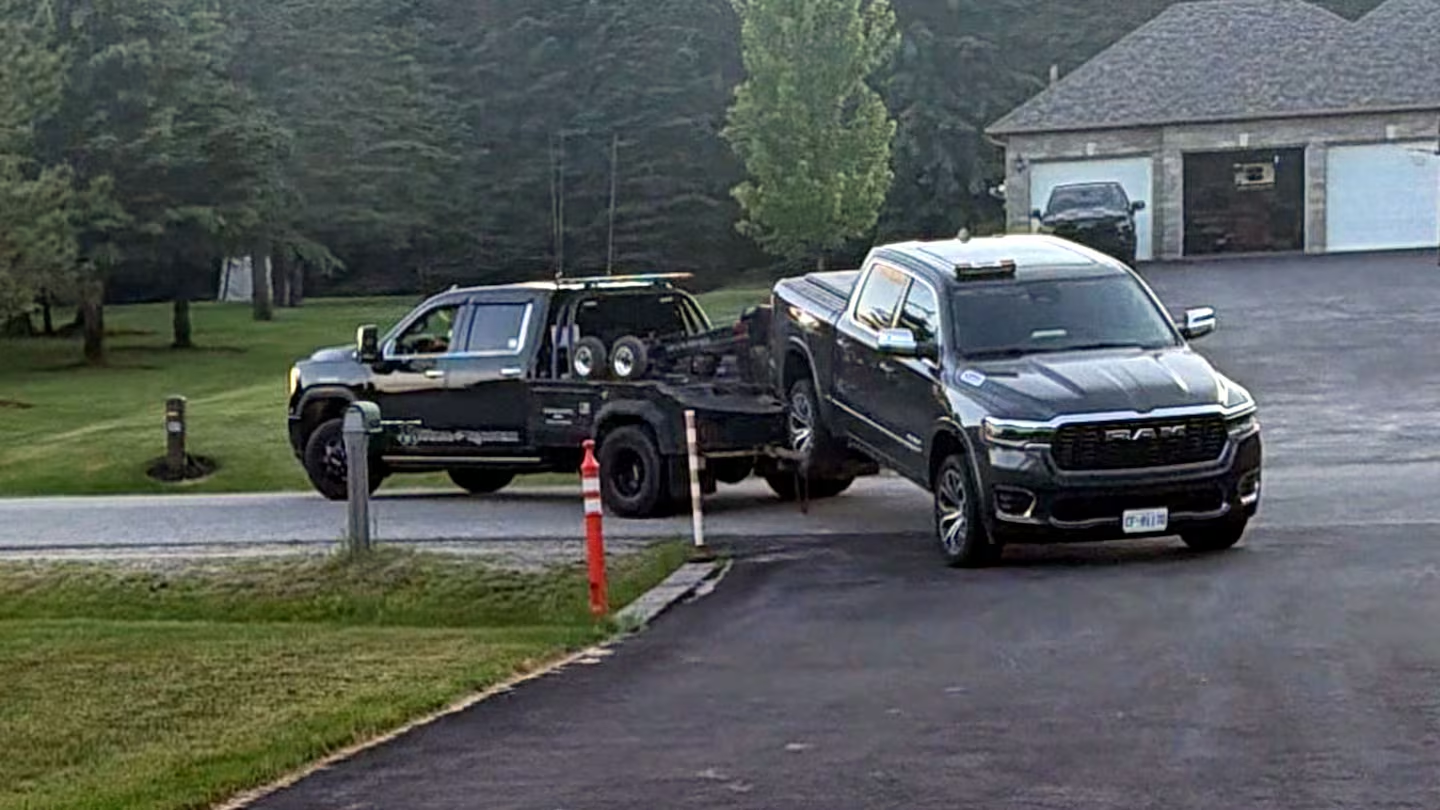
Ashley Martin of New Lowell, near Barrie, purchased a 2026 Ram Tungsten for approximately $112,000. According to Martin, a service warning appeared while he was driving home on the day he purchased the truck.
The vehicle later broke down at a stop sign and had to be towed to the dealership.
Martin said technicians subsequently replaced or worked on several components, including catalytic converters, oxygen sensors, the fuel tank and fuel pump. Despite repeated repairs, new problems continued to emerge.
At the time of the W5 investigation, Martin said the truck had been in the repair shop for approximately two months.
His position was straightforward: he no longer wanted repeated repairs — he wanted the new vehicle he believed he had originally paid for.
The case ultimately resulted in a positive outcome for Martin. He said Ram agreed to take back the problematic truck and provide him with a brand-new replacement vehicle.
Audi S5 Reportedly in Shop for 149 Days
Another case involved Georgetown resident Marie McAlpine, who leased a new 2025 Audi S5.
McAlpine said the vehicle had spent 149 days in the repair shop and experienced engine-system, software and sensor problems.
Most concerning was an incident in which she said the engine shut down while she was travelling on Highway 401 at highway speed.
Despite being unable to use the Audi for months, McAlpine said she continued making lease payments.
She subsequently told W5 that she was able to reach a resolution with Audi.
Volkswagen Tiguan in Repairs for 190 Days
Oakville resident Xuejian Chen faced an even longer wait involving his leased 2026 Volkswagen Tiguan.
The vehicle reportedly experienced several problems, including a failed turbocharger and malfunctioning air conditioning.
Chen said the problems disrupted his plans to the point that he had to cancel his summer holidays.
The Tiguan was eventually returned to him after approximately 190 days.
Volkswagen told W5 that the vehicle had been repaired and returned to the customer, while acknowledging that obtaining a required part took time.
Why Are New Vehicles Becoming So Difficult to Repair?
Modern vehicles contain increasingly sophisticated electronics, computers, sensors and software systems.
That technology provides safety, efficiency, convenience and entertainment features, but it can also make diagnosing problems much more complicated.
A warning light that once might have indicated a relatively straightforward mechanical issue can now involve interconnected sensors, software, electronic control modules and other components.
The W5 report also points to a shortage of technicians with the specialized expertise required to diagnose some of these complicated problems.
The result can be repeated repairs in which one problem appears to be resolved only for another to emerge.
U.S. Consumers Have Lemon Laws
The situation has renewed debate over whether Canadian provinces should adopt consumer protections similar to American “lemon laws.”
All 50 U.S. states have some form of lemon-law protection.
Although requirements vary between jurisdictions, the basic concept is that when a manufacturer cannot repair a serious defect within a reasonable number of attempts or a vehicle remains unusable for an extended period, the consumer may become entitled to a replacement vehicle or manufacturer buyback.
Rosemary Shahan, founder of Consumers for Auto Reliability and Safety and an influential advocate behind early U.S. lemon-law legislation, told W5 that common thresholds can involve approximately three or four unsuccessful repair attempts or around 30 days out of service, depending on the applicable state law.
Compare that with some of the Canadian cases highlighted by W5:
| Vehicle | Reported repair-shop time |
|---|---|
| 2026 Ram Tungsten | About 2 months |
| 2025 Audi S5 | 149 days |
| 2026 Volkswagen Tiguan | 190 days |
Yet outside Quebec, Canadian consumers generally do not have the same legislated lemon-law framework described in the report.
Quebec Has Taken the Lead in Canada
Quebec became the first Canadian province to introduce specific lemon-vehicle protections.
Consumer advocates now want other provinces to follow.
Car Help Canada senior consultant Shari Prymak told W5 that lemon legislation could force manufacturers to take greater responsibility when vehicles repeatedly cannot be repaired.
According to a survey cited by Car Help Canada, 95 per cent of respondents supported introducing a lemon law in their province, while 72 per cent believed lemon laws would improve warranty-repair outcomes for consumers and dealerships.
What Can Canadian Consumers Do Now?
One important option available to many Canadian vehicle owners is the Canadian Motor Vehicle Arbitration Plan (CAMVAP).
CAMVAP provides a process for resolving certain disputes between consumers and vehicle manufacturers involving alleged defects in vehicle assembly or materials and disputes concerning the application or administration of a new-vehicle warranty.
The arbitration process is free to consumers, and cases are generally heard within approximately three months.
However, advocates argue CAMVAP is not equivalent to comprehensive provincial lemon legislation. The W5 report notes limitations, including that participation by manufacturers is voluntary.
The Bigger Consumer-Protection Question
The cases raise an important issue beyond whether repairs are covered by warranty.
A warranty may pay to repair a defective vehicle, but consumers can still face significant inconvenience and financial consequences when a new vehicle remains unavailable for weeks or months.
They may continue paying loans or leases, insurance and other expenses while being unable to use the vehicle they purchased.
For consumers spending $50,000, $80,000 or more than $100,000 on a new vehicle, advocates argue there should eventually be a point where repeated repairs are no longer considered an adequate solution.
A legislated lemon law could establish a clearer threshold: if a substantially defective new vehicle cannot be repaired after a reasonable number of attempts or remains out of service beyond a defined period, the manufacturer would be required to replace it or buy it back.
With vehicles becoming more technologically complex and expensive, the W5 investigation is likely to add momentum to calls for provinces — particularly Ontario — to examine whether Canadians should receive protections comparable to those available to vehicle buyers throughout the United States.