

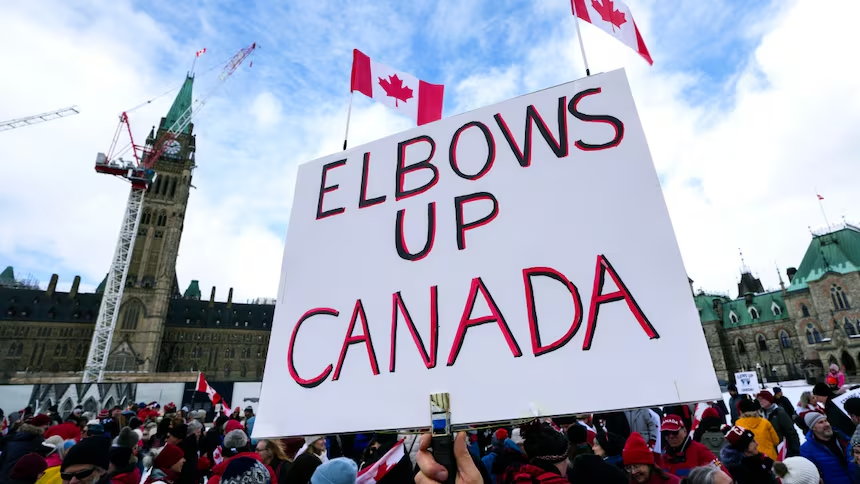
Ottawa — New data reviewed by CBC News shows Canadians are sharply reducing their travel to the United States, curbing purchases of U.S. goods, and shifting exports to other markets as the fallout from U.S. President Donald Trump’s tariffs continues to reshape cross-border relations.
Prime Minister Mark Carney previously warned that Canada’s “old relationship” with the United States was “over soon,” and statistics now confirm a deep change in Canadian behaviour.
Canadian visits to the U.S. fell dramatically this summer, with August showing a 34 per cent year-over-year decline in car trips and a 25 per cent drop in air travel. This marks eight consecutive months of declining cross-border travel, forcing Air Canada, Flair, Porter, and WestJet to suspend or scale back multiple U.S. routes while adding 28 new international routes to Europe, the Caribbean, and South America to meet demand.
Trade data mirrors the shift. Canadian exports to the U.S. have declined by $5 billion so far this year, while exports to Europe are up 26 per cent and shipments to the United Kingdom have surged 63 per cent since Trump’s inauguration. Exports to Central and South America are also up 13 per cent as Canadian businesses aggressively pursue alternative markets.
Consumer habits are changing as well. Grocers have removed many U.S. products from shelves, adding more than 100 Canadian suppliers since January. Liquor boards across the country report U.S. whiskey and bourbon sales down more than 60 per cent, while Indigo says sales of Canadian-authored books have jumped 25 per cent.
Canadian cultural consumption is also on the rise. CBC/Radio-Canada reports a 34 per cent increase in streaming of Canadian programming, with hits like Schitt’s Creek and Murdoch Mysteries seeing major spikes in viewership. Attendance for the Juno Awards quadrupled online this year, reflecting renewed interest in homegrown culture.
Experts say the data reflects a sustained backlash against Trump’s economic and political rhetoric, including his repeated references to Canada as the “51st state.”
“Canadians are clearly voting with their wallets and passports,” said Christopher Sands, director of the Johns Hopkins Center for Canadian Studies. “Until there is a visible shift in U.S. policy, it’s unlikely this boycott will ease.”
With Ottawa deepening trade ties with Europe and the Commonwealth, the rift signals a long-term realignment of Canada’s economic and cultural focus away from its southern neighbour.