

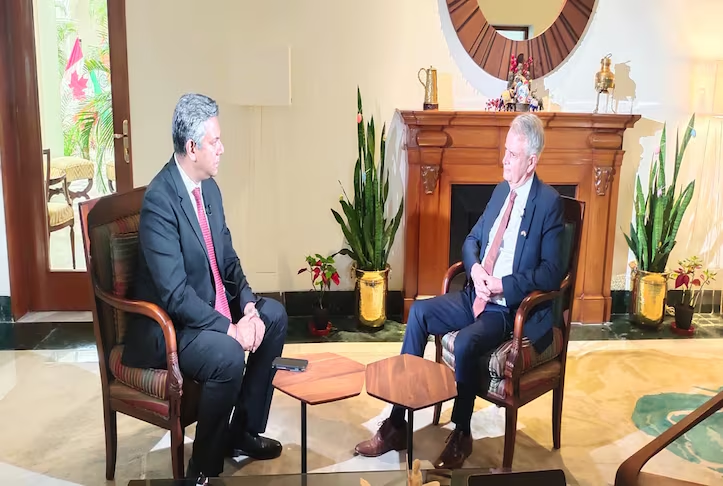
A major diplomatic thaw may be underway as Canada’s envoy to India says both countries are now ready to turn the page and rebuild one of the world’s most important bilateral relationships.
In a significant statement, Christopher Cooter said there is now renewed confidence between Canada and India, adding that both governments are prepared to move forward with a more pragmatic and productive partnership.
The comments come shortly after Mark Carney assumed office, succeeding Justin Trudeau, under whose leadership relations between Ottawa and New Delhi had sharply deteriorated.
The diplomatic fallout began after allegations surrounding the killing of Hardeep Singh Nijjar, which triggered a prolonged dispute, mutual accusations and strained political trust. That period created uncertainty not only for governments, but also for businesses, students and families connected across both countries.
Now, the tone appears to be shifting. According to the envoy, both prime ministers recognize the need to be realistic in a changing global economy. With India emerging as one of the fastest-growing major economies, Canada sees a valuable long-term partner in trade, energy, education and investment.
Despite political tensions, economic ties never fully stopped. Canadian investment in India remains substantial, and businesses in both countries continue to support thousands of jobs. That resilience, officials suggest, proves the relationship’s deeper foundation is stronger than temporary political disputes.
Energy is expected to be a major pillar of the reset. Canada signalled interest in becoming a reliable supplier of oil, LNG, uranium and critical minerals to India beginning in the coming years. As India expands its industrial base and energy demand rises, those sectors could become central to future cooperation.
Education is another key area. Canada remains a top destination for Indian students, and officials say efforts are underway to improve visa processing, student support and new academic partnerships. Possibilities include joint degrees and future Canadian campuses or collaborations in India.
For communities across the GTA—especially in places like Brampton, Mississauga and Toronto, where strong Indo-Canadian ties shape daily life—this reset carries real meaning. It could influence business growth, student mobility, immigration confidence and community relations for years ahead.
Diplomacy often moves slowly, but moments like this matter. If both sides can turn pragmatism into policy, Canada and India may be entering not just a reset—but a stronger new chapter.