

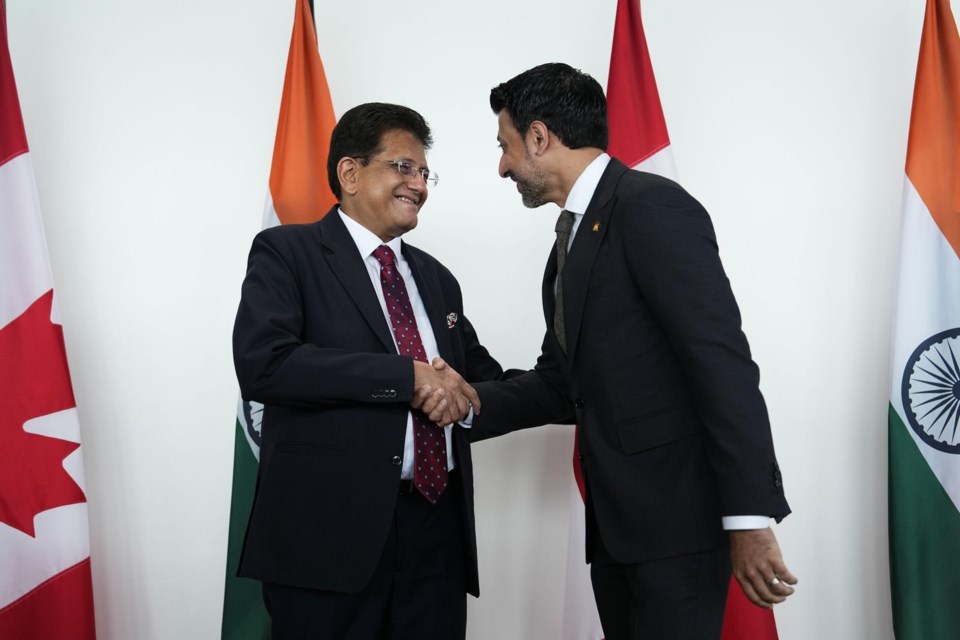
A major diplomatic and economic reset appears to be rapidly unfolding between Canada and India as India’s Commerce and Industry Minister Piyush Goyal praised Prime Minister Mark Carney for dramatically transforming relations between the two countries following years of political tension.
Speaking in Ottawa Monday during a major trade and investment visit to Canada, Goyal described Carney’s recent trip to India as the turning point that completely changed the direction and tone of bilateral relations.
Goyal said both countries are now moving with remarkable speed and intent toward rebuilding strategic cooperation, strengthening economic partnerships and finalizing a long-awaited free trade agreement by the end of 2026.
The Indian minister made the comments ahead of meetings with Canada’s International Trade Minister Maninder Sidhu, who has emerged as a key figure in expanding Canada’s trade relationships beyond the United States.
Canada and India have been engaged in free trade negotiations since 2010, but discussions effectively collapsed in 2023 after the Canadian government accused the Indian government of involvement in the assassination of Sikh activist Hardeep Singh Nijjar in Surrey.
The diplomatic crisis severely strained relations between Ottawa and New Delhi and led to widespread political fallout both domestically and internationally.
However, since taking office in 2025, Prime Minister Mark Carney has made rebuilding ties with India a major foreign policy priority. His visit to Mumbai and New Delhi earlier this year marked the first visit by a Canadian prime minister to India in eight years and signaled a clear shift toward renewed engagement.
The trip concluded with high-level meetings between Carney and Indian Prime Minister Narendra Modi, resulting in several major commercial agreements, including a $2.6-billion uranium supply deal intended to support India’s nuclear energy expansion.
In total, officials say the two countries signed more than $5.5 billion in commercial agreements spanning energy, trade and investment sectors.
Goyal said Carney’s leadership fundamentally changed how both countries view one another and opened the door to what he described as a complete overhaul of the Canada-India relationship.
Both governments are now targeting an ambitious goal of tripling bilateral trade to US$50 billion by 2030.
The scale of India’s renewed interest in Canada was visible through the size of Goyal’s delegation, which includes more than 100 senior executives from sectors such as mining, energy, aerospace, automotive manufacturing and technology — reportedly the largest Indian business delegation ever to visit Canada.
During his trip, Goyal is also meeting with senior Canadian business leaders, startup executives and pension fund representatives while continuing discussions with Foreign Affairs Minister Anita Anand and Prime Minister Carney.
Trade Minister Maninder Sidhu said Canada and India have maintained continuous communication throughout the renewed negotiations, jokingly referring to the process as “WhatsApp diplomacy.”
Sidhu confirmed that another Canadian trade delegation will travel to India later this year to continue advancing negotiations toward a formal trade agreement.
The renewed relationship comes at a critical time for both countries as they attempt to diversify economic partnerships and reduce dependence on the United States amid growing geopolitical and trade uncertainties.
Experts say India increasingly views Canada as a stable and reliable supplier of energy, uranium, critical minerals, agricultural products and advanced technology.
Vina Nadjibulla of the Asia Pacific Foundation of Canada said shifting global conditions, including instability in the Strait of Hormuz caused by conflict involving Iran, are pushing India to urgently diversify its energy supply chains.
India, one of the world’s largest energy importers, is now looking more aggressively toward reliable suppliers like Canada for oil, uranium and renewable energy cooperation.
Nadjibulla also pointed to growing opportunities in artificial intelligence, quantum computing and technology partnerships, areas both governments now see as central pillars of future cooperation.
Despite the renewed optimism, the diplomatic reset has not been without criticism. Some members of Canada’s Sikh community continue to urge Ottawa to maintain pressure on India over Nijjar’s killing and broader concerns involving accountability and human rights.
Sukh Dhaliwal, the Liberal MP representing the Surrey riding where Nijjar was killed, previously acknowledged the concerns being raised by constituents regarding the renewed engagement with India.
Still, political observers say the speed and scale of the rapprochement between Canada and India marks one of the most significant shifts in Canadian foreign policy in recent years, with economic interests, energy security and geopolitical strategy increasingly driving both countries toward deeper cooperation.