

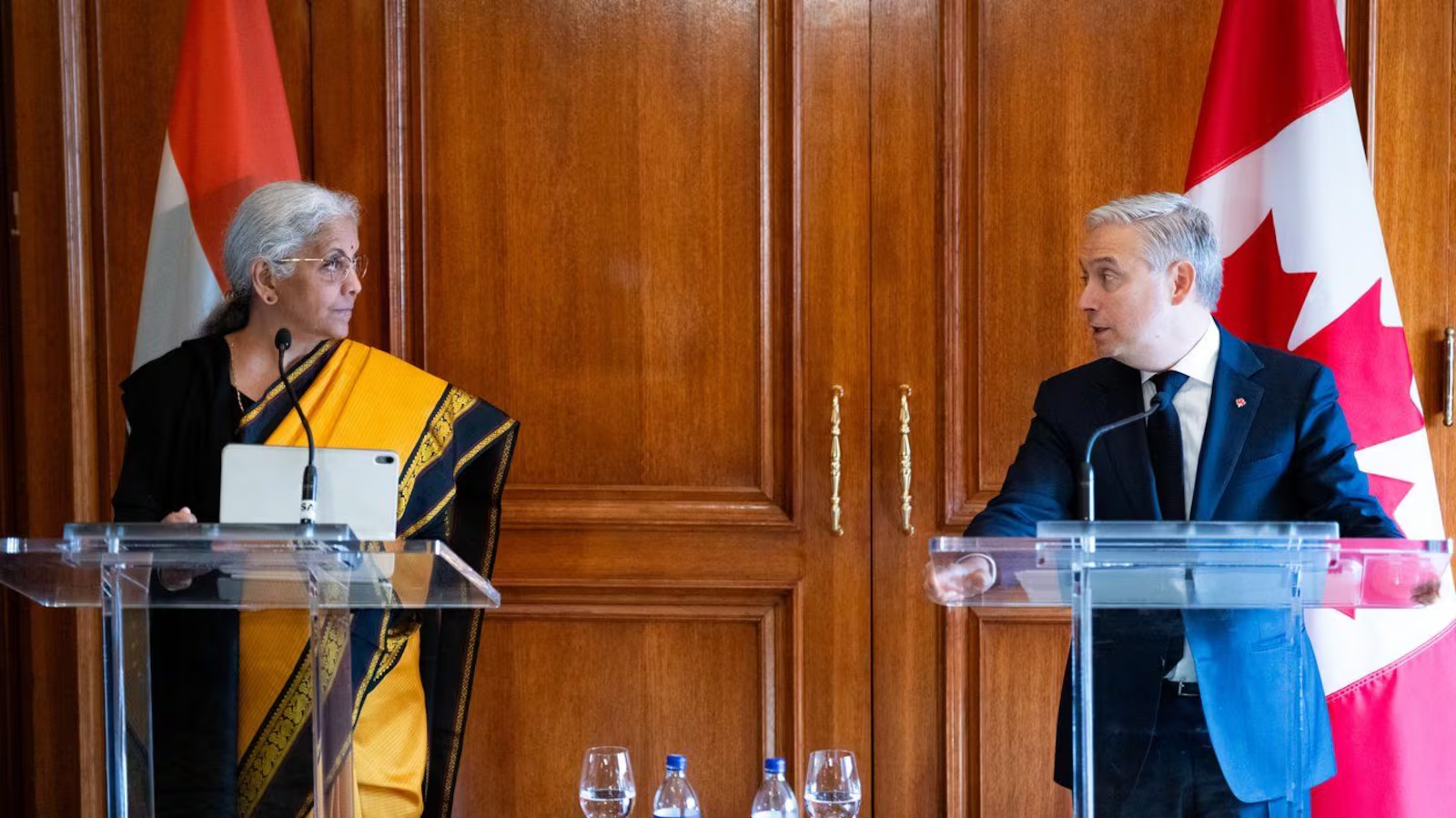
Canada and India are moving to significantly deepen their economic and financial relationship, with Finance Minister François-Philippe Champagne highlighting opportunities in energy, food security, technology, investment and financial services during talks with his Indian counterpart in Toronto.
Champagne hosted India’s Finance and Corporate Affairs Minister Nirmala Sitharaman on Thursday, where the two ministers announced a new economic and financial dialogue aimed at expanding co-operation between the two countries.
The ministers also participated in a discussion at the Canadian Club Toronto, emphasizing the growing importance of Canada-India economic ties at a time of major changes in global trade and geopolitical relationships.
Champagne described the Canadian and Indian economies as “uniquely complementary,” arguing that each country has resources and capabilities that could support the other’s economic ambitions.
Canada can provide India with greater energy and food security, Champagne said, while India offers Canada access to enormous scale, skilled talent and rapidly developing technology sectors.
Financial services emerged as one of the key areas identified for greater co-operation.
Champagne said Canada is exploring ways to make payments between Canada and India easier and more efficient. Such changes could potentially reduce transaction fees and foreign exchange costs for families transferring money between the two countries, including families supporting Indian students studying in Canada.
Technology and artificial intelligence infrastructure also featured prominently in the discussions.
As India rapidly expands its digital economy and develops more data centres to support artificial intelligence, Champagne said Canadian critical minerals and energy resources could become increasingly important to the country’s growth.
Canada has been working to establish itself internationally as a dependable supplier of energy, critical minerals, agricultural products and other strategic commodities as wars, tariffs and changing trade relationships reshape the global economy.
The renewed focus on India also comes as Canada faces another period of serious trade tensions with the United States.
Asked whether the escalating Canada-U.S. trade conflict was accelerating Ottawa’s efforts to expand business with India, Champagne said diversifying Canadian trade had always been the federal government’s “plan A.”
Sitharaman said stronger bilateral economic relationships have become increasingly important amid global geopolitical instability.
She credited Prime Minister Mark Carney and Indian Prime Minister Narendra Modi with bringing renewed momentum to Canada-India relations.
According to Sitharaman, the newly announced economic and financial dialogue is intended to move the relationship beyond conventional trade in goods and services toward a broader partnership involving investment, finance, capital markets and regulatory co-operation.
The discussions follow Carney’s official visit to India in February, when Champagne accompanied the prime minister. It was the first official visit to India by a Canadian prime minister since Justin Trudeau travelled there in 2018.
Modi is also expected to visit Canada in the coming months, potentially providing another opportunity for the two governments to advance their economic agenda.
International Trade Minister Maninder Sidhu has said Canada wants to finalize a trade agreement with India before the end of 2026.
The two countries have set an ambitious goal of more than doubling bilateral trade to $70 billion by 2030, potentially making India an increasingly important market for Canadian businesses seeking alternatives beyond traditional North American markets.
Investment ties are already substantial. Canadian investment in India exceeded $110 billion in 2024, with major Canadian pension funds having significant exposure to Indian infrastructure and other long-term development projects.
The renewed economic engagement represents a significant improvement in a relationship that had deteriorated sharply following Canadian allegations that agents connected to the Indian government were involved in violence against Canadian citizens.
Those allegations included claims surrounding the 2023 killing of a pro-Khalistan activist in British Columbia, which contributed to a prolonged diplomatic dispute between Ottawa and New Delhi.
Over the past year, however, both governments have taken steps toward rebuilding the relationship, with economic co-operation increasingly becoming a central part of that effort.
With India among the world’s fastest-growing major economies and Canada seeking to diversify its international trade and investment relationships, both governments are now signalling that they see considerable economic value in strengthening the partnership.
The push toward $70 billion in bilateral trade by 2030, combined with negotiations toward a possible trade agreement, expanding investment and closer financial co-operation, could mark a major new phase in Canada-India economic relations.