

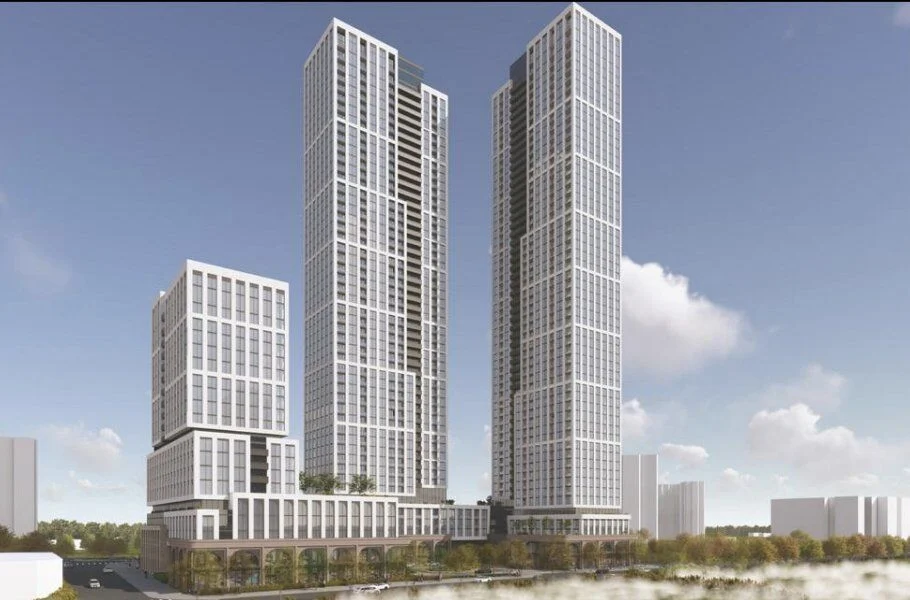
Brampton’s skyline is about to undergo a dramatic transformation as city officials give the green light to two new skyscrapers—set to become the tallest buildings the city has ever seen.
The City of Brampton’s planning and development committee has approved a zoning bylaw amendment allowing two residential towers, 50 and 55 storeys tall, to rise at 30 Peel Centre Drive, near Bramalea City Centre. Combined, the towers will house 1,238 condo units. A third 20-storey building will serve as a retirement residence with 300 suites, connected to the towers by a five-storey podium.
“This is a milestone for Brampton,” said Regional Councillor Gurpartap Singh Toor. “As the fastest-growing city in the country, it’s time we saw developments of this scale take shape. These towers will quite literally take Brampton to new heights.”
However, not everyone is on board. Regional Councillor Pat Fortini, who represents the area, expressed concern about the density of the project. “I understand the need for housing, but a development this dense could strain local infrastructure—especially water, sewage, and traffic,” Fortini said in an email.
The development will replace the current Bramalea Retirement Residence, a six-storey building originally built as a hotel in the 1980s and converted to a retirement home in 2014. The developer, Lev Developments Inc., says it is working closely with current residents to ensure smooth relocation with minimal disruption and ongoing care.
Plans also include ground-floor retail and commercial space, four levels of underground parking with 886 vehicle spots, and 996 bicycle spaces. More than 30 per cent of the residential units will feature two or more bedrooms, with the rest made up of one-bedroom and one-bedroom-plus-den layouts.
The project, to be built in three phases over 12 to 15 years, is located within a designated major transit station area, earmarked for higher-density, transit-oriented development.
A statutory public meeting held last September saw a few residents raise concerns about displacement of seniors, building height, traffic congestion, and infrastructure readiness. Despite the objections, city planning staff deemed the proposal as “good planning in the public interest.”
With Brampton continuing to grow rapidly, these towering additions mark a new chapter in the city’s urban evolution.