

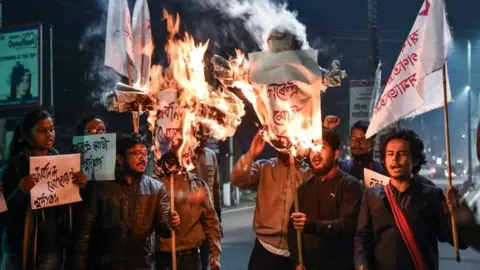
Guwahati / New Delhi — What began as localized protests by tribal communities in Assam is now threatening to become a national political flashpoint. The demand for Scheduled Tribe (ST) status by six indigenous groups — Moran, Matak, Tai Ahom, Chutia, Koch-Rajbongshi, and the Adivasi Tea Tribes — has escalated into mass mobilizations, road blockades, and torch rallies. The protests are not only shaking Assam but could also test Prime Minister Narendra Modi’s image as a leader who keeps his promises.
Broken Promises and Growing Anger
In 2014, Modi and the BJP made granting ST status to these communities a cornerstone of their campaign in Assam. The pledge helped BJP sweep much of the state and consolidate its presence in the Northeast. Eleven years later, no official notification or constitutional amendment has been issued, leaving communities feeling betrayed.
“We voted for change, we voted for dignity, and we voted for the promises made by Modi ji,” said Nabajyoti Moran, president of the All Moran Students’ Union. “But every year the government delays, our patience is wearing thin. If nothing happens this time, the BJP will pay for it in 2026.”
Escalation on the Ground
The last week has seen:
- 30,000-strong rallies in Upper Assam districts like Tinsukia and Dibrugarh, with protestors threatening an economic blockade starting September 15.
- Police clashes with Koch-Rajbongshi and Tea Tribe protesters in Golakganj and Jorhat, drawing criticism for excessive force.
- Torchlight marches demanding a public announcement from the Prime Minister during his upcoming Assam visit.
National Ramifications: Modi’s Popularity at Stake
Political analysts say this crisis has the potential to erode Modi’s carefully cultivated image as a leader who delivers.
- Credibility Questioned: Opposition parties, including the Congress and AAP, are amplifying the protests nationwide, accusing the Prime Minister of breaking promises and misleading voters.
- Northeast Strategy Under Strain: The BJP made historic gains in the Northeast in the last two Lok Sabha elections, often touting it as the “gateway to New India.” A tribal backlash could reverse those gains, not just in Assam but also in states like Nagaland, Tripura, and Manipur where identity politics are deeply influential.
- Urban Sympathy: Coverage of baton-charges on peaceful tribal protestors is generating sympathy among urban middle-class Indians, many of whom see this as a social justice issue.
“Modi’s brand depends on trust and decisive action. If this issue festers, it will chip away at the credibility of the BJP’s slogan of ‘Sabka Saath, Sabka Vikas’,” said Professor Sanjoy Hazarika, a political commentator and public policy expert.
BJP’s Future and Electoral Risk
The stakes are high for the BJP ahead of the 2026 Assam Assembly elections and the 2029 general elections:
- Voting Bloc Impact: The six communities together represent nearly 20–25% of Assam’s population. Losing their support could cost BJP dozens of Assembly seats and several Lok Sabha constituencies.
- Opposition Mobilization: Congress leader Gaurav Gogoi has already pledged to make ST recognition a central issue in the next election campaign, accusing BJP of “11 years of deception.”
- Coalition Strains: Regional allies like Asom Gana Parishad (AGP) are also under pressure from their grassroots supporters to push the BJP harder or reconsider their alliance.
Beyond Assam: Implications for India
While the protests are geographically concentrated, they carry symbolic weight across India:
- Other Marginalized Communities May Take Cue: Dalit, OBC, and tribal groups in states like Jharkhand, Chhattisgarh, and Madhya Pradesh could be emboldened to intensify their own demands.
- Opposition Narrative Strengthened: The INDIA bloc can frame this as a failure of BJP’s governance model, claiming that promises made to marginalized groups nationwide — from farmers to unemployed youth — remain unfulfilled.
- Economic Impact: If the threatened blockades proceed, tea production, oil exploration, and goods transport in Assam could be disrupted, impacting India’s economy and raising inflationary pressures.
Modi’s Next Move
The Prime Minister’s upcoming visit to Assam is now viewed as a make-or-break moment. BJP insiders suggest there may be a symbolic announcement or a timeline for ST status as a way to calm tensions.
“Modi has built his political career on delivering big, bold announcements. Assam may be where he needs to make one more — and soon,” said Rohini Mohan, a Delhi-based political analyst.
Conclusion
The unrest in Assam has evolved into more than just a regional issue — it is now a test of Narendra Modi’s leadership, BJP’s commitment to its promises, and the party’s electoral durability in one of its strongholds. How the government responds in the coming weeks could determine not only Assam’s political future but also the BJP’s ability to maintain its dominance on the national stage.