

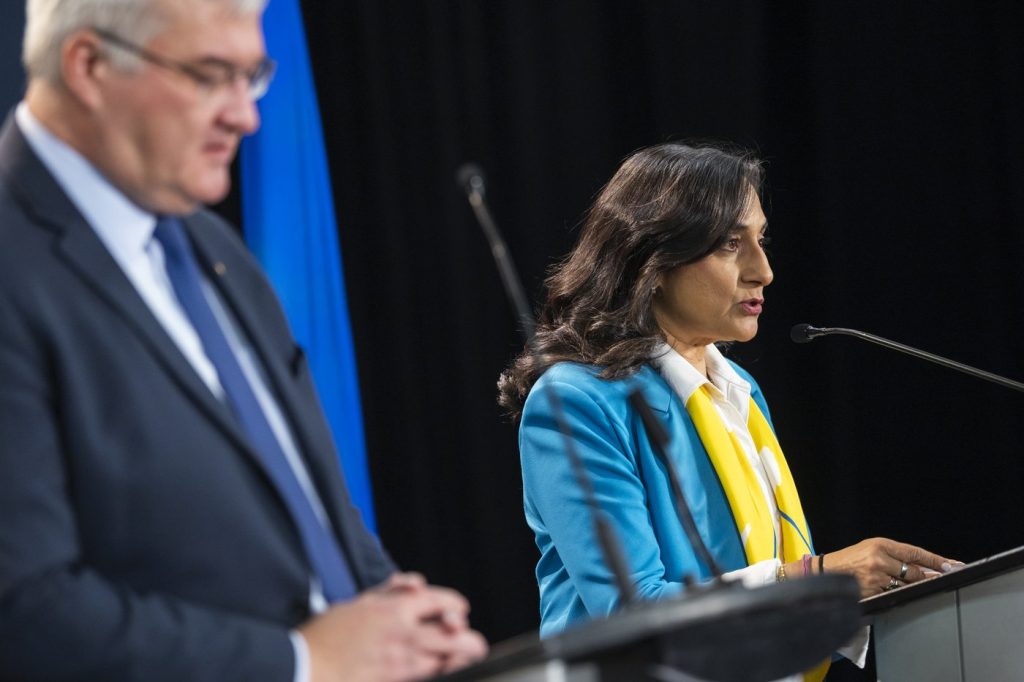
Canada’s Foreign Affairs Minister Anita Anand reaffirmed Monday that decisions about Ukraine’s sovereignty must be made by Ukraine itself, underscoring Ottawa’s position as diplomatic efforts to end the war with Russia continue.
Anand made the remarks following a conversation with Andrii Sybiha, Ukraine’s foreign minister, which came shortly after Canada pledged an additional $2.5 billion in economic assistance to support Ukraine’s defence against Russia’s invasion.
In a post on social media, Anand said she emphasized that “decisions about Ukraine’s sovereignty must be made by Kyiv itself,” adding that she and Sybiha would remain in close contact.
Ukraine has been resisting Russian aggression since 2014, when Moscow illegally annexed Crimea and Russian-backed separatists launched an armed uprising in the Donbas region of eastern Ukraine. Russia escalated the conflict with a full-scale invasion in February 2022.
Sybiha said in his own social media statement that he briefed Anand on Ukraine’s ongoing efforts to secure a peace agreement with Moscow. Those discussions included a high-level meeting over the weekend between Ukrainian President Volodymyr Zelenskyy and U.S. President Donald Trump in Florida.
“We focused on future security guarantees for Ukraine and ways to strengthen our co-operation within the peace efforts,” Sybiha wrote. He also thanked Canada for keeping Ukraine a priority on the G7 agenda during its 2025 presidency.
Zelenskyy met with Canadian Prime Minister Mark Carney in Nova Scotia on Saturday before travelling to Florida. Trump hosted Zelenskyy at his Mar-a-Lago resort on Sunday, later stating that Ukraine and Russia were “closer than ever before” to reaching a peace settlement.
Russian President Vladimir Putin has said he wants four partially occupied Ukrainian regions, along with the Crimean Peninsula, to be internationally recognized as Russian territory. He has also demanded that Ukraine withdraw from areas in eastern Ukraine that Russian forces have not fully captured. Kyiv has rejected all of those conditions.
Following his meeting with Zelenskyy, Trump claimed that “Russia wants to see Ukraine succeed,” a statement that drew criticism from analysts.
Zelenskyy said Monday that the United States has proposed providing Ukraine with security guarantees lasting 15 years as part of a possible peace framework. He added that Kyiv would prefer a longer commitment — up to 50 years — to deter future Russian aggression.
Negotiators continue to seek progress on major unresolved issues, including troop withdrawals, territorial control, and the status of the Russian-occupied Zaporizhzhia nuclear power plant.
“Without security guarantees, realistically, this war will not end,” Zelenskyy said in voice messages to reporters responding to questions sent via WhatsApp. He noted that details of the proposed guarantees have not been made public, but would include monitoring mechanisms and the “presence” of partner countries. Russia has said it would oppose the deployment of NATO troops in Ukraine.
French President Emmanuel Macron said Ukraine’s allies are expected to meet in Paris in early January to finalize each country’s concrete contributions toward security guarantees.
Wesley Wark, a senior fellow at the Centre for International Governance Innovation, said there is little clarity about what a U.S. security guarantee would entail.
“The complication is really framed in terms of Donald Trump’s own thinking about Russia,” Wark said in an interview, adding that Trump has consistently avoided criticizing Russia’s invasion of Ukraine and has, in his view, engaged in “magical thinking” about Putin’s intentions.
Trump’s assertion that Putin wants Ukraine to succeed is “the most ridiculous, absurd thing I’ve ever, ever heard,” Wark said. “Unless Trump can be moved from his view of Putin and of what Russia is up to in Ukraine, the prospects for any genuine peace deal are very, very dim.”
Wark said Ukraine’s allies, including Canada, may need to determine whether there are sources of influence within the Trump administration that could shift the president’s perspective.
“By points of leverage, I mean, are there voices that Trump would listen to that might be persuaded to take a different view of what Vladimir Putin is really up to?” he said.